
Morgan Stanley Chief Investment Officer Mike Wilson has been making sense of the stock market since joining the bank in 1989 as an investment banker. Wilson isn’t just Morgan Stanley’s CIO, though; he’s also its Chief Equity Strategist, a dual role that puts him in contact with most of the largest mutual and hedge funds in America.
On Nov. 9, I wrote that Wilson believed the S&P 500 would roll over and form an actionable bottom around 7,100 to 7,300. The prediction was prescient, but understated the drop. The S&P 500 retreated 8% last week, opening near 7,150 on Friday, Nov. 20, before closing the week at 6,910.
The sell-off prompted Wilson to send a note to Morgan Stanley’s clients, shared with me, saying that the drop had set the S&P 500 and tech-heavy Nasdaq index up for a move higher.
“Last week delivered the capitulation and index catch-down we’d been waiting for. While the S&P broke below our 7,100–7,300 range, we view this as an overshoot of fair value,” wrote Wilson. “This is the fat pitch we have patiently been waiting for, and we’re not going to miss it. Markets bottom on bad news and deleveraging. We have had a lot of both.”
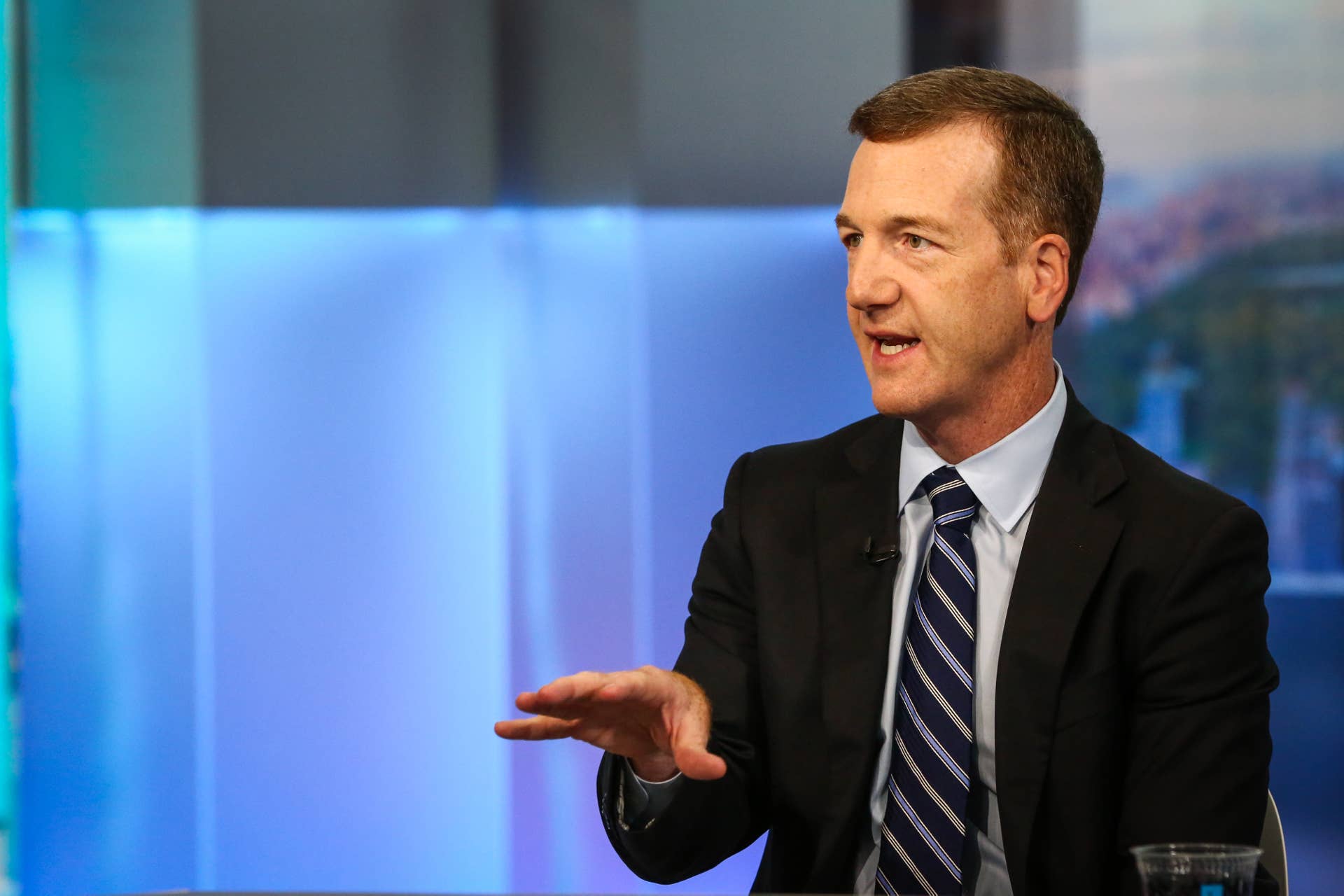 Morgan Stanley CIO Mike Wilson says the stock market is poised to move higher after the tech sell-off.
A stock market rocked by newsflow
The S&P 500 and Nasdaq selloff dropped both indexes into correction territory, meaning each has fallen more than 10% from its recent peak. Bear markets represent a 20% drop, but those don’t happen nearly as often.
For perspective, the S&P 500 has endured a 15% drawdown annually since 1975, but 20% drawdowns have occurred only once every three years, according to Schwab.
The decline occurred amid a flurry of news that forced many investors to reassess their equity weightings in portfolios, including a ‘blue wave’ win by Democrats in the midterm election reminiscent of 2018. The post-election uncertainty was elevated, similar to 2018, by the fact the the Federal Reserve had ended its market friendly path toward rate cuts in favor of higher rates to crimp rebounding inflation.
Related: Scott Bessent sends a strong verdict to Nvidia’s stock investors
Higher rates are considered unfriendly to stocks because increased borrowing costs weigh on corporate profits and limit company expansion plans by raising the risk-free rate used in Capital Asset Pricing Models and Discounted Cash Flow (DCF) analyses. The higher the rates, the less likely companies are to build new plants and expand into new markets, and the less likely investors are to provide the capital to do so.
The midterm swoon occurred later than normal but largely on schedule, given that the second year is historically the weakest-performing of the four-year Presidential election cycle. Historically, stocks retreat into mid-term elections, setting the stage for the third year, which has delivered the best returns of the period, according to the Stock Trader’s Almanac.
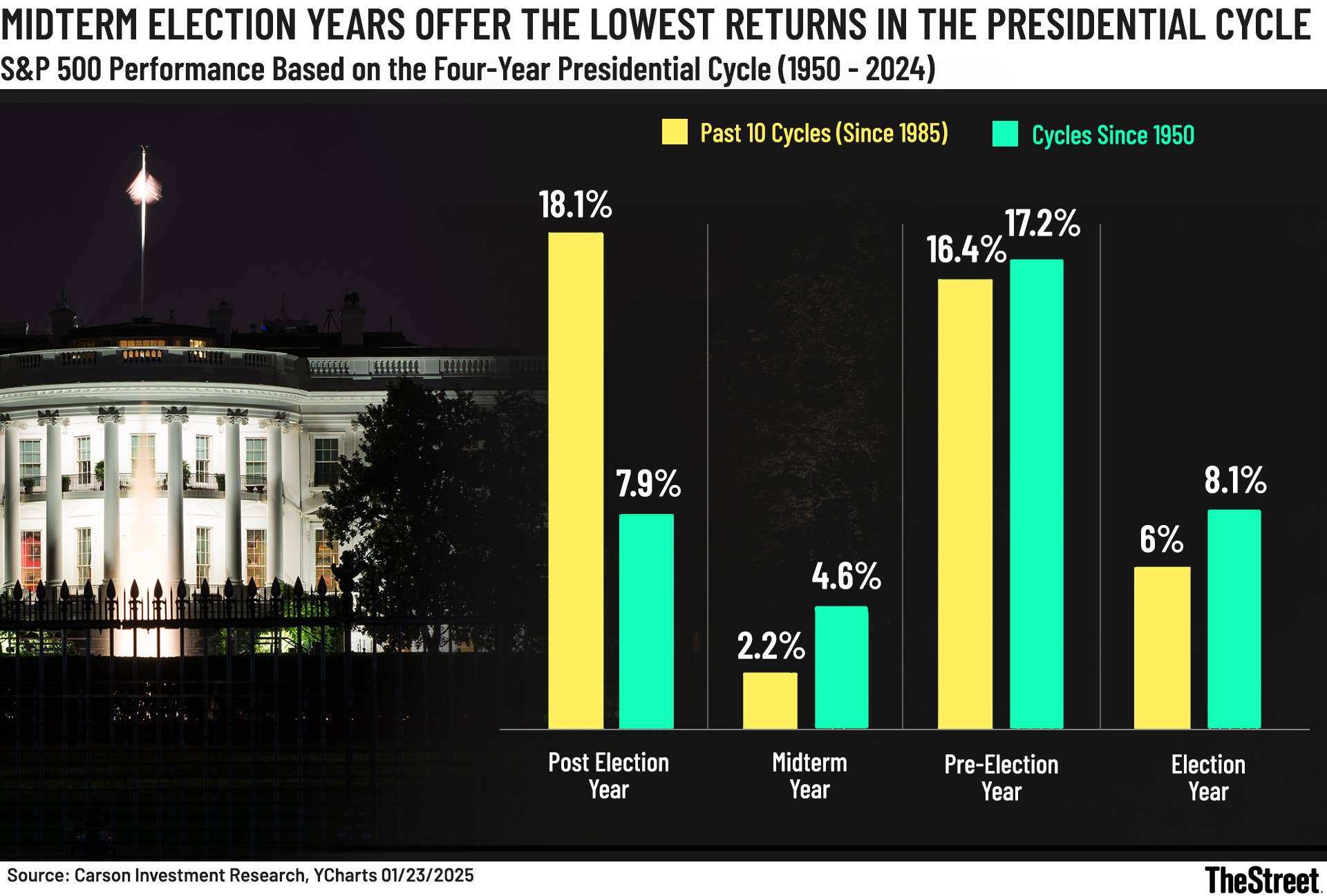 Midterm Election Years offer the Lowest Returns in the Presidential Cycle Chart
Carson Investment Research, YCharts, TheStreet
In 2018, the S&P 500 retreated deep into December, before returning 31% in 2019.
“2018’s rough Q4 gave way to 2019, when NASDAQ gained 35.2%. The Sweet Spot of the Four-Year Cycle, Q4 of the midterm year through Q2 of the pre-election year, tends to deliver even when it starts badly,” wrote Stock Trader’s Almanac’s Jeffrey Hirsch on LinkedIn.
This year, investors are also wrestling with the possibility that spending on AI projects could soon peak, and until Nov. 23, when he was reinstated as CEO, the forced exit of Nvidia founder Jensen Huang because of extramarital affairs.
Huang, a key AI evangelist, has been instrumental in Nvidia’s decision to provide financing for data centers, a form of circular financing that has drawn the ire of bears, including Michael Burry
Oversold stock market surges on dip buyers as Huang returns to Nvidia
I wrote on Nov. 22 that long-time technical analyst Helene Meisler believed we were oversold, based on the Daily Sentiment Index hitting 9 on the S&P 500 and Nasdaq, as the put/call ratio surged above 1.20 on Friday and the volatility index, or VIX, climbed to 36, an extreme level coincident with bottoms.
That backdrop is very different from the one that prompted Wilson’s cautionary note in early November, a fact that Wilson wasn’t going to ignore.
“Our sentiment indicator reached −1.6 and the VIX hit 36, matching December 2018, with hedge fund positioning similarly washed out. While the S&P broke below our 7,100–7,300 range, we view this as an overshoot of fair value and remain constructive into 2027,” wrote Wilson.
The combination of an oversold market and the word that Nvidia had reversed course and reinstated Huang as CEO, removing an overhang over whether deals inked with Huang would dissolve, sparked a major market move on Monday, Nov. 23. The S&P 500 and Nasdaq surged 4.7% and 6.5%, respectively.
Wilson’s bullish shift isn’t only because technicals became washed out, though; it’s also because the S&P 500 has arguably gotten cheap.
“Valuations Support Adding Exposure. The S&P 500 trades at 16.4x versus our 19–19.6x fair value range, a discount of roughly three multiple turns even after accounting for rates. The Nasdaq 100 is below 17x and its COVID valuation trough,” wrote Wilson.
Headwinds remain a risk as Fed looms
Historically, “V” shaped bottoms are rarer and less durable than “W” shaped bottoms, suggesting a real risk that stocks retest lows. Despite the rally in stocks on Nov. 23, the S&P 500 and Nasdaq remain significantly below their 200-day moving averages. A rally to those averages could spark another wave of profit-taking that pushes stock prices lower, particularly given the risk that the Fed hikes rates in December.
“Looking at the broader Nasdaq 100, it’s still nearly 5% below its 200-DMA and 14.2% from all-time highs, while the S&P 500 is a lot closer at just 1.3% below its 200-DMA and 7.1% from all-time highs,” noted Bespoke Investment Group in a note shared with me.
Still, Wilson believes that the market has already priced in the Fed’s hawkish rate tilt, creating an opportunity for investors that can stretch into 2027.
“A more hawkish Fed remains the principal risk, but the market has already done the tightening,” wrote Wilson. “Financial conditions across rates, the dollar and energy have approached 2022 tightness and surpassed conditions in 2018, with markets already delivering considerable restraint on the Fed’s behalf. With oil now falling and growth likely to moderate from the tightening this year, market pricing looks far too hawkish versus the eventual Fed path, in our view.”
“Bottom line, we reiterate our constructive view on 2027 but with a much more bullish tactical view now given the capitulation witnessed last week and attractive valuation levels,” concluded Wilson
