
Most retirement savers know the standard career-change playbook: When you leave a job, you roll your old workplace 401(k) into an individual retirement account (IRA) to gain broader investment choices and lower fees.
What far fewer investors realize is that the pipeline works in reverse — and moving money backward from an IRA into a current employer’s 401(k) can solve two major tax headaches at once.
Charles Schwab highlights the strategy, known as a reverse rollover, as an overlooked way to shield high earners from surprise taxes on Roth conversions and help older workers postpone mandatory withdrawals.
Yet Vanguard and Fidelity Investments point out that executing the move requires navigating strict IRS rules — and surrendering some of the very flexibility that draws savers to IRAs in the first place.
First, it helps to understand why rolling a 401(k) into a traditional IRA can quietly backfire. Once pre-tax money sits inside an IRA, the IRS lumps all of your non-Roth IRAs together when calculating taxes on future Roth conversions, potentially turning what you thought was a tax-free move into an unexpected tax bill.
Schwab spotlights a two-pronged tax escape hatch
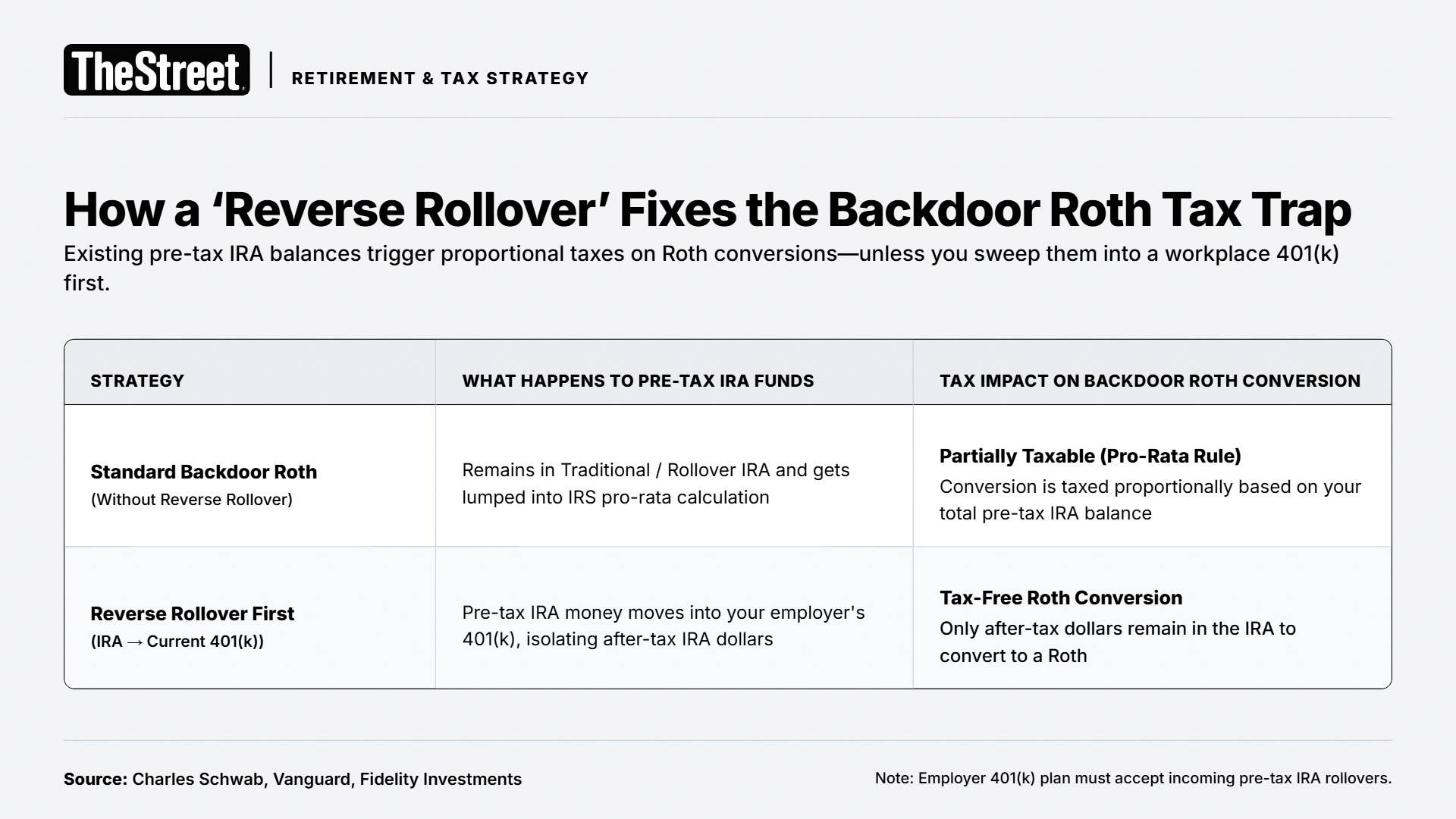
In its guidance on reverse rollovers, Charles Schwab notes that shifting pre-tax IRA balances into a current workplace 401(k) — provided the employer’s plan accepts incoming rollovers — removes those dollars from the IRS calculation used for Roth IRA conversions.
Under the IRS pro-rata rule, investors with existing pre-tax IRA balances cannot cherry-pick only after-tax contributions for a “backdoor” Roth conversion. Instead, the conversion is taxed proportionally across all traditional, SEP, and SIMPLE IRAs combined.
“If your traditional IRA contains both pretax and after-tax contributions, a Roth conversion will be taxable in proportion to the pretax value of the account (known as the pro rata rule),” Hayden Adams, a writer for the Schwab Center for Financial Research, explained.
By sweeping pre-tax IRA funds into a workplace 401(k), savers can isolate their after-tax IRA basis and convert it cleanly to a Roth IRA.
Schwab also flags a second advantage for workers staying on the job into their 70s. Under the “still-working” exception, employees who own 5% or less of their company can generally delay required minimum distributions (RMDs) from their current 401(k) until retirement — a break that does not apply to traditional IRAs.
“Unfortunately, you’ll still need to take RMDs from your IRAs. However, rolling an IRA into your 401(k) would allow you to delay those RMDs, too. This could be ideal for workers whose RMDs would push them into a higher tax bracket,” Adams wrote.
Still, Schwab cautions that moving funds back into a workplace plan comes with strings attached.
“For one, your money can be locked up in the 401(k) until you retire, excepting loans and financial hardship, and the funds become subject to plan rules,” Adams noted, adding that IRAs typically offer far broader investment menus.
Charles Schwab, Vanguard, Fidelity Investments
Vanguard warns of aggregation traps and timing rules
Vanguard frames the pro-rata rule as one of the biggest stumbling blocks for high-income savers attempting backdoor Roth conversions after rolling over an old workplace plan.
In its backdoor Roth IRA guide, Vanguard warns that existing rollover IRA balances can severely erode the tax efficiency of the strategy unless they are cleared out before year-end.
“If you have a balance in a rollover IRA, you may not want to make a backdoor Roth conversion because of the pro rata rule,” Vanguard wrote.
“This rule requires all IRA distributions to be taken proportionally from your pre-tax and after-tax contribution sources, which could limit the tax benefits you’d receive from a Roth conversion.”
More Retirement:
- Annuities can be a retirement safety net to prevent outliving savings
- Vanguard flags a retirement fear built into 401(k) plans
- Suze Orman has a serious retirement warning for 2027
Even when investors use a reverse rollover or conversion to clear the deck, Vanguard emphasizes that Roth conversions carry strict holding periods and reporting requirements on IRS Form 8606.
“Converted amounts are subject a 5-year holding period to avoid a 10% penalty if you’re under age 59 ½; earnings are always subject to a separate 5-year rule for tax-free withdrawal,” Vanguard noted.
Fidelity flags recordkeeping pitfalls and lost flexibility
Fidelity Investments agrees that rolling pre-tax IRA assets into a workplace plan can clear the path for a tax-free Roth conversion, while warning that investors bear the burden of separating pre-tax and after-tax dollars properly.
In its Roth conversion guidance, Fidelity notes that workplace plans cannot accept after-tax IRA basis — meaning savers must track their non-deductible contributions carefully so only pre-tax money moves into the 401(k).
“The only catch is that the workplace plan has to allow this type of rollover, and you have the responsibility to not only track and report the after-tax contributions, but also prevent the after-tax assets from rolling to your retirement plan at work,” Fidelity explained.
Beyond tax mechanics, Fidelity urges savers to weigh broader trade-offs before shifting money out of an IRA and back into an employer-sponsored plan.
“There may be considerations related to fees, investment choices, creditor protection, RMDs, and other factors that need to be weighed when deciding whether a rollover is appropriate for you,” Fidelity wrote.
Related: Vanguard, Fidelity clash on hidden 401(k)-to-IRA rollover cash
