
T-Mobile has quietly made a significant move to upgrade its network for customers amid elevated competition.
Verizon and AT&T have been racing to purchase spectrum licenses to improve their 5G networks. Spectrum gives carriers additional airwaves to carry more data, helping increase network capacity, improve speeds, and expand coverage, depending on the frequency band.
In June, Verizon completed its $1 billion purchase of low- and mid-band spectrum licenses from UScellular across four frequency bands, enhancing coverage and network capacity in some U.S. locations.
AT&T closed its $23 billion purchase of 50 MHz of spectrum from EchoStar in July, strengthening its 5G network with licenses covering virtually every U.S. market.
SpaceX’s Starlink Mobile, which plans to enter the wireless market, has also been pursuing spectrum. In October, it agreed to purchase Grain Management’s nationwide portfolio of 800 MHz low-band spectrum, a deal pending federal approval that could help Starlink Mobile become a major U.S. mobile carrier.
T-Mobile moves to acquire spectrum from Bluewater Wireless
As the wireless market intensifies, T-Mobile has moved to enhance its 5G network by filing applications with the FCC on Nov. 12 to acquire 58 spectrum licenses from Bluewater Wireless, according to Ookla lead industry analyst Mike Dano.
Dano flagged the move in a LinkedIn post on Nov. 18, revealing that the licenses are in the 600 MHz band and cover 435 counties in 27 U.S. states. It is unclear how much the deal is worth.
This proposed purchase would increase T-Mobile’s 600 MHz holdings by 10 MHz in most counties and add 20 MHz in five counties across Colorado and South Carolina. Dano said that this type of spectrum “generally improves network speeds and performance.”
T-Mobile also landed a short-term lease with Bluewater Wireless that would allow it to start using the spectrum 10 days after filing with the FCC, meaning customers in the affected areas could eventually benefit from enhanced network capacity and connectivity.
Read more: T-Mobile pushes back on SpaceX’s bid to take its customers
“These 600 MHz licenses from Bluewater will undoubtedly improve the performance of T-Mobile’s network,” wrote Dano in the LinkedIn post.
He also said that while signals in the 600 MHz low-band spectrum generally have wider coverage and can better penetrate buildings, they don’t offer the same advantages as those in the 2.5 GHz mid-band spectrum.
“I checked Speedtest data for Android phones in Q3 2026 in these 435 counties, and found that about 14% of T-Mobile 5G tests recorded 600 MHz as the phone’s main 5G connection (other bands might be used at the same time),” he wrote. “And, not surprisingly, T-Mobile’s 5G speeds on 600 MHz were about 7x slower than its speeds on its mid-band 2.5 GHz spectrum.”
Dano also said that the deal between T-Mobile and Bluewater Wireless is also “interesting” because Starlink Mobile has been hunting for low-band spectrum.
“T-Mobile is looking to improve the performance of its low-band 5G network across the country… and that Starlink isn’t buying up all the spectrum that’s currently available,” he wrote. “The next big spectrum event to watch is the FCC’s upper C-band auction in April 2027. Will Starlink bid? Will T-Mobile? And who will win? That’s the real question here.”
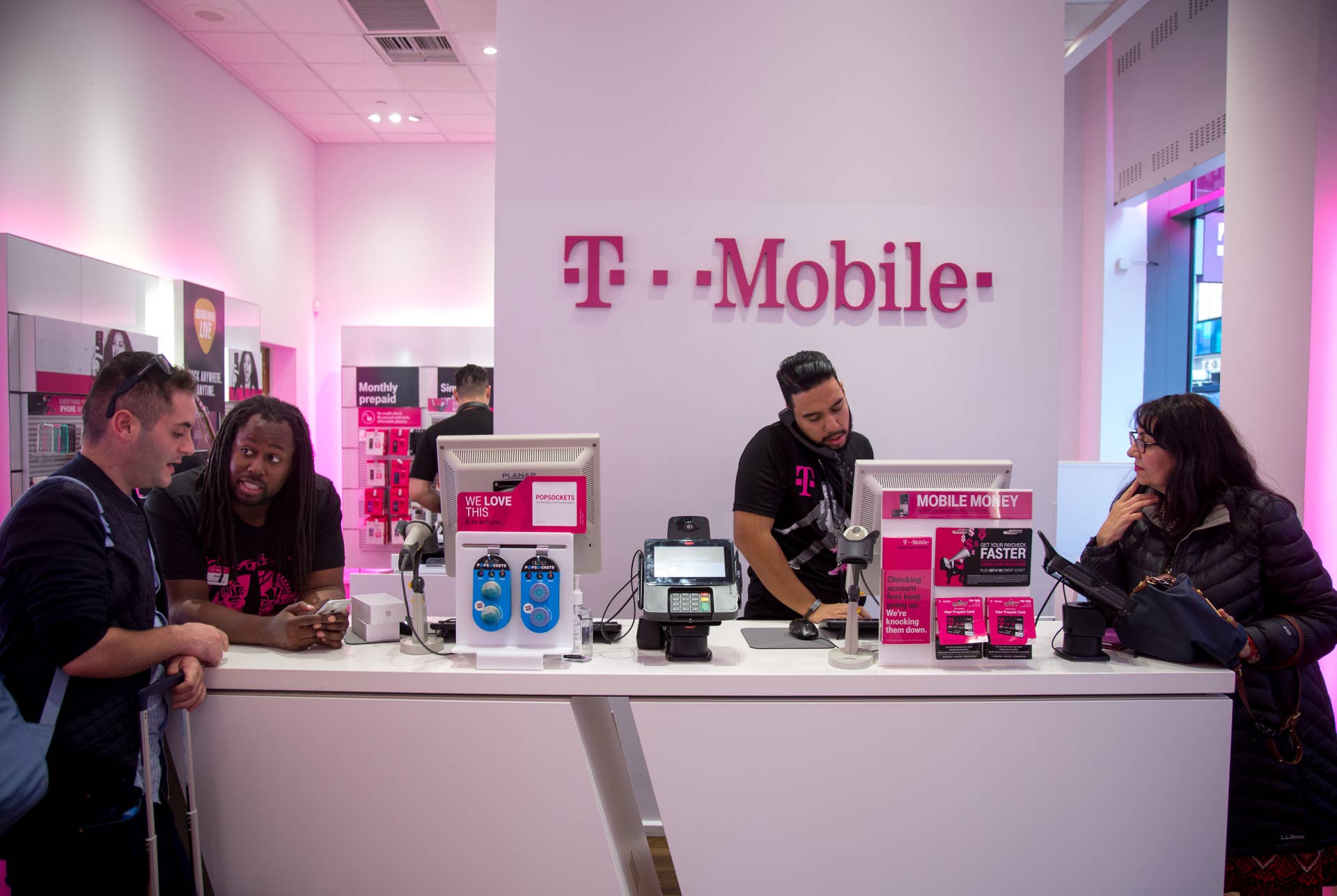 T-Mobile has moved to acquire 58 spectrum licenses from Bluewater Wireless to improve its network for customers.
T-Mobile adds spectrum amid growing pressure to retain customers
T-Mobile’s move to purchase spectrum licenses from Bluewater Wireless to improve its 5G network comes at a time when it is facing customer retention challenges.
In its most recent earnings report, T-Mobile revealed that its postpaid account churn (the percentage of postpaid wireless and broadband accounts that customers canceled) hit 1.09% in the third quarter of 2026, up from 0.97% a year earlier.
T-Mobile also brought in 274,000 new postpaid accounts during the quarter, a 31% drop from the additions it recorded in the same period in 2025.
Improving network performance could help T-Mobile attract and retain customers, particularly as Americans are increasing their wireless data use.
More T-Mobile News:
- T-Mobile sees customer loyalty take a significant turn
- T-Mobile reduces a generous discount as customers see prices rise
- T-Mobile adds monthly fee to a new iPhone feature for customers
A recent survey from CTIA found that Americans used a record 159.3 trillion MB of data in 2025, which is 20% more than in 2024 and a nearly 60% spike over the past two years. This wireless data consumption is more than what Americans used in the entire 4G decade.
CTIA said the survey findings highlight the surging demand on U.S. wireless networks as consumers increasingly rely on connected technologies such as artificial intelligence, wearable devices and streaming services.
“This continued surge in demand reflects the increasingly central role wireless plays in everyday life,” said CTIA CEO Ajit Pai in a press release. “America’s wireless providers are stepping up to the challenge, investing nearly $30 billion last year alone to expand capacity and lay the foundation for future AI-native 6G networks.”
CTIA projects that wireless data demand will quadruple by 2032, with rapid expansion of AI expected to add further pressure to U.S. wireless networks. AI is growing at three times the rate of traditional wireless traffic and could account for nearly one-third of all broadband traffic by 2034.
Against this backdrop, network performance is influencing consumers’ decisions about whether to switch mobile providers. According to a survey from Oxio, which was shared with TheStreet, 37% of Americans would switch mobile providers for faster speeds, while 34% would switch for better coverage.
Related: T-Mobile makes unexpected phone plan change for customers
