
When Nvidia NVDA and other beaten-down chip stocks suddenly rally, investors sitting on the sidelines may feel like they’re missing out on a buying opportunity.
But what’s actually driving the rebound? And how long will it last?
Thomas Hayes, chairman and managing member of Great Hill Capital, believes investors would be wise to exercise patience before jumping back into the AI trade.
That’s because some of the buying activity may come from traders closing out bearish bets, while institutional investors in need of cash may view the rebound as an opportunity to sell.
While Hayes anticipates a strong year-end rally, he would wait at least a couple of days for the initial market reaction to settle before selectively buying AI stocks.
He also believes lingering questions about financing costs and returns on AI investments could create even more attractive buying opportunities in 2027.
Hayes recently sat down with TheStreet’s Caroline Woods to discuss why he’s cautious about buying Nvidia right now—and names three opportunities he’s uncovered outside the crowded chip sector.
Why investors should be cautious about a Nvidia rally
Hayes’ warning starts with the mechanics of a rebound.
Traders who sell a stock short borrow shares and sell them in the hope of buying them back at a lower price. If the stock rises instead, they may buy shares to close those positions, adding demand in a process known as short covering.
That buying activity can push prices higher without addressing longer-term questions about a company’s earnings potential.
Hayes believes the initial surge in chip stocks could be driven in large part by short covering, making it difficult to determine whether the rally reflects renewed confidence in the companies’ business prospects.
He also expects some institutional investors that suffered losses to sell into the rebound to raise cash. Investors who used borrowed money may need to reduce their borrowings, a process known as deleveraging.
As a result, selling pressure from investors seeking liquidity could offset some of the buying activity from traders closing out their short positions.
Hayes isn’t suggesting that the rebound is destined to fail. In fact, he expects a strong rally into year-end and believes the financing outlook for the AI ecosystem could improve.
His point is that a sharp, single-day rally doesn’t resolve the financing and profitability concerns that troubled investors in the first place.
For investors who already own Nvidia, Hayes’ rapid-fire answer was to hold. For those considering a purchase, he favors waiting for a more attractive entry point, although there’s no guarantee the stock will trade at a lower price.
Why AI spending and borrowing costs still matter
One of the longer-term concerns surrounding the AI trade is the relationship between infrastructure spending and the profits those investments eventually generate.
Companies building AI infrastructure must invest in equipment and facilities before they know precisely how profitable those investments will be.
Hayes expects investors to increasingly question return on invested capital, a measure of how effectively a business generates profits from the capital committed to it.
He also expects greater scrutiny of free cash flow, or the cash a business generates after accounting for operating expenses and capital expenditures.
Borrowing costs factor into those calculations.
Hayes contrasted the cost of financing a data center at 5% with borrowing costs of 13% to 15% for some specialized cloud providers, often referred to as neocloud companies.
Although those rates aren’t necessarily representative of every borrower, more expensive financing can make projects harder to justify and could affect expectations for future orders and infrastructure spending.
The Federal Reserve also poses a potential risk, in Hayes’ view. He said a larger-than-expected interest rate increase, or an increase accompanied by more hawkish language about inflation, could threaten the year-end rally he anticipates.
Hayes’ concerns come as Federal Reserve officials debate how aggressively to combat persistent inflation. In a November 18 interview on CNBC, Fed Governor Christopher Waller said the Fed needs to get more aggressive, and advocated for a 0.50% interest rate increase at the Fed’s December 9, 2026 meeting.
But despite his near-term caution, Hayes remains optimistic about AI’s longer-term potential.
I think that you’re going to find better opportunities to buy the AI trade at even better prices at certain points in 2027 because I am in the camp that we are in inning four or five or six.
Thomas Hayes, when asked whether investors could find better prices for AI stocks in 2027
Hayes expects productivity gains and returns on AI investments to materialize over time, potentially beginning in 2028 or 2029.
That leaves a window during which investors could grow impatient.
After all, recognizing the potential of a promising technology and identifying an attractive entry point for a stock are two different things.
Why Hayes looks beyond the biggest AI stocks
Hayes’ case for looking beyond AI stocks begins with earnings growth.
He said the group he calls the “Unmagnificent 493,” a shorthand for the S&P 500 companies outside the Magnificent Seven, had recently outpaced the AI trade in terms of earnings growth.
He views this shift as evidence that investment opportunities are spreading beyond a handful of market leaders.
While the two groups Hayes is comparing aren’t directly equivalent, broadening earnings growth could create opportunities elsewhere in the market.
But Hayes draws an important distinction between a short-term rebound trade and an investment he expects to hold for several years.
He sees greater appeal in businesses whose existing cash generation, valuations, or diversified operations provide multiple avenues for growth, rather than relying entirely on a rapid rebound in AI spending.
That approach could appeal to investors who want exposure to technology while also exploring opportunities outside the semiconductor sector.
It requires patience, however, as stocks can remain out of favor for extended periods, and low valuations relative to projected earnings can reflect legitimate business concerns.
Why Hayes sees Alibaba as an alternative AI investment
Alibaba BABA is one example of a company Hayes believes could benefit from AI without relying on the same investment thesis as a semiconductor stock.
He points to Alibaba’s e-commerce and cloud businesses, as well as its investments in other companies, as sources of potential value.
Hayes said Alibaba traded at approximately 13 times his estimate of next year’s earnings and nine times his earnings estimate for the following year.
A valuation multiple expresses a stock’s price relative to a measure such as earnings. Lower forward earnings multiples can indicate that a stock is more attractively priced, although they depend on earnings forecasts that may not materialize.
Hayes also cited $33 billion in net cash, or cash after subtracting debt, as part of his assessment of Alibaba’s balance sheet.
In addition, Alibaba’s e-commerce business gives Hayes another reason to own the stock.
He believes a recovery in Chinese consumer spending could benefit Alibaba even if his AI expectations prove too optimistic. He also pointed to the company’s international commerce operations as another source of potential growth.
Of course, investing in Alibaba also means gaining exposure to China.
Hayes acknowledged policy and accounting risks and said Great Hill Capital takes a selective approach rather than investing in companies simply because the country is out of favor.
For investors considering Alibaba, the question is whether its combination of e-commerce, cloud services, and investments justifies its valuation after accounting for those risks.
While a strong cash position can provide financial flexibility, it doesn’t necessarily limit the stock’s downside.
Why Hayes favors Baxter International as a turnaround stock
Baxter International BAX offers investors a different type of exposure.
Hayes views the medical technology company as a turnaround opportunity in a defensive area of the market.
Defensive stocks typically represent businesses whose operations are considered less sensitive to economic fluctuations, although their share prices can still decline.
Hayes said some large, highly valued companies can drive up the overall valuation of a sector index, making the entire group appear expensive.
His argument for investing in Baxter is that individual companies within defensive sectors may trade at more attractive valuations than their higher-profile counterparts.
Hayes cited Baxter’s share-price decline of more than 50% from its COVID-19 pandemic highs, along with the company’s efforts to reduce costs, pay down debt, and generate free cash flow.
He also pointed to management’s ability to exceed expectations and raise its financial guidance.
At the time of the discussion, Hayes said Baxter traded at approximately 12 times 2026 earnings and that Great Hill Capital believed the stock could double over the next three to five years.
Whether that forecast materializes will depend on more than cost reductions or the stock’s previous decline.
Investors interested in turnaround opportunities must determine whether operational improvements are sustainable and whether those improvements are already reflected in the stock price.
Debt reduction and free cash flow generation are important metrics to monitor, but they don’t eliminate operational risks or guarantee a higher valuation.
Why PayPal’s cash flow attracts Hayes
Hayes said PayPal PYPL was the largest holding in Great Hill Capital’s portfolio.
His investment thesis centers on the company’s ability to generate cash, repurchase shares, and improve growth and profit margins following a steep decline from its pandemic-era highs.
Hayes cited annual free cash flow of $6 billion to $6.5 billion and a free cash flow yield of nearly 15%.
Free cash flow yield compares a company’s annual free cash flow with its market capitalization. It helps investors assess how much cash a company generates relative to its valuation, although the yield can fluctuate as cash flow and share prices change.
Hayes also emphasized the importance of PayPal’s share repurchases, also known as stock buybacks.
When a company reduces its number of outstanding shares, existing shareholders generally own a larger proportion of the business.
However, that doesn’t necessarily translate into a higher stock price, as the value of shareholders’ stakes still depends on the company’s performance.
Hayes’ turnaround thesis also hinges on easing concerns about PayPal’s profit margins, or the portion of revenue remaining after costs.
He said margins had begun to improve and pointed to growth in Venmo, Braintree, branded checkout, and buy now, pay later services. The sustainability of those improvements will be important for investors considering the stock.
Hayes believes PayPal could be worth more than $100 per share if it returns to growth and trades at what he considers a more normal valuation, a process he said could take several years.
The risk for investors is that growth could disappoint or the market could continue to assign PayPal a lower valuation.
How Hayes’ 3 stock picks stack up against Nvidia
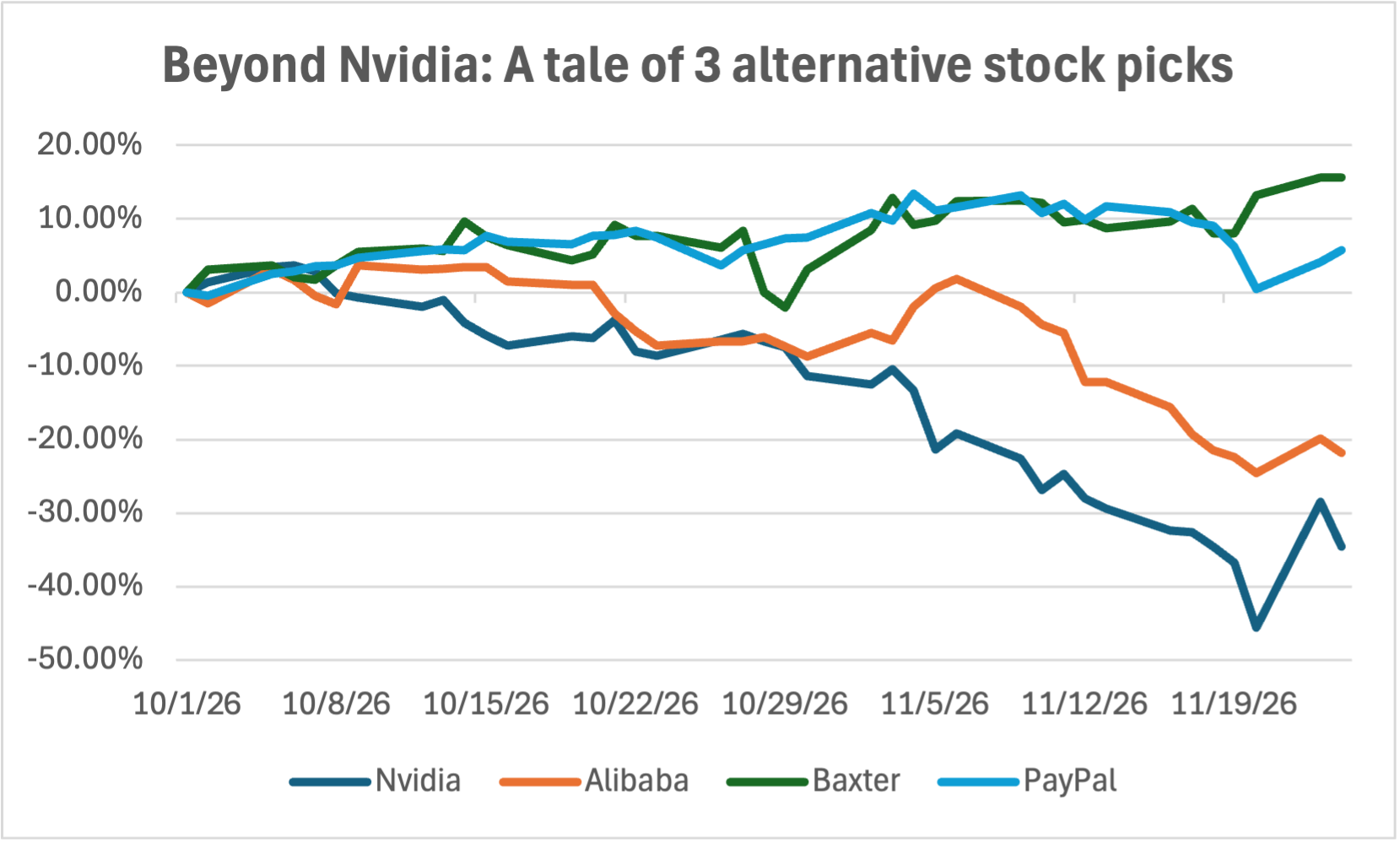
All three of Hayes’ alternative stock picks have outperformed Nvidia since the beginning of October, although their performance has been decidedly mixed.
While Baxter International and PayPal have gained approximately 16% and 6%, respectively, Alibaba has decreased by roughly 22%.
Nvidia, meanwhile, experienced a steep sell-off that intensified following the resignation of its CEO, Jensen Huang. Despite a rebound surrounding his dramatic reinstatement on November 23, Nvidia shed approximately 35% of its value over the period.
Yahoo! Finance
When Hayes would take profits on a chip-stock rebound
For shorter-term traders, Hayes has a different investment time horizon than he does for his preferred turnaround stocks.
He said he would probably begin reducing his exposure to semiconductor and memory stocks if those beaten-down shares rallied 30% to 50% from their lows into year-end.
The distinction is important: Hayes was describing a potential exit strategy in the event of a rebound of that magnitude, rather than suggesting that every chip stock had already experienced such gains or that every investor should sell.
His reasoning is that once the initial enthusiasm surrounding the rebound fades, investors could revisit the same questions about financing costs and returns on AI investments.
For Alibaba and Baxter International, by contrast, Hayes discussed a potential holding period of three to five years, assuming the investments perform as he expects.
While a longer investment horizon gives a turnaround thesis time to materialize, it also leaves investors exposed to the possibility that the underlying business or their original investment assumptions could deteriorate.
The two strategies require different approaches to portfolio management.
Short-term traders can determine in advance how much of a rebound would prompt them to reassess their positions.
Longer-term investors, on the other hand, can monitor operating results and evaluate whether their original reasons for owning a stock remain valid, rather than viewing every market rally as a potential selling opportunity.
How to choose between an AI rebound and a longer-term stock investment
Investors weighing these opportunities should start by considering what they hope to accomplish with their investment.
For those looking to capitalize on a short-term AI rebound, it’s worth considering Hayes’ warning that short covering and selling pressure from institutional investors can make the initial rally difficult to interpret.
Investors should also consider what would prompt them to reassess their positions, whether the anticipated rebound materializes or their investment thesis begins to weaken.
For those seeking longer-term investment opportunities, the underlying business is just as important as the stock’s valuation.
For Alibaba, that means weighing China-related risks against the potential of its e-commerce and cloud businesses. For Baxter International, it means monitoring the company’s turnaround efforts. And for PayPal, it means determining whether cash flow, growth, and profit margins support its valuation.
There’s no guarantee that Hayes’ forecasts will materialize or that any of these three stocks will offer downside protection.
But his investment strategy underscores an important distinction: Knowing whether you’re investing in a short-term market rebound or buying a business you intend to own for years can help you determine when to buy, when to hold, and when to sell.
Some or all of this content may have been generated by AI. While we strive for accuracy, AI can occasionally produce incorrect information. If you buy something via one of our links, we may earn a commission.
