
Judging from Wall Street’s early 2027 stock market forecasts, it might seem that autumn’s turbulence was more or less a brief speed bump.
Major investment banks still continue to project another banner year ahead, even after Federal Reserve rate-hike jitters and AI spending doubts knocked the S&P 500 down from its Oct. 6 record of 7,818.93 to 7,201.09 on Nov. 24.
Bank of America Securities isn’t buying that complacency though. In a note shared with me, Chief Investment Strategist Michael Hartnett issued a blunt reality check for investors heading into 2027.
Though most on Wall Street are calling for smooth sailing, Hartnett warns that a painful economic slowdown is perhaps the single biggest underpriced risk in markets today and is advising clients to play defense now.
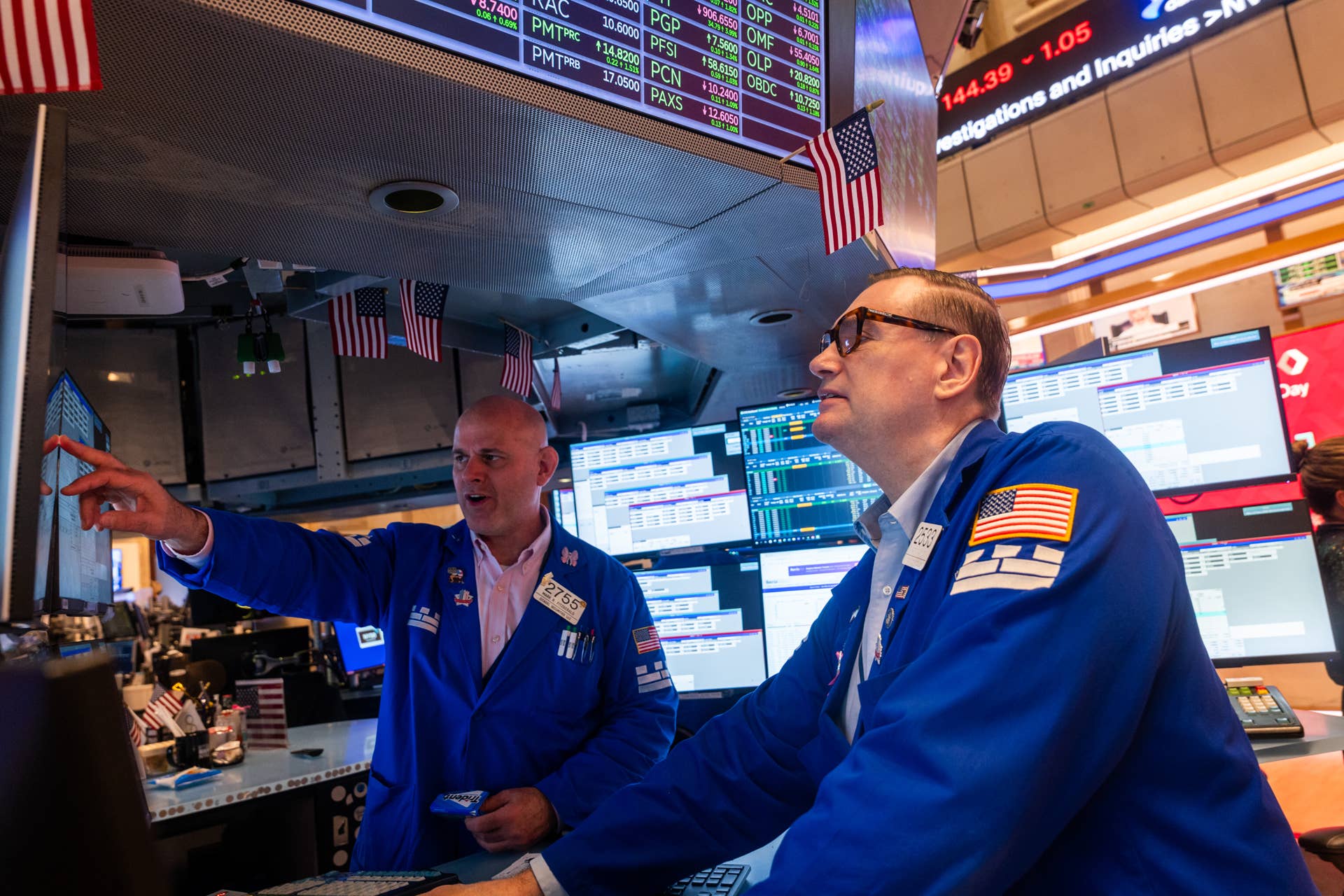 Bank of America outlines a possible S&P 500 decline amid recession risks.
Inside Bank of America’s 2027 S&P 500 forecast and hard-landing math
Hartnett’s alarm starts off with a growing gap between market nerves and institutional positioning.
As per Bank of America’s November Global Fund Manager Survey as reported by Biggo, just 3% of fund managers are forecasting a steep downturn over the next 12 months, in comparison with 50% expecting a soft landing and 42% predicting no landing at all.
More Wall Street:
- Arista Networks stock gets fresh backing from Jim Cramer and Wall Street
- Oracle stock sinks as Wall Street confronts a $20 billion AI problem
- Wall Street just got a candid look at who is winning the AI race
Cash levels have dropped to a historically thin 3.6%, down from 3.9% in October, even as global stock funds absorbed $310 billion over the past four weeks.
That crowding leaves stocks remarkably exposed. Hartnett warned that a “hard landing” is the biggest threat to market consensus, arguing that Wall Street projections of 15% to 20% global earnings growth are currently looking too optimistic as AI capital spending and K-shaped wealth effects taper off.
In a true bust, he projects a bear market that drags the S&P 500 down to nearly 6,666, implying a 7.4% to 8% downside from late-November levels.
For clarity, recession isn’t Bank of America’s base case.
Under a “Goldilocks” soft landing scenario that involves global growth above 3%, dropping inflation, sliding oil prices, and 21 global rate cuts in the back half of 2027, Hartnett expects a bull market to broaden out that could potentially carry the S&P 500 to around 7,777, an 8% increase from Nov. 24, yielding 4% to 8% upside for global stocks, with an extreme AI-boom surprise reaching 8,888.
That discipline echoes Bank of America’s broader view.
In September, BofA U.S. equity chief Savita Subramanian bumped the bank’s 2026 year-end S&P 500 target from 7,100 to 7,400, along with a 12-month target of 7,800, which is a lot more conservative than the 8,700 targets at Goldman Sachs, Morgan Stanley, and Barclays, or UBS’s 8,900 call.
The AI cash crunch, and BofA’s ‘GRAB’ shield before a spring pivot
Bank of America is clearly conservative and bracing for significant volatility, while rivals forecast S&P 500 year-end targets of 8,700+.
To explain that, it’s important to look at the balance sheets powering AI. BofA projects a whopping $1.3 trillion in AI CapEx in 2027, even with hyperscalers’ free cash flow swinging to a negative $283 billion.
That leaves stocks remarkably vulnerable to any spending cut or credit shock. In BofA’s November survey, 52% of fund managers said they expect an AI hyperscaler to announce a CapEx reduction within six months, up from 30% in October, while 34% flagged an AI bubble and 31% cited an AI credit event as top tail risks.
Hartnett also mapped out concrete stress lines to watch.
This includes an S&P 500 break below its 6,845 year-end 2025 close, initial jobless claims topping 250,000, or investment-grade credit spreads growing beyond 100 basis points.
Until investor fear becomes a lot more visible, Hartnett advises hedging with “GRAB” assets.
- Government bonds: TLT, IEF, and SHY for stability.
- Real estate: XLRE, offering diversification away from AI.
- High-quality stocks: AAA-rated companies for defensive exposure.
- Gold: GLD, potentially benefiting from a weaker dollar.
- Later opportunities: After rate hikes end, pivot toward semiconductors (SMH), commodities (DBC), Bitcoin (IBIT), and consumer staples (XLP).
What Bank of America’s 2027 warning means for investors
Hartnett’s playbook is essentially a practical roadmap for sequencing portfolio risk over the next six months.
First, it would be wise to look at Bank of America’s three macro green lights before chasing a sustained bull run.
This includes the 10-year Treasury yield slipping below 4.5%, WTI crude falling below $70 a barrel, and a clear peak in the U.S. dollar. Until all that aligns, expect choppy trading and stay selective.
Second, it’s important for investors to apply the “GRAB” framework to stress-test their allocation.
If mega-cap tech and AI names dominate your 401(k) or brokerage account, pairing core stocks with short-to-intermediate Treasuries, AAA-rated quality businesses, or modest real estate and gold exposure cushions a slide toward 6,666.
Finally, keep dry powder ready for spring. If interest-rate hikes wrap up in the first half of 2027 without a credit breakdown, beaten-down consumer staples and cyclical sectors might end up offering a far better risk-reward than today’s crowded trades.
Related: Jim Cramer resets Nvidia stock target as Jensen Huang returns as CEO
