
What’s not to like?
Interest rates may be coming down sooner than expected now that those revised employment figures rocked the Federal Reserve – and the rest of the world – last week.
💵💰Don’t miss the move: Subscribe to TheStreet’s free daily newsletter💰💵
Which would be welcomed by potential homeowners across America as well as car buyers, college students and anyone who uses a credit card.
Investors would also be pretty happy if some of the economic uncertainties facing markets were tamped down.
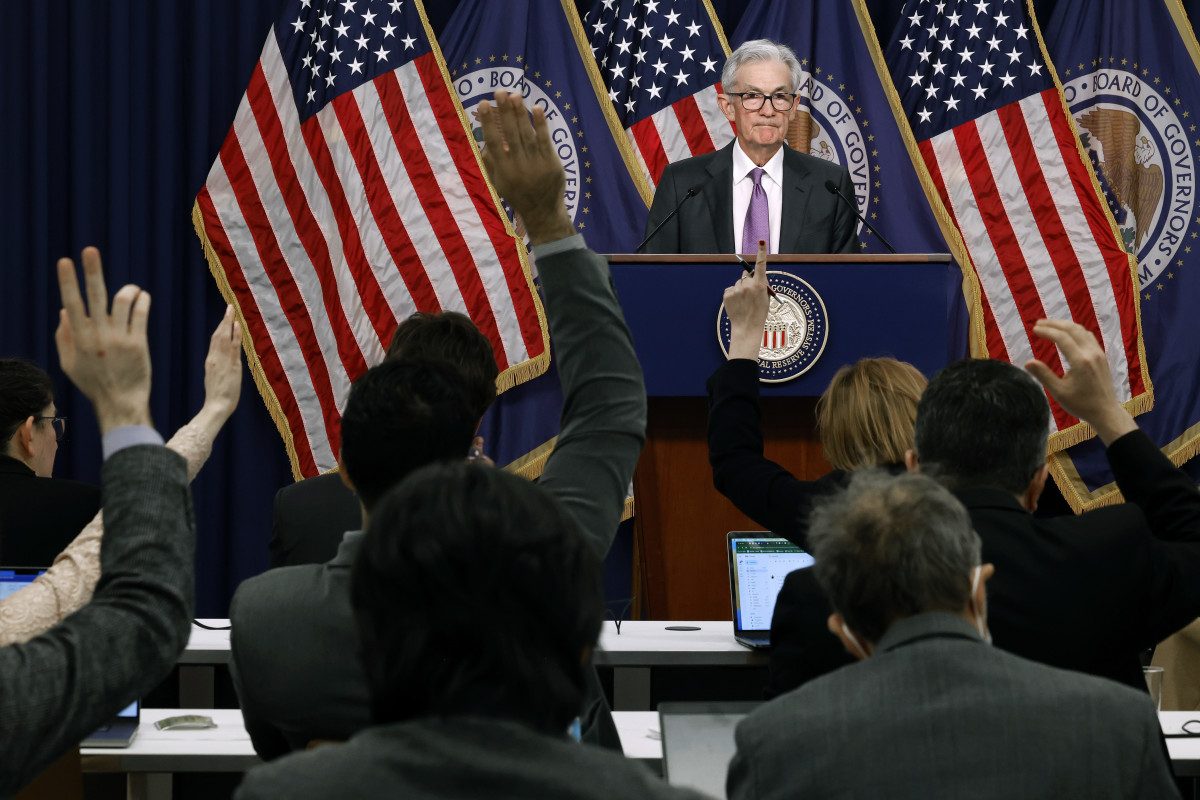 Federal Reserve Chair Jerome Powell has not capitulated to President Donald Trump’s demands for lower interest rates but new economic data may prompt a change..
Chip Somodevilla/Getty Images
Federal Reserve had a very busy week
The Federal Open Market Committee, the Fed’s 12-member policymaking panel, voted as expected last Wednesday to hold the Federal Funds Rate steady at 4.25% to 4.50%.
The majority of the FOMC members voted to maintain its “wait-and-see” approach over concerns of lagging tariff inflation on consumers and businesses.
Note that at that time, Fed Chair Jerome Powell described the job market as “solid.”
(Wait for it.)
But for the first time since 1993, two FOMC members dissented, saying it was time for a .25% cut in short-term interest rates based on slight cooling in the most recent jobs reports.
President Donald Trump the next day went ballistic on Powell, berating him once again for failing to lower rates and doubling down on calls for Powell to resign from the independent central bank.
Then on Friday, the Bureau of Labor Statistics reported a lower than expected jobs number for July plus startling revisions of the May and June jobs data that showed a dramatic overall drop of almost 700,000 new jobs for that three-month period.
Related: Why the Federal Reserve matters so much
That cooling suddenly became a deep freeze.
“The labor market in the U.S. apparently died not a slow death, but a rather sudden death,’’ TheStreet Pro’s veteran trader Stephen Guilfoyle said.
Guilfoyle has long been skeptical of recent BLS employment numbers, and of the now fired BLS Commissioner Erika McEntarfer.
“Throughout her tenure, McEntarfer has come under fire not just for the inaccuracy in the reporting of data she was responsible for, but also for her agency’s mismanaged data release practice,’’ Guilfoyle said, adding that the “real problem is that the central bank still relied upon the BLS as did U.S. financial markets.”
Had Powell been in possession of the accurate data, Guilfoyle said “he may not have needed convincing’’ that the rate cut was needed.
Now the Fed is looking backwards.
FOMC considers an interest rate cut in September
The CME Group FedWatch Tool, which tracks the probabilities of changes to the Fed rate as implied by the 30-Day Fed Funds futures prices, shows a 92.1% chance of a .25% rate cut when the FOMC meets Sept. 17.
Maximum employment and price stability are the twin priorities — officially called the congressional dual mandate — of the Federal Reserve.
These monetary policy goals require a strategic balance of macroeconomics because higher interest rates lower inflation but increase job losses, and lower interest rates decrease unemployment but increase inflation.
The independent central bank uses interest rates as a tool to manage its dual mandate.
More Federal Reserve:
- GOP plan to remove Fed Chair Powell escalates
- Trump deflects reports on firing Fed Chair Powell ‘soon’
- Former Federal Reserve official sends bold message on ‘regime change’
The Federal Funds Rate is the price the Fed charges U.S. banks to borrow money overnight.
This sets short-term benchmark interest rates for borrowing money via credit cards and home equity, auto and student loans.
Related: Federal Reserve votes on interest rates
The 10-year Treasury Bond yield is the benchmark for longer-term interest rates like the 30-year fixed mortgage, currently hovering around 6.8%.
The Fed has set an inflation target of 2% before it would consider cutting rates.
Cheaper borrowing costs encourage businesses to invest and expand, potentially leading to job creation and wage growth.
For consumers, increased disposable income from lower debt payments can result in higher spending on goods and services, a key driver of economic growth.
Fed governor’s early resignation sparks buzz
Meanwhile on Friday afternoon, Fed Governor Adriana Kugler announced her early resignation effective this Friday.
Kugler’s term would have expired at the end of January.
That opening was seen by Fed watchers as an opportunity for Trump to nominate a loyal supporter who would back his demands for lower rates.
It’s been fast-forwarded by five months, and Trump told reporters Sunday and Monday that he expected to submit a name “soon.”
Powell’s term as chair expires at the end of May and he has said he would not resign.
The White House has alluded that the new governor, who must be approved by the GOP-led Senate, could in turn become the next Fed chair.
Related: Jobs report shocker resets Fed interest rate cut bets