
There are only two AI leaders that matter in the fight for coding supremacy right now, and neither is backing down from the other.
Anthropic’s Claude Fable 5 remains the benchmark every Chinese lab measures itself against, and two different companies made that exact comparison within three days.
Alibaba (BABA) shares climbed as much as 5.4% in Hong Kong trading on Monday, July 20, after the company previewed Qwen 3.8 Max, a model it says trails only Fable 5 among today’s leading systems, according to Bloomberg.
The claim landed three days after Moonshot AI’s Kimi K3 made a nearly identical pitch and briefly rattled global tech stocks. What complicates Alibaba’s version is the state of its own relationship with Anthropic, which has gone from tense to openly adversarial in the past two weeks.
Alibaba is racing to catch a rival it just banned
Alibaba banned employees from using Anthropic’s Claude Code for work starting July 10, after finding code capable of detecting whether a user was based in China.
The ban followed a separate accusation from Anthropic, which told the U.S. Senate Banking Committee that operators tied to Alibaba’s Qwen lab ran roughly 25,000 fraudulent accounts to extract Claude’s outputs through a technique called distillation.
Related: Alibaba’s Anthropic ban hides bigger AI shift
Alibaba pushed staff toward its own coding platform, Qoder, instead of Claude Code. That is the same platform now hosting the Qwen 3.8 Max preview, which means the model built to replace Claude Code internally is also the one Alibaba is using to publicly chase Claude’s performance. Could it eventually catch up?
A pattern is forming among China’s AI labs
Alibaba is not the first Chinese lab to frame a release this way. Zhipu AI made an almost identical claim in June, landing within a percentage point of Opus 4.8 on a closely watched benchmark with its GLM 5.2 model, at a fraction of the cost.
Moonshot AI’s Kimi K3, released July 17 with 2.8 trillion parameters, positioned itself the same way just three days before Alibaba’s announcement. Seeking to capitalize on a model release that rattled tech markets and redefined global perceptions of China’s AI capabilities, Moonshot has reportedly told investors it plans to go public in as little as six months.
None of these rankings comes from an independent benchmark. Alibaba has not published a model card or a benchmark table for Qwen 3.8 Max, which means its claim of trailing only Fable 5 rests entirely on internal testing, the same position every other Chinese challenger has taken this year.
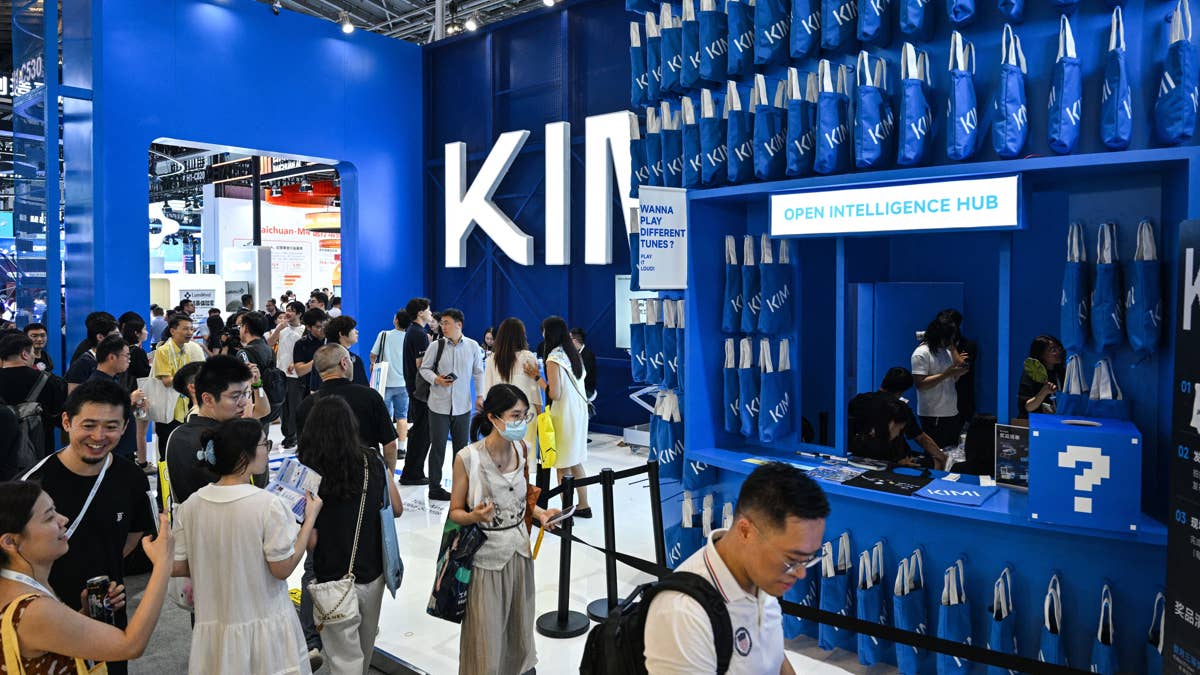 Alibaba shares rose 5.4% after unveiling Qwen 3.8 Max, days after Alibaba banned staff from using Anthropic’s Claude Code over a data risk dispute.
HECTOR RETAMAL / Getty Images
Open weights are becoming the real pitch
Alibaba has promised Qwen 3.8 will ship as an open weight model soon, though it has not set a date. That detail matters more than the benchmark claim, because Washington briefly cut off foreign access to Fable 5 and its more restricted sibling, Mythos, in June before partially restoring it in July.
A model that can be downloaded and run on a company’s own servers cannot be switched off by an export order, and Chinese labs have started marketing that difference as much as raw performance.
Alibaba holds a stake of roughly 36% in Moonshot AI, giving it financial exposure to both companies racing to become the default open alternative.
Because of this stake, Monday’s rally represents less of a clean win over an outside rival and more of a scenario where one Alibaba-backed company is outperforming another, allowing Alibaba’s stock to capture the upside either way.
More AI:
- The new Chinese AI model rattling U.S. tech investors
- Anthropic restores access to Mythos 5 for select organizations
- SoftBank CEO offers stinging critique of Musk’s AI bet
The rally came with steep losses elsewhere
MiniMax fell 6% on Monday even as Alibaba climbed, Seeking Alpha reported. Shares of Zhipu AI, which trades as Z.AI and competes directly with Alibaba in open weight models, fell as much as 15% on top of a 28% plunge in the prior session.
Goldman Sachs analysts led by Ronald Keung wrote that the string of releases points toward several large parameter, high end coding models competing head to head, Seeking Alpha reported.
The firm named Alibaba a top pick among cloud developers, citing rising hyperscaler spending on AI infrastructure that benefits the company regardless of which model wins the benchmark race.
Access is becoming as important as capability
The bigger story is not which model currently trails Fable 5 by the smallest margin. It is that access, not just capability, has become part of how investors value these companies, a lesson reinforced when Washington’s own security agencies briefly lost their access to Mythos alongside everyone else.
Every new claim of trailing only Fable 5 buys the challenger a news cycle and a stock pop, but Anthropic’s position at the top has yet to move.
Even so, the sheer volume of domestic demand is testing infrastructure limits; Moonshot had to halt new user sign-ups on Sunday to manage the strain on its servers.
The real contest underway is which Chinese lab, and by extension which of its backers, becomes the default choice if access to the leader is ever restricted again. Alibaba’s stock is pricing in an answer before that question has actually been settled.
Related: Alibaba shares defy major AI scandal as Wall Street bites