
After much fanfare and a long list of Elon Musk’s typical promises, Tesla’s (TSLA) Robotaxi finally launched in Austin, Texas, on June 22.
Musk is, predictably, glowing over the feedback, sharing a thread on X via the official Tesla account of all the user-posted experiences after taking a ride in the autonomous vehicles.
💵💰Don’t miss the move: Subscribe to TheStreet’s free daily newsletter💰💵
Feedback on the rides mentions smooth stops, slowdown for speed bumps, and one instance of the Robotaxi stopping for a pedestrian in real time.
One user also noted that trying to tip the Robotaxi at the end of the ride in the Robotaxi app got a screen reading “Just Kidding” — tips are not required, since no human operates the vehicle.
Related: Tesla fans flock to social media to celebrate robotaxi launch
While the group of people invited to try the service were carefully curated — and all big Tesla supporters — the good press comes at a crucial time for Musk, who has faced major negative feedback this year.
The combination of Musk’s work with Donald Trump’s administration on founding and running the Department of Government Efficiency (DOGE) and stepping away from Tesla hit the company hard earlier this year, and many Tesla owners sold their vehicles in protest, clearly signaling they were losing faith in Musk.
But now Musk has a new problem to contend with — and this one has deep pockets.
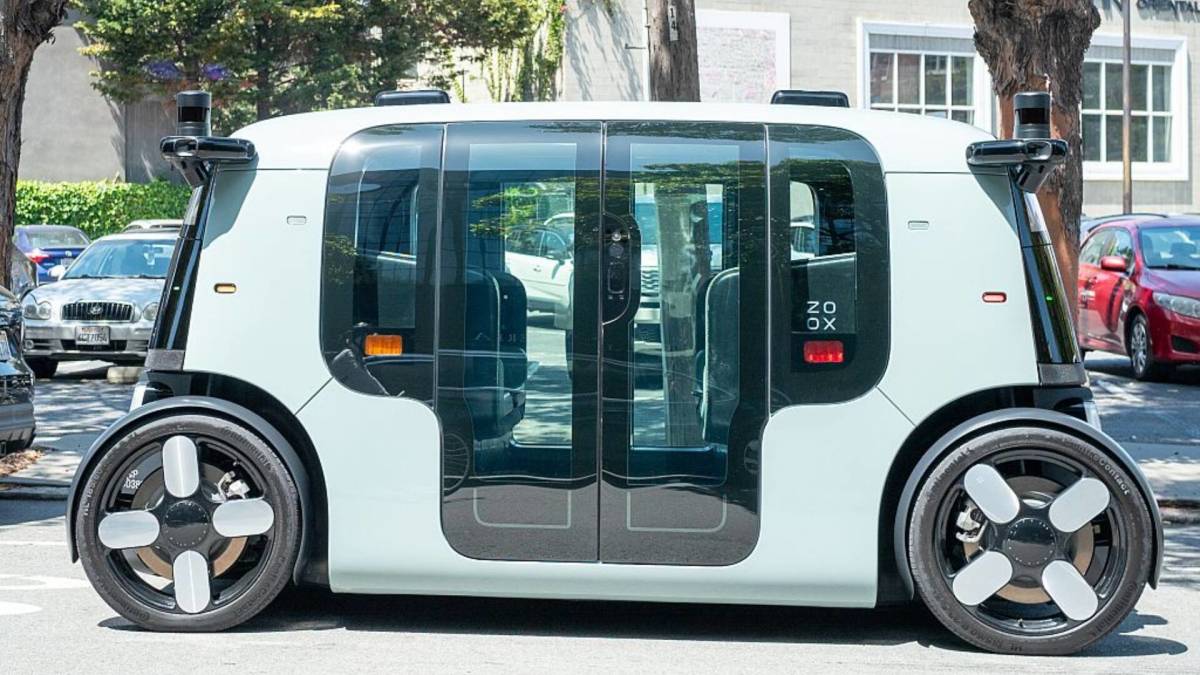 Amazon’s autonomous rideshare company is setting its sights on Tesla’s Robotaxi.
Image source: Smith Collection/Gado/Getty Images
Amazon’s robotaxi service just made a major move
While the concept of a robotaxi has sounded like a Tesla-exclusive thing to those who don’t dig deeply into the news around autonomous vehicles, it’s anything but.
Alphabet (GOOGL) -owned Waymo, originally known as the Self-Driving Car Project when it was first founded in 2009, has since expanded to San Francisco, Austin, Los Angeles, and Phoenix, with Atlanta being added this summer.
Now Amazon is joining the party in a major way.
Zoox, Amazon’s autonomous rideshare company, has just opened a massive new robotaxi production facility in Hayward, California.
Related: Driverless taxi company and Uber share huge expansion plans
At 220,000 square feet, the new production facility can make more than 10,000 vehicles a year. Zoox has said it will also create hundreds of jobs for people in the San Francisco Bay Area.
Founded in 2014, Zoox started testing its vehicles by July 2018, running them through notoriously challenging areas to navigate, such as San Francisco’s Financial and North Beach Districts, as well as Las Vegas.
Zoox’s efforts were of such concern to Musk, in fact, that Tesla filed a lawsuit against the autonomous driving company the following year, alleging that Zoox was using proprietary Tesla information and trade secrets.
Musk actually had a fair argument for this, as several ex-Tesla employees went to work for Zoox. The suit was settled in April 2020 after Zoox admitted that the ex-Tesla employees “were in possession of Tesla documents pertaining to shipping, receiving, and warehouse procedures when they joined Zoox’s logistics team.”
Zoox plans a full commercial launch later this year in the same two cities where it’s done testing, which it has documented in great detail on its official website.
An autonomous vehicle standoff
While’s Musk’s Robotaxi launch seems as if it’s off to a great start, the technology’s number one most vocal supporter is the most behind in the race. He originally promised his self-driving vehicles would be on the road by 2020.
Waymo is currently the clear leader in the space, with 10 million trips completed as of May 2020 and plans to test in New York City next. Zoox has made it clear it’s about to aggressively enter the competition, however.
And although Zoox is also getting a later start, the new facility is preparing to deploy on a large scale. This means it still needs time to catch up, but will bring what looks like a very solid entry to the table.
In the meantime, Tesla’s Robotaxi is only operating in Austin in a geofenced area of the city and is not yet available to the general public. If Musk wants to catch up with competitors and recover Tesla’s reputation while he’s at it, he needs to make some moves — and fast.
Related: Tesla’s robotaxi finally launches, but there’s a twist