
Amazon (AMZN) has officially passed Walmart (WMT) to become the largest company in the world by annual sales. It is a milestone that would have seemed far-fetched not long ago, and one that tells a complicated story about what “biggest” really means in retail today.
Amazon posted $716.9 billion in revenue for fiscal year 2025. Walmart, whose fiscal year ends Jan. 31, reported $713.2 billion in sales for fiscal year 2026. On paper, it looks like a clean crown change. In practice, it is anything but.
The headline number is real. But understanding what is actually driving Amazon’s lead, and where Walmart is quietly closing the gap, reveals a far more nuanced fight for retail dominance.
AWS is doing a lot of heavy lifting in Amazon’s revenue lead
Strip out Amazon Web Services, and the story looks very different. AWS generated $35.6 billion in sales in Q4 2025 alone, up 24% year over year, its fastest growth rate in 13 quarters. For the full year, the cloud division’s annualized run rate hit $142 billion, accounting for roughly 20% of Amazon’s total revenue.
That cloud business carries operating margins that dwarf anything in traditional retail. Without it, Amazon’s e-commerce and international segments would still trail Walmart in raw goods sold. The comparison is less apples-to-apples and more apples-to-data-centers.
What Amazon’s Q4 revenue actually breaks down to:
- North America (retail + services): $127.1 billion, up 10% year over year
- International: $50.7 billion, up 17% year over year
- AWS (cloud computing): $35.6 billion, up 24% year over year
- Advertising: $21.3 billion, up 23% year over year
Walmart, by contrast, generates virtually all its revenue from selling physical and digital goods. When you compare North America segments directly, Walmart’s U.S. business alone outpaces Amazon’s North America retail segment. In the category that matters most to everyday consumers, Walmart is still the undisputed king.
Walmart takes fight directly to Amazon online
Walmart has not stood still while Amazon climbed past it on the revenue chart. The Bentonville giant has spent years and billions of dollars transforming its digital operation, and the results reported Thursday morning were hard to ignore.
More Walmart
- Walmart surprises shoppers with bold new restaurant offering
- Walmart CEO pay gap widens with workers
- Walmart borrows a strategy Target has used for decades
U.S. e-commerce sales rose 27% in Walmart’s fiscal fourth quarter. Global e-commerce grew 24% in the same period. E-commerce now accounts for 23% of U.S. sales, a record high for the company and its eighth consecutive quarter of e-commerce growth above 20%.
Walmart’s digital push by the numbers:
- Walmart Connect advertising:grew 41% year over year in the U.S., with full-year ad revenue hitting $6.4 billion
- Membership income:exceeded $4.3 billion for the full year, with Walmart+ fee revenue up double digits, per the earnings call
- Store-fulfilled delivery:surged approximately 50% in the quarter, a key edge over Amazon’s warehouse model
- Advertising and membership:growing contributions to overall profit, with the company calling them a key part of its diversified profit mix going forward
Walmart’s strategy mirrors Amazon’s playbook. Build an ecosystem of third-party sellers, layer advertising on top, and use its store network as a fulfillment advantage no pure e-commerce player can match. Curbside pickup, same-day delivery from stores, and Walmart+ memberships are all pulling in that direction.
Groceries are where the real battle is playing out
Forget cloud computing and ad revenue for a moment. The fight that actually determines who wins the next decade of retail is happening in the grocery aisle, and Walmart is still comfortably ahead.
Walmart’s network of more than 4,600 U.S. stores gives it a pricing and logistics edge in fresh and perishable goods that Amazon has struggled to replicate at scale. Amazon has made inroads. CEO Andy Jassy said Amazon delivered more than 8 billion items same- or next-day in 2025, a 30%-plus jump from 2024, with groceries and everyday essentials making up half of that total.
Still, Walmart’s store-as-warehouse model means it can fulfill online grocery orders in ways that a warehouse-dependent competitor simply cannot. For millions of customers who want fresh produce delivered within hours, that physical footprint remains a structural advantage that is very hard to replicate.
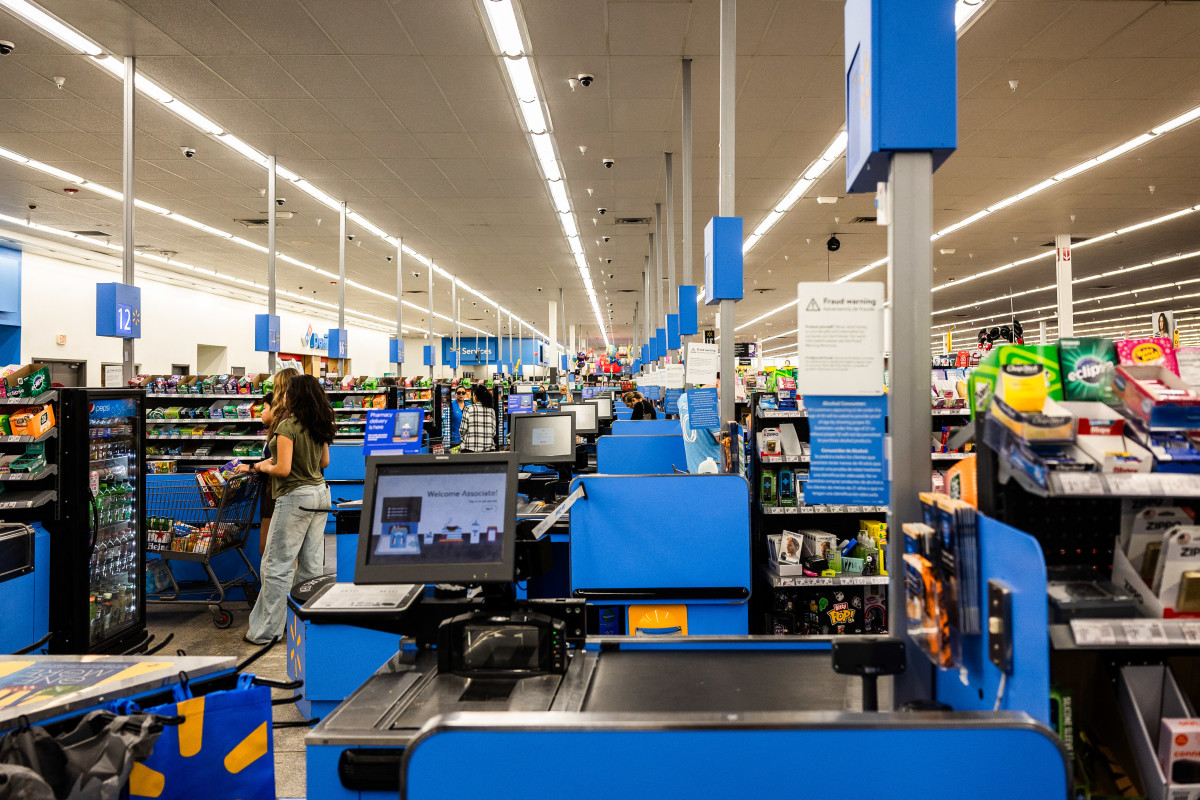
Photo by JC MILHET on Getty Images
What the revenue milestone actually means
Amazon’s overtaking of Walmart is less about retail supremacy and more about the enduring power of diversification. AWS alone contributes profit margins that no traditional retailer can match. Walmart counters with steadier cash generation, a consumer trust built over decades, and an omnichannel model that is only getting sharper.
The two companies have become fundamentally different businesses that happen to compete in the same consumer space. Amazon blends product sales with high-margin cloud services, digital advertising, and logistics technology. Walmart sells things, and it does that better than almost anyone else on earth, increasingly in the digital world as well as the physical one.
Amazon holds the revenue title. But Walmart, with e-commerce growing 27% in the U.S. and advertising and membership becoming an increasingly significant share of its profit mix, is making clear the race is nowhere near over.
Related: Walmart and Sam’s Club turn to robots to cut costs, lower prices