
Autonomous vehicle company Zoox has been working behind the scenes for the last decade on a vehicle that immediately stands out on the road.
While rivals like Tesla’s Robotaxi and Alphabet’s Waymo garner most of the headlines, Zoox doesn’t get much press, but once you see one, it’s hard to forget it.
There’s a reason the rectangular glass-paneled Zoox robotaxi looks so weird. Besides the vehicles’ lack of steering wheels, perhaps the most interesting Zoox feature is its two-engine design.
In July, Zoox cut the ribbon on a new serial production facility for purpose-built U.S. robotaxis in Hayward, California, near Silicon Valley.
Morgan Stanley analyst Bran Nowak, who has seen the facility, says “Zoox’s Hayward, the CA facility, is 220,000 square feet (~3.5 American football fields) and, at full scale, has the capacity to assemble more than 10,000 robotaxis per year.”
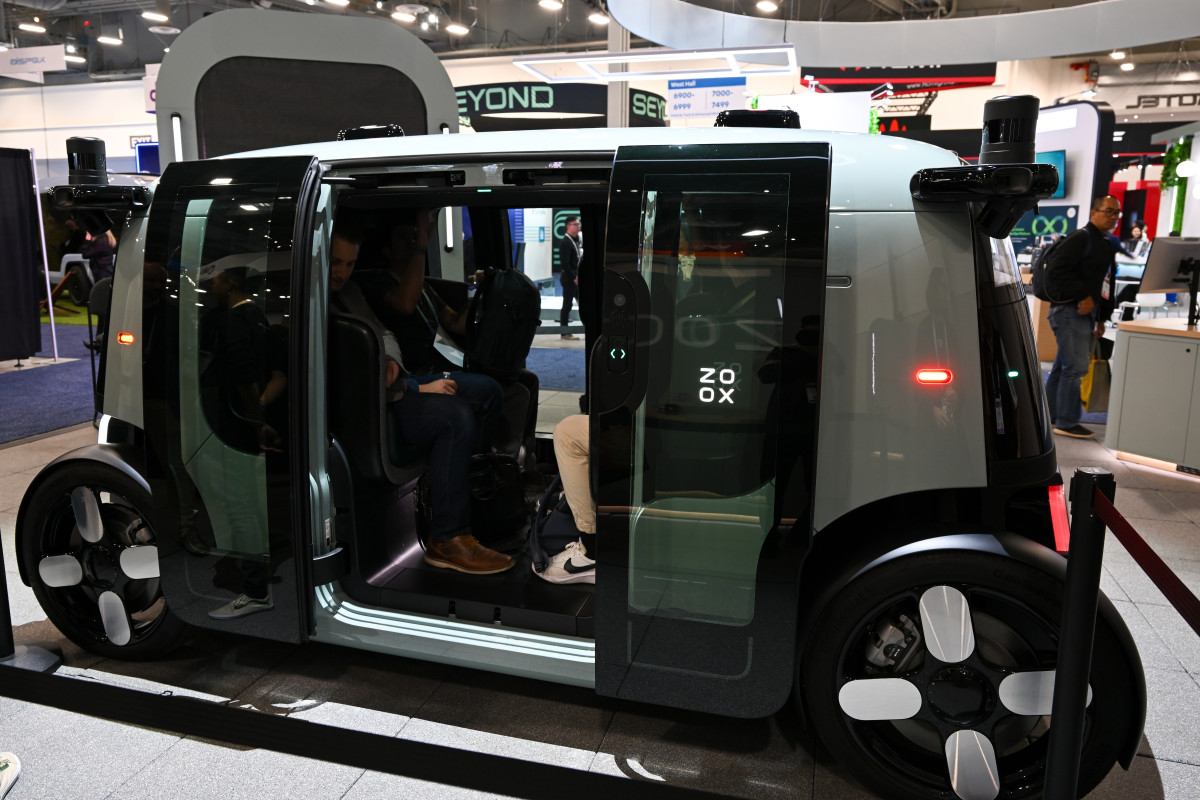
Photo by Anadolu on Getty Images
Zoox expands to San Francisco, offers free rides for early users
Amazon acquired Zoox in 2020.
Zoox calls its vehicles bidirectional, meaning there is no forward or reverse, because both directions are forward. The two motors at different ends of the car allow it to drive forward in two directions.
Related: Las Vegas Strip bets on free service to ease a frustrating problem
On Nov. 18, Zoox officially launched its Zoox Explorers early rider program in San Francisco, allowing people to ride for free to gather feedback for a wider launch.
“Zoox has been testing our autonomous technology in San Francisco since 2017,” said Aicha Evans, CEO. “It’s our home. A city of innovation and progress, with an amazing mobility ecosystem that we feel Zoox can really complement. We have seen incredible interest in Zoox in this market and are excited about this first step to bring our purpose-built robotaxi experience to more people.”
Zoox will pick up and drop riders off near their destinations within its service area, which Evans said “includes the majority of SoMa, Mission, and Design District neighborhoods.” The rides are all supervised by a human safety monitor.
This is the second city to which Zoox has expanded in recent months. If you’ve been to Las Vegas since September, you’ve probably seen the shuttles on The Strip.
Riders who want a free trip will need to download the Zoox app and join a waitlist. They will receive an update once it’s their turn.
San Francisco robotaxi field is getting crowded
Zoox is entering an already crowded field in San Francisco, but it is hoping it has the technology to set it apart.
Unlike Tesla, which has said it doesn’t use the technology because it’s too expensive, both Waymo and Zoox employ light detection and ranging (LiDAR) to navigate traffic autonomously.
Speaking of Tesla, the company officially launched its Robotaxi service in San Francisco on July 31.
Related: Amazon sends a bold message Tesla fans need to hear
San Franciscans can hail Tesla Robotaxis through the app. Just like the service in Austin, there is a human “safety monitor” in the driver’s seat making sure everything is working properly.
Waymo also operates in the city. In September, the company received permission to operate commercially at San Francisco International Airport and San Jose Mineta International Airport. Before that, it revealed it would begin testing Denver and Seattle for expansion.
Of the three autonomous driving companies, Waymo has the most passenger miles on the road.
Waymo quick facts:
- Founded in 2009.
- Passed first U.S. state self-driving test in Las Vegas in 2012. Source: IEEE Spectrum
- Spun out from Alphabet as a separate subsidiary in 2016.
- As of July 2025, Waymo One is available 24/7 to customers in Los Angeles, Phoenix, and the San Francisco Bay Area.
- The current Waymo fleet features over 1,500 vehicles. By 2026, the company expects to add 2,000 more.
- Surpassed 100 million miles of autonomous driving in July 2025.
- Waymo plans to launch in Miami, Dallas, and Washington in 2026 and recently announced expansion plans for London.
Related: Waymo shows the secret to avoiding traffic tickets in funny video