
American civilians have been lucky when it comes to war.
A major battle hasn’t reached U.S. mainland shores in more than a century. While there were southern border skirmishes with Pancho Villa at the Battle of Ambos Nogales during World War I, there hasn’t been all-out war on U.S. mainland soil since the Civil War.
But while the devastation of the latest war is again occurring on foreign soil, Americans are paying at the pump as the latest barrage of missiles hits the biggest oil producers in the world.
The U.S. and Israel launched strikes against Iran over the weekend, and Iran retaliated with its own strikes.
At first, the stated U.S. rationale for the attack was to stop Iran’s nuclear ambitions. However, many pointed out that the Trump administration said last year that the U.S. and Israel had already “obliterated” Iran’s nuclear capacity.
Israeli officials at the time did not agree with the “obliterated” adjective, but the Israel Atomic Energy Commission and IDF Chief of Staff Lt. Gen. Eyal Zamir both agreed that the attacks set Iran’s nuclear ambitions “back by years, I repeat, years.”
Well, just seven months later, they are back bombing Iran, but this time the objective is less clear and has constantly shifted, The Washington Post reported.
Iran’s retaliatory attacks on the Gulf states and its closure of the Strait of Hormuz sent gas prices soaring on Tuesday, March 3.
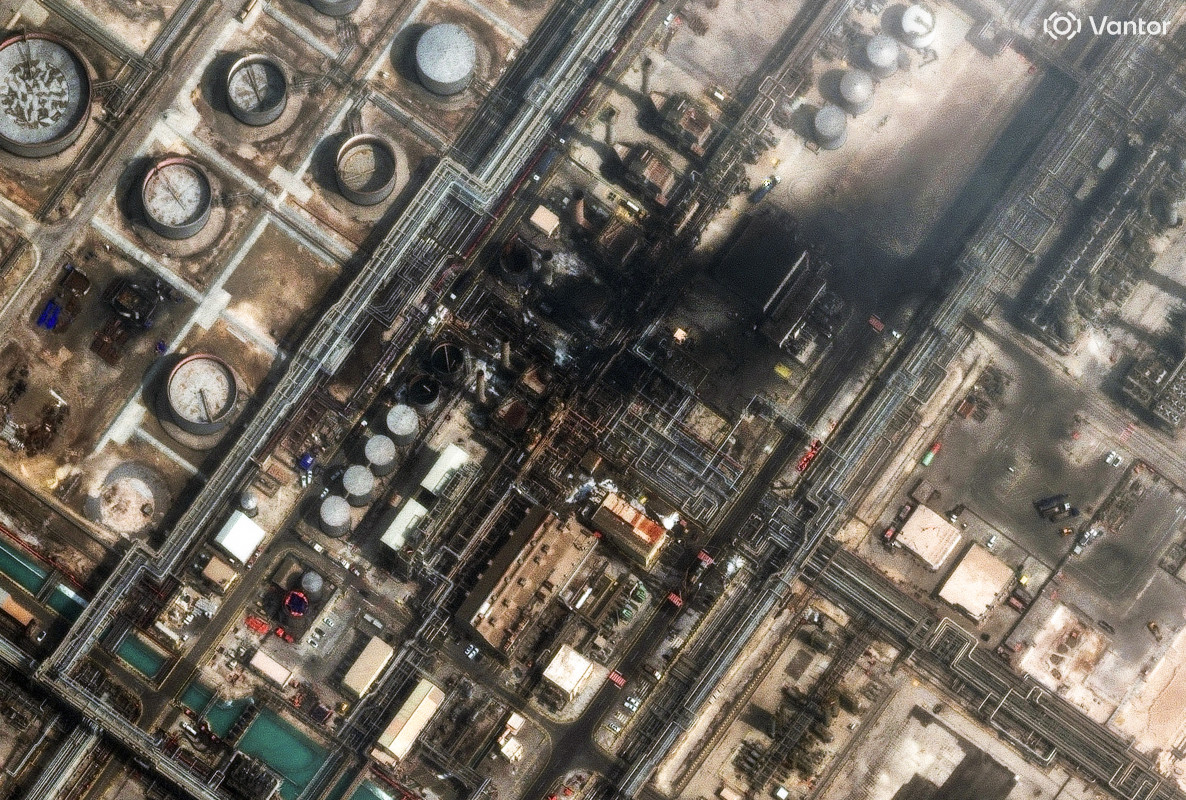 Ras Tanura Refinery in Saudi Arabia was badly damaged by Iranian drone and missile strikes.
Photo by Maxar on Getty Images
Gas prices rise in the largest one-day increase since 2005
If you were smart enough to get your gas on Monday, March 2, you saved a lot of money because the price of a gallon of petrol jumped 11 cents overnight, rising to $3.11 per gallon on average, per AAA and as reported by the Associated Press.
This represents the largest one-day increase since Hurricane Katrina in 2005.
Related: What happens to oil prices if bombs and bullets fly in Iran
Crude oil futures trading on the COMEX were up 8.1% Tuesday to $77 a barrel. Over the past five days, the average price for a barrel of crude was $68.57. Over the past month, it was $65.12, and over the past three months, the average cost of a barrel of crude oil was steady at $61.
Iranian oil is already heavily sanctioned by the U.S, and as of this year, China buys more than 80% of the estimated 1.9 million barrels of crude Iran ships out daily, Reuters reported.
So the spike in price isn’t from the attacks on Iran; rather, it stems from Iran’s response to the attacks. Iran has targeted the oil infrastructure of the Gulf states that house U.S. military bases, where up to 40,000 troops are stationed in the region, according to NPR.
Iran has sent drones and bombs to oil refineries in the United Arab Emirates, Qatar, and Saudi Arabia.
But perhaps the biggest factor pushing prices up Tuesday is Iran’s closure of the Strait of Hormuz, through which more than 20% of global oil travels.
That has some fearing oil prices could surge to $100 a barrel, though Wall Street analysts are a bit more conservative in their doomsday scenarios.
Wall Street estimates Iran war oil price increase
The last time the Brent crude oil price hit $100 was in 2011, when speculators thought the “Arab Spring” in Egypt could lead to the closure of the Suez Canal.
While no one knows how long the current conflict will last, Saul Kavonic, head of energy research at MST Marquee, recently weighed in.
Related: J.P. Morgan revamps oil prices target for the rest of 2026
“If the status quo is maintained, where the majority of volumes from the Strait of Hormuz remain unable to flow, then prices are very low compared to the impact that will have on supply, demand of the market,” Kavonic told CNBC.
Every week this conflict continues, about 100 million barrels of crude won’t reach the market, he added. That type of change will inevitably lead to triple-digit prices.
However, analysts at Citi have a less alarming estimate.
Citi expects Brent crude to trade between $80 and $90 over this coming week and will pull back to $70 if the situation is de-escalated.
Meanwhile, analysts at Goldman Sachs are pricing in an $18 per barrel “real-time risk premium” on crude prices, according to a note on Sunday, March 1. That premium could come down to $4 a barrel if only 50% of flows through the Strait of Hormuz are halted for a month.
“The disruption creates a dual supply shock: Not only are current exports through the Strait halted, but OPEC+ additional volumes and ultimately most of OPEC’s spare capacity — typically a key lever for balancing the global oil market — are inaccessible while the waterway remains closed,” WoodMac analysts said in a note, according to Reuters.