
Ford’s (F) electric vehicle ambitions haven’t paid off for the carmaker so far, but analysts at Jefferies see the company as the U.S. carmaker best equipped to handle the changing landscape over rival General Motors.
Jefferies formed this conclusion despite Ford saying it expects to lose more than $5 billion on Mode e, its electric vehicle division, this year.
Largest Regional BEV sales 2024 (according to IEA):
- China: 6.4 million
- Europe: 2.2 million
- U.S.: 1.2 million
- Rest of the world: 1 million
For the U.S., battery electric vehicle (BEV) sales are traveling in the right lane, while China and Europe are in the passing lane.
That’s not to say U.S. consumers aren’t putting their foot on the gas.
According to J.D. Power, electric vehicles are on pace to exceed 12% market share in the U.S. for the first time, following a 2.6% year-over-year increase.
But thanks to both private and government investment, China and Europe have the underlying infrastructure (e.g., charging stations) to support market shares that dwarf the U.S.
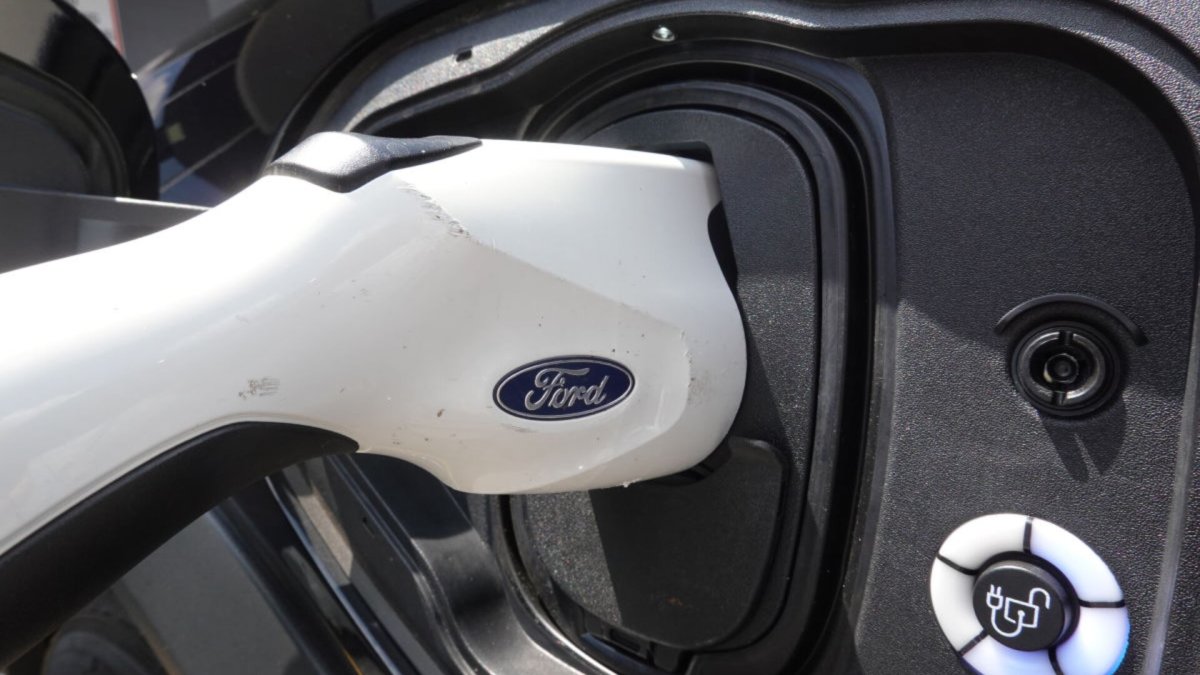 Ford’s electric vehicle division is expected to lose billions this year.
Image source: Olson/Getty Images
Jefferies analyst upgrades Ford on EV division, raises price target
Jeffferies analysts recently upgraded Ford to hold from underperform because the company has more flexibility than GM to handle changes in carbon dioxide regulations and potential tariff increases.
The firm raised its price target on Ford to $12 from $9 per share. Ford shares were trading at $12.64 per share at last check on the afternoon of Oct. 6.
Ford has already outlined a multibillion-dollar strategy that could result from the relaxed emissions rules President Donald Trump has hinted at enacting.
Related: Ford takes Tesla EV battle to the NFL
That strategy includes a slower electric rollout and a greater focus on hybrids. Looser emission standards could also lift sales for Ford’s traditional internal combustion engine vehicles.
Since it already has a plan for two regulatory realities, Jefferies analysts say it is better prepared for any potential changes.
Those changes are already happening.
2025 has been an inflection point for U.S. EV sales, driven by a third-quarter jump that has coincided with the expiration of a $7,500 tax credit on September 30.
BEV sales are rising, but HEV remains more popular
To help push manufacturers and consumers, European Union officials have targeted climate neutrality (net-zero greenhouse gas emissions) by 2050, with an interim target to reduce net greenhouse gases by 66.2% and 72.5% by 2030, compared to 1990.
According to data from the European auto lobby ACEA, battery electric vehicles (BEV) accounted for nearly 16% of the EU market share through August, an increase from 12.6% a year ago.
Hybrid-electric vehicle (HEV) registrations jumped to 34.7% of the market, and plug-in hybrids (PHEV) were 8.8%. Combined, EVs accounted for over half of all vehicle sales in the EU.
Combined, gas and diesel car market share fell to 37.5% in August from 47.6% a year ago.
Here in the U.S., dealers sold 1.6 million HEVs, compared to 1.2 million BEVs.
However, unlike in Europe, the U.S. government is expected to lower emission standards and provide less financial support for EV consumers.
“The federal tax credit was a key catalyst for EV adoption, and its expiration marks a pivotal moment,” said Stephanie Valdez Streaty, director of Industry Insights at Cox Automotive. “This shift will test whether the electric vehicle market is mature enough to thrive on its own fundamentals or still needs support to expand further.”