
Among the most common excuses people use to justify not working out and taking care of their physical well-being is not having enough time. I’ve been there!
Although the pace of modern life makes maintaining that balance quite challenging, those who truly want it find a way, while those who don’t want it enough find an excuse.
The 24-year-old gym giant Anytime Fitness was built trying to limit those excuses as much as possible through its 24-hour availability and accessibility in multiple countries. In February 2026, the “Let’s Make Healthy Happen” chain announced that it had opened more than 365 gyms worldwide during 2025.
Anytime Fitness now boasts more than 6,000 locations worldwide and is promoting international expansion. At the same time, its U.S. franchised location count has reportedly declined for three consecutive years.
For members at some local clubs, that decline is no longer just a number.
Anytime Fitness has been closing gyms over the past couple of years
According to the 2026 Franchise Disclosure Document (FDD), its franchised U.S. location count fell from 2,318 to 2,271 between the start of 2023 and the end of 2025. That’s a net decline of 47 locations in three years.
Moreover, during those three years, Anytime Fitness added 146 franchised U.S. locations, while 193 left the franchise system through terminations, non-renewals, and other departures.
The data suggests that, despite ongoing consumer demand as supported by latest industry data from Health and Fitness Association (HFA), the brand’s global success doesn’t necessarily mean every individual location is doing well.
“A multi-brand parent can spread risk, but an individual franchisee doesn’t have that luxury. They own a gym, and that gym has to make money,” franchise attorney Beverly Bradshaw recently told Inc. Magazine.
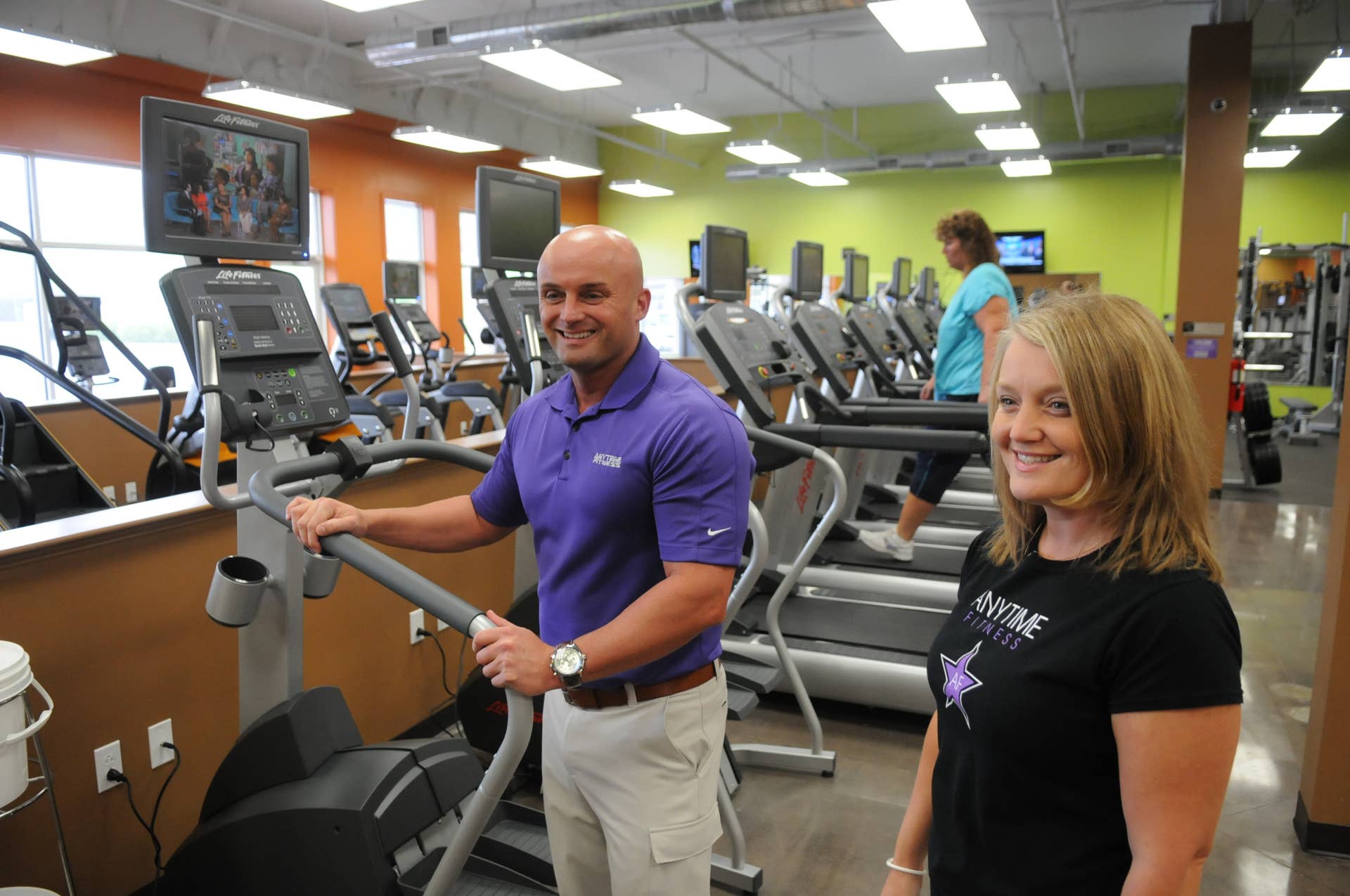 Anytime Fitness has been closing gyms across U.S. over the past couple of years, while expanding globally.
MediaNews Group/Reading Eagle via Getty Images / Getty Images
These Anytime Fitness locations are closing or have already closed in 2026
Some of the latest closures are already visible at the local level. According to Inc.’s Nov. 2, 2026, report, three locations are closing, one has already closed, and one is relocating.
Anytime Fitness didn’t immediately respond to Inc.’s request for comment.
2026 Anytime Fitness closures and relocations
- Closed (April 2026): 1726 S. Division Street, Guthrie, OK
- Closing: 1064 Cypress Parkway, Poinciana, FL
- Closing: 1862 S. West Avenue, Freeport, IL
- Closing: 1417 Coshocton Avenue, Mount Vernon, OH
- Relocating (tentative): From 9529 Braddock Road to 10621A Braddock Road, University Mall, Fairfax, VA
What Anytime Fitness customers should know if their gym closes
If your club is on this list, or you’re worried yours could be next, you may still have options. The chain allows members to access other Anytime Fitness locations nationwide and internationally, meaning customers may be able to continue working out at a nearby club.
Membership transfers are also permitted without a transfer fee, although changing the home gym could affect monthly dues. However, cancellation policies, contract terms, and potential termination fees vary by location because each club is independently owned and operated.
Customers who have prepaid for memberships should contact their home club to clarify whether they qualify for a refund or transfer. Anytime Fitness does not publish a universal refund policy specifically for gym closures, so members should review their membership agreements and request written confirmation of any changes to their payments or contracts.
Members can find more information in the company’s official membership FAQ.
Why are Anytime Fitness locations closing?
So why are franchisees leaving the system? Running an Anytime Fitness gym comes with substantial financial commitments.
According to the company’s 2026 FDD, franchisees face monthly royalty, advertising, and technology fees, in addition to rent, employee wages, utilities, and equipment expenses.
Commercial leases and financing obligations can make the situation even more challenging. Bradshaw also told Inc. that leaving the franchise does not necessarily mean leaving behind those financial commitments. Franchisees may still be responsible for leases, loans, and personal guarantees.
In addition, revenue varies significantly between individual locations. The 2026 FDD shows that the 1,683 franchised gyms included in its financial performance disclosure reported average annual revenue of $446,814, while the individual range was $90,337 to $2,048,737.
These figures represent revenue, not profit, and illustrate the differences in financial performance across the network.
U.S. gym membership is at a record high, but some Americans are cutting back
These closures are coming as the chain expands internationally. But the challenges facing individual franchisees are not necessarily unique to the chain, and broader industry figures suggest gym operators are navigating an increasingly complicated consumer market.
In 2025, about 81 million Americans belonged to a gym, studio, or other fitness facility, making it an all-time high and a 5.2% increase from 2024, according to HFA’s 2026 U.S. Health & Fitness Consumer Report.
“Even in an uncertain economy, people keep going to the gym because they see real value in what these spaces provide,” stated Anton Severin, vice president of research at HFA.
The report also revealed that Americans made nearly 7 billion visits to gyms, studios, and health clubs, and only 4.6% did not use their membership at all, which is considered an all-time low.
HFA found that 49.4% of gym members meet federal aerobic activity guidelines, compared with just 24.5% of Americans who don’t use fitness facilities, suggesting a link between gym membership and meeting activity guidelines.
However, YouGov’s September 2026 survey reveals another side of the story. Among Americans who do wellness activities, 31% are spending more and 13% are spending less.
Cost remains a concern, as 13% had reduced or stopped paying for gym memberships over the previous year, the same share who cut spending on fresh fruit and vegetables.
These findings suggest that while Americans continue to prioritize wellness, some are becoming more selective about what they spend on.
A 2026 survey found that 26.9% of sports and fitness participants said out-of-pocket costs had affected their participation, while 30.2% reported higher costs than a year earlier, according to the Sports & Fitness Industry Association (SFIA).
Among those affected by rising costs, nearly one-quarter said they were very unlikely to continue their current activities if expenses increased further.
“Rising costs are already affecting how some Americans participate, making affordability and access increasingly important as our industry works to turn today’s momentum into sustained engagement,” said Alex Kerman, senior director, head of research for SFIA.
Anytime Fitness is not the only gym chain facing closures
Other chains are feeling the pressure, too.
As I recently reported, Planet Fitness appears to have a new customer problem. The budget-friendly gym giant has faced slower membership growth and changing consumer expectations. It plans to close five locations across the country.
Other fitness chains have faced even bigger setbacks. Blink Fitness filed for Chapter 11 bankruptcy in August 2024, seeking a buyer after struggling with the financial fallout from the Covid pandemic.
PureGym eventually acquired its corporate operations and a significant number of locations for $121 million, but five gyms were permanently closed after negotiations with landlords fell through.
The pandemic also pushed 24 Hour Fitness and Gold’s Gym into Chapter 11 bankruptcy in 2020. Gold’s Gym said it had to permanently close approximately 30 company-owned locations as part of its restructuring.
