
Investors in the U.S. and abroad are having a debate with the U.S. president that they can’t hope to win.
President Donald Trump has long argued that the U.S. is being taken advantage of in international trade, evidenced by the trade imbalances between America and its trade partners.
Tariffs and a running trade war were staples of Trump’s first administration, and in his second term he wasted no time pursuing many of those same policies, much to investors’ chagrin.
Over the past few weeks markets have given away much of what they’ve gained over the past six months, with the S&P 500, Nasdaq and Dow Jones Industrial Average all trading at levels they haven’t seen since September.
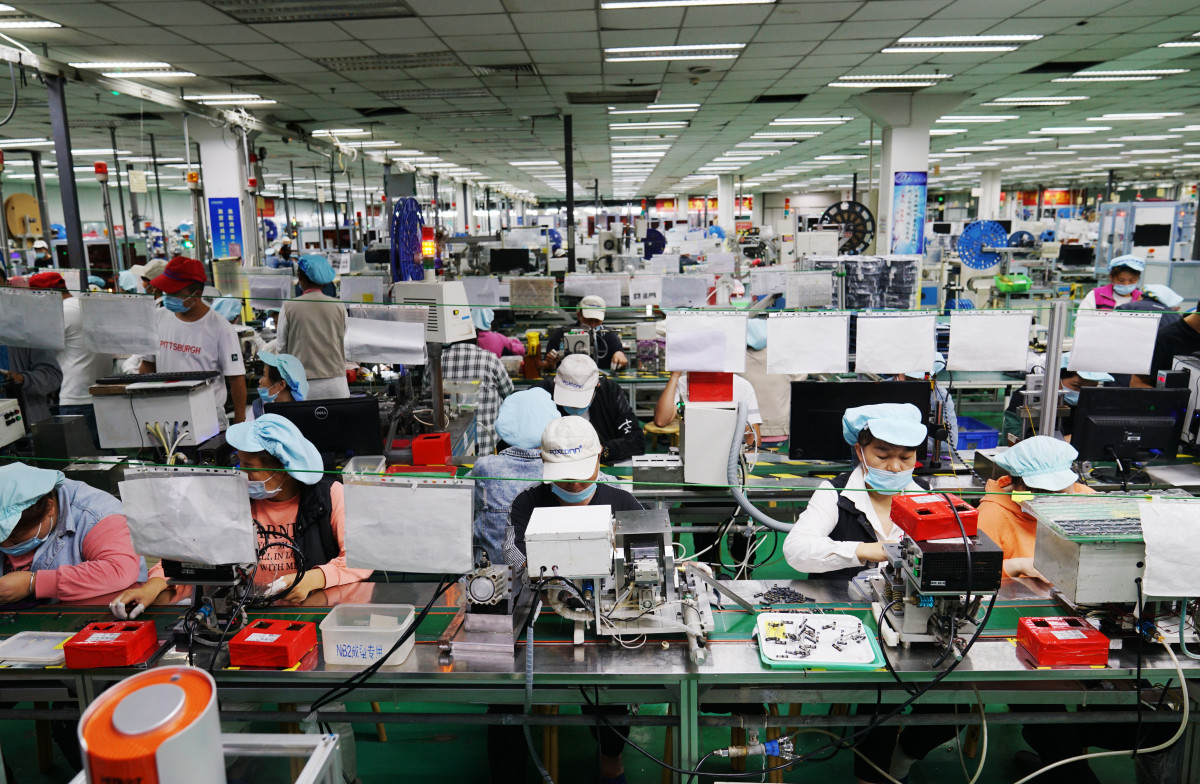 Employees work at a Foxconn factory in Zhengzhou, Henan Province, China on Sept. 4, 2021. Foxconn is a key partner in manufacturing Apple products.
Despite the investor dissatisfaction, and concern among consumers, Trump has said he is willing to endure some near-term pain to balance the U.S. trade deficit and bring jobs back to the U.S. (In a recent speech to Congress he said, “There’ll be a little disturbance. But we’re OK with that. It won’t be much.”)
Tech leader exposes flaws in Trump tariff logic
Earlier this month the administration said the U.S. gained 10,000 manufacturing jobs during Trump’s first full month in office, thanks in part to 8,900 new auto manufacturing positions coming online in February.
The idea is that the economic calculus for companies moving production overseas changes if it’s more expensive to do so. Investing in jobs and production domestically enables these companies to avoid paying tariffs while boosting the U.S. workforce.
More technology news
- Leading cognitive scientist sounds the alarm on new AI use
- OpenAI rival powers toward milestone with massive implications
- Two tech leaders engage in fierce chess match over hot AI startup
However, critics point out that Trump’s tariffs have prompted retaliatory tariffs from targeted countries, and the companies that pay them are likely to pass them through to consumers via higher retail prices, increasing inflation.
Critics also note that job numbers got a temporary boost of 5,000 in 2018 when Trump first started implementing tariffs though at least one study showed that the country ultimately lost as many as 75,000 jobs due to the move.
While a number of Silicon Valley executives have extended olive branches to the U.S. president during his second go-round in the Oval Office, in 2018 Apple (AAPL) Chief Executive Tim Cook had a very pointed outlook on Trump’s tariff policy.
“There’s a confusion about China. The popular conception is that companies come to China because of low labor costs. I’m not sure what part of China they go to, but the truth is, China stopped being a low-labor-cost country many years ago,” Cook said in a video circulating on social media.
“The reason (for moving jobs to China) is because of the skill. The quantity of skill in one location and the type of skill” Chinese workers possess, according to Cook.
Apple looks to China for skilled labor
While Cook’s comments might not be true for every sector, he insists that this skilled-talent imbalance is the case for large tech companies like Apple.
“The products [Apple makes] require really advanced tooling. The precision you have to have in tooling and working with the materials we do are state-of-the-art. And the tooling skill is very deep” in China, he said.
The bench for the U.S. roster isn’t nearly as deep, according to Cook.
“In the U.S., you could have a meeting of tooling engineers, and I’m not sure we could fill the room. In China, you could fill multiple football fields. Vocational expertise is very, very deep here,” he said.
I like @bungarsargon but this is incorrect.If it was just a matter of price, then maybe tariffs could work. Just bring those jobs home!Except China isn’t cheap labor anymore. They’re highly skilled. And skill doesn’t easily come home.Tim Cook explained this in 2018: https://t.co/LGcpBN1vXp pic.twitter.com/FzRbJGhS4A
— Balaji (@balajis) March 15, 2025
Related: Veteran fund manager unveils eye-popping S&P 500 forecast