
Apple rarely invents a market. It waits.
The company lets someone else take the risk, watches a category mature, then walks through the front door and takes the customers. By the time the incumbents understand what is happening, the fight is already over.
Look at what happened to the wristwatch.
When Apple shipped the first Apple Watch (AAPL) in 2015, a handful of mid-tier brands ran that business. Swatch Group (SWGAY) sold Tissot and Longines. Fossil Group (FOSL) made watches for Michael Kors and Armani. They felt untouchable.
A decade later, the math is brutal. Apple is now the largest watchmaker on earth by units. Swatch’s revenue is down roughly 28% from 2014, and Fossil’s sales have fallen about 70%, according to Bloomberg. The Apple Watch alone now brings in an estimated $17 billion a year.
When I line those numbers up, the pattern is impossible to miss. Apple does not enter markets. It absorbs them.
Now it is aiming that same playbook at something sitting on your face. Apple is building smart glasses meant to swallow a $200 billion eyewear market, Bloomberg’s Mark Gurman reported.
Why the Apple Watch playbook matters here
The playbook is simple, and it works. Apple skips the rough first version of a product, waits until the technology is good enough and cheap enough, then ships something that feels obvious in hindsight.
It did this with the MP3 player, the smartphone, the tablet, and the smartwatch. Each time, it let rivals prove a market existed, then took the most profitable slice.
More Tech Stocks:
- Morgan Stanley sets jaw-dropping Micron price target after event
- Nvidia’s China chip problem isn’t what most investors think
- Quantum Computing makes $110 million move nobody saw coming
Eyewear is a tempting next target. About 2.2 billion people worldwide have some form of vision impairment, Bloomberg noted, and most of them treat frames as a fashion choice, not a medical purchase.
That market is large and slow. The global eyewear business was worth roughly $200 billion in 2024, according to Grand View Research, and it is still ruled by a few legacy brands and one giant supplier, EssilorLuxottica (ESLOY), that owns Ray-Ban and quietly sets frame prices.
Apple wants the zone where glasses cost between $200 and $500, Bloomberg confirmed. That is the same mid-tier territory it raided in watches, where it later passed Rolex as the top brand by revenue.
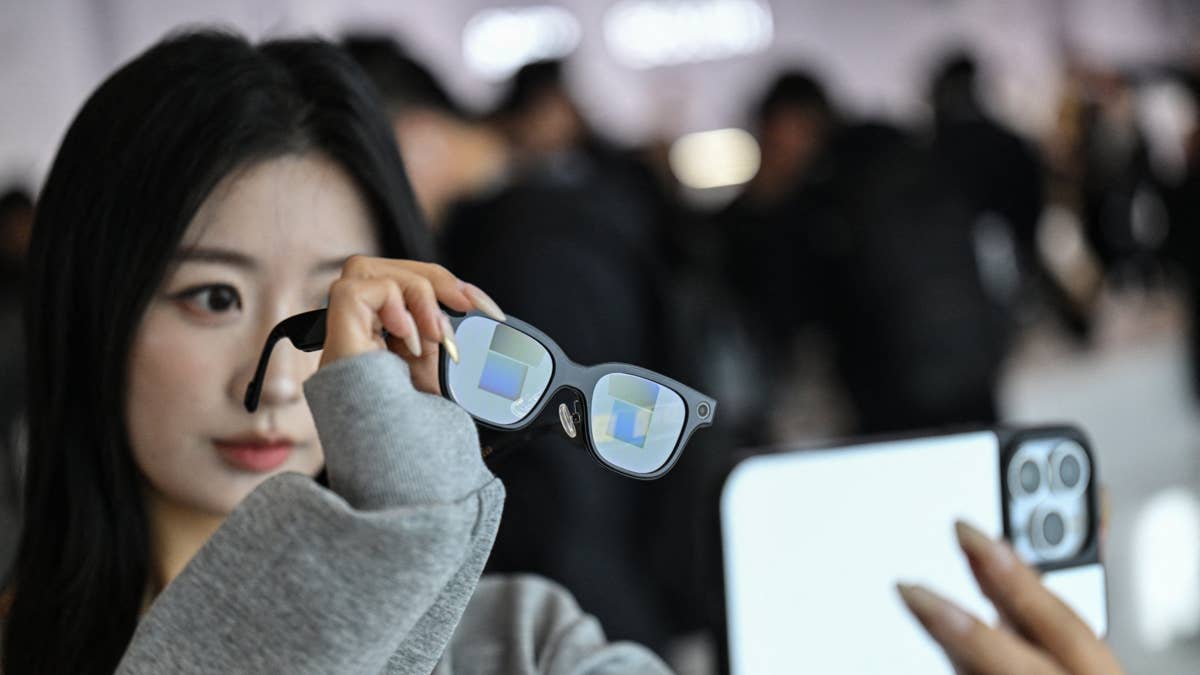 Apple is building smart glasses aimed squarely at the $200 billion eyewear market.
Retamal/AFP via Getty Images
Inside Apple’s delayed smart glasses plan
Here is the news. Apple’s first glasses, codenamed N50, were supposed to be revealed by late 2026 and ship in early 2027. That timeline has slipped to a launch at the end of 2027, according to Bloomberg.
The reason for the delay is software, not hardware. Apple’s revamped Siri is on track, but the visual artificial intelligence (AI) features that make smart glasses worth wearing are proving harder to finish.
Related: Apple’s next AI test may not be Siri
The first version will be modest. It will carry cameras for photos and video, speakers and microphones for calls and music, Siri notifications, and possibly turn-by-turn walking directions. What it will not have is an in-lens display, the augmented reality trick Meta (META) just added to its newest Ray-Bans.
Bloomberg reports that Apple believes its entry will “fundamentally alter how consumers think about buying glasses.”
My read on that timeline is less flattering. Apple is not early here. It is late, and it knows it.
The numbers behind the eyewear fight
The hard part is that Meta got there first, and the gap is wide.
The fight, by the numbers:
- Global eyewear market value in 2024: About $200 billion, Grand View Research noted.
- Apple Watch annual revenue: Roughly $17 billion, Bloomberg reported.
- Meta’s smart-glasses market share in late 2025: About 82%, according to Counterpoint Research.
- Apple glasses target price: $200 to $500, Bloomberg confirmed.
- Apple glasses launch target: Late 2027, according to Bloomberg.
Meta has spent years building Ray-Ban smart glasses, signing retail deals with optical chains, and stacking on AI features while Apple sat on the sidelines. It also runs on Android, which is far larger than the iPhone globally.
Apple’s long refusal to support Android hands Meta a side of the market it may keep for good.
What the new smart glasses mean for your Apple investment and your face
If you own Apple stock, this is a slow burn, not a 2026 catalyst. The glasses will not move revenue for at least two years.
Wall Street is watching anyway. Veteran analyst Dan Ives at Wedbush lifted his Apple price target to $400, the most bullish call on the Street, betting that new hardware and AI services keep the machine running, TheStreet highlighted.
If you wear glasses, the stakes are more personal. Frame prices have stayed high for years because one company controls so much of the supply. A real Apple challenger could finally loosen that grip, the way the Apple Watch reset what people expect to pay for a wristwatch.
That is the actual prize. Not another gadget, but the $200 billion habit of buying frames.
What to watch next
The first test arrives September 1, when Tim Cook hands the top job to John Ternus, a hardware engineer who has spent his career shipping Apple devices.
Ternus inherits the glasses as the first signature product of his run. Whether Apple ships on time, and whether late still beats Meta, will define his early years.
For now, the smart move is to watch the calendar, not the hype.
Related: AI-enabled smart glasses allow you to be productive literally anywhere