
The AI spending scare has hammered Amazon (AMZN) stock, pushing it into the penalty box, but Bank of America analysts have a different perspective.
The bank reaffirmed its Buy rating on the stock and reset its price target to $275, implying nearly $64.36 in upside from Amazon’s current $210.64 share price (a 30.6% potential gain).
Essentially, BofA’s making the argument that Mr.Market, in many ways, is stuck in the wrong debate.
Over the past few weeks, investors have obsessed over Amazon’s colossal AI capex numbers and whether the returns can ever catch up.
Contrary to popular belief, BofA argues that, in today’s AI-powered economy, infrastructure capacity is clearly monetizable. So when compute demand continues to outstrip supply, every incremental buildout is essentially a forward revenue indicator.
That’s perhaps why Billionaire Ken Griffin’s Citadel added nearly $2.52 billion worth of Amazon stock, taking its total position to over $3.2 billion, as per its latest 13F filing.
Hence, if capacity additions continue translating into sales, the consensus numbers might be too low, and the market may be underestimating Amazon’s incredible earnings power.
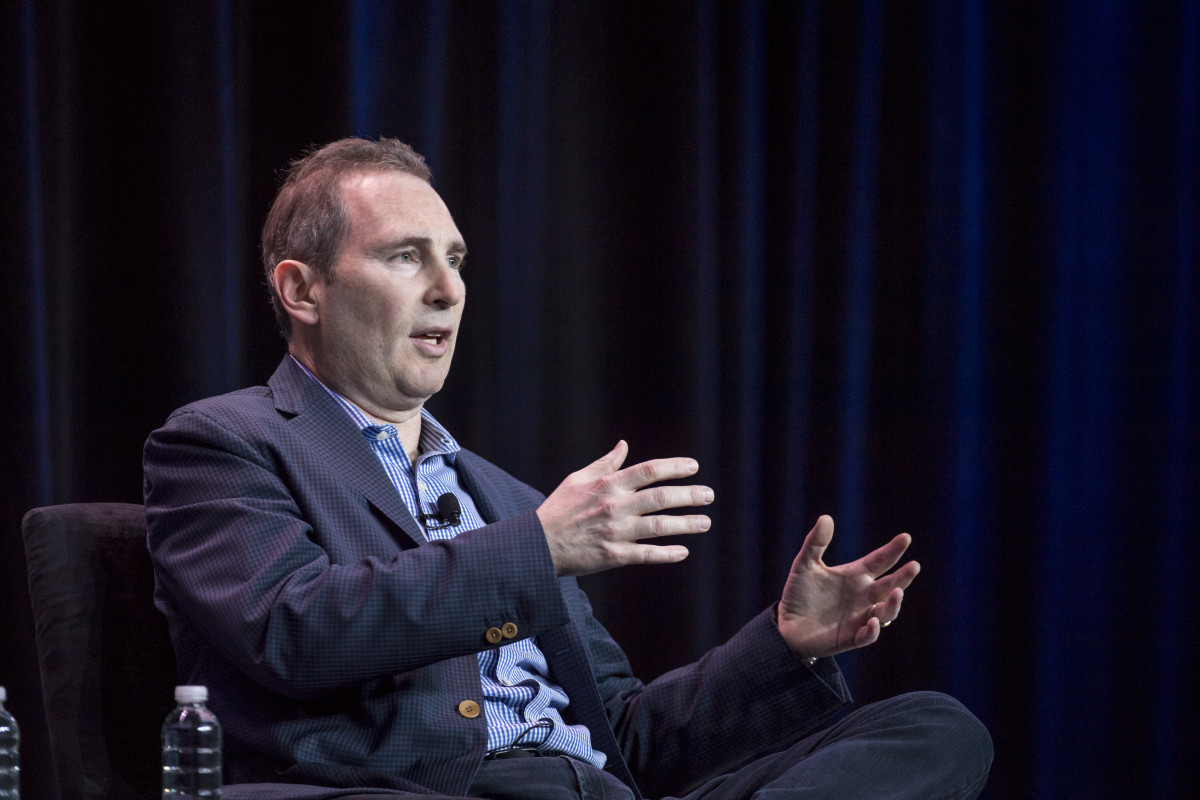 Bank of America raises Amazon price target, sees stronger upside tied to AI infrastructure buildout.
Photo by Bloomberg on Getty Images
Wall Street’s latest Amazon stock price targets
- Citi (Buy): $320 price target; +51.9% upside from $210.64.
- Wells Fargo (Overweight): $304 price target; +44.3% upside.
- UBS: $301 price target; +42.9% upside.
- Goldman Sachs (Buy): $280 price target; +32.9% upside.
- JPMorgan (Overweight): $265 price target; +25.8% upside. Sources: Tipranks, Investing.
AWS math forces the Street to rethink Amazon
In AI infrastructure, more power means more revenue.
More AI Stocks:
- Morgan Stanley sets jaw-dropping Micron price target after event
- Bank of America updates Palantir stock forecast after private meeting
- Morgan Stanley drops eye-popping Broadcom price target
That’s exactly why BofA is bullish on Amazon, particularly its cloud services, which doubled their power capacity from 2022 to Q3 2025 (from nearly 8.0 gigawatts to almost 15 GW).
Last year alone, AWS added a mighty impressive 3.9 GW, including 1.2 GW in Q4. That incredible momentum is expected to continue through 2027, with Amazon’s management looking to double capacity again by 2027.
BofA models AWS jumping to nearly 31.4 GW by 2027, which points to additions of a tremendous +6.4 GW in 2026 and +8.3 GW in 2027, or almost 15 GW of incremental capacity over the next couple of years.
In terms of dollars, in 2025, AWS generated $21.2 billion in incremental sales with 3.9 GW of additions. That equates to nearly $5.4 billion of sales per GW.
If everything holds steady, AWS sales may reach $35 billion in 2026 and $45 billion in 2027, compared with Wall Street estimates of $32 billion and $38 billion, respectively. That points to total AWS sales of $163.7 billion in 2026 and $208.8 billion in 2027, above the market’s consensus.
Big spending, bigger expectations for AWS
The obvious thorn in Amazon’s proverbial side is its gigantic capex figure.
For perspective, its management had guided to $200 billion in total capital expenditures for 2026, a whopping $52 billion above Mr. Market’s $148 billion expectations.
Related: Jim Cramer drops unexpected take on stock market
Clearly, the idea here is to spend now, monetize later, but the glaring issue is that the “spend now” part is astronomical.
Despite the daunting figure, CEO Andrew Jassy struck a remarkably upbeat tone in Amazon’s Q4 earnings call,
Nevertheless, that surprise level of spending turns ROI into a ticking clock.
For things to go smoothly, AWS demand needs to stay red-hot, and, naturally, stronger capacity becomes a critical forward-revenue signal.
However, if enterprise budgets start wobbling, AI projects get canned or delayed, the tech giant might be sitting on pricey underutilized infrastructure.
Also, the pricing premium might fade away if we see hyperscalers all build at once.
On top of that, it’s tough to ignore the plumbing where data center build costs, power gear, and supply chain constraints will likely chip away at margins that were supposed to flip the narrative.
Amazon stock returns vs. the S&P 500
- 1W: AMZN +2.86%; S&P 500+0.94%.
- 1M: AMZN -11.93%; S&P 500 +0.44%.
- 6M: AMZN -7.59%; S&P 500 +7.87%.
- YTD: AMZN -8.74%; S&P 500 +1.47%.
- 1Y: AMZN -1.02%; S&P 500 +16.64%.
- 3Y: AMZN +125.28%; S&P 500 +74.96%. Source: Seeking Alpha.
How Amazon can calm the AI capex panic
BofA cites multiple catalysts driving Amazon stock higher, beyond the obvious core profit engine in AWS.
Custom chip momentum is a big part of that equation.
Bofa touts Tranium’s momentum, spearheaded by robust demand for Trainium3, which is expected to be nearly fully subscribed by mid-2026. In contrast, Trainium4 is expected to take things up a notch or two with Nvidia compatibility, dramatically reducing friction for customers.
Analysts also cite Amazon’s lofty claim that Trn3 is 4 times more energy-efficient than Trn2, a meaningful competitive edge as AI compute demand rises.
Related: Legendary economist delivers blunt warning on inflation, tariffs
Moreover, Amazon continues to gain major traction with big-name AI players, including a massive $38 billion, seven-year deal with OpenAI, as well as $50 billion to expand AI and infrastructure for the U.S. government.
Furthermore, BofA analysts feel the shift from AI training to inference will largely benefit low-cost platforms such as AWS. That agentic AI tools (including Kiro, security agents, and DevOps agents) will pave the way for more consistent, ongoing usage.