
Bank of America thinks that the stock market’s “easy” leadership era is buckling, and it’s not because the economy is suddenly falling apart.
In a Friday note reported by Business Insider, Michael Hartnett’s team argued that the early-2020s era, when Big Tech (and the Magnificent 7) could do no wrong, is over, and that it’s time to watch the market segments that actually look like the economy.
A big part of that is that the AI boom is effectively dragging hyperscalers into a significantly heavier spending cycle.
For some context, the four leading tech giants in Google-parent Alphabet, Amazon, Microsoft, and Meta have collectively guided to nearly $635–$665 billion of 2026 capex linked to AI data centers/chips.
With such colossal capex numbers, there are also considerations around valuation and stock buybacks, which have fueled tech stocks for years.
On top of that, Hartnett links the next phase of stock market leadership to politics. With President Donald Trump pushing hard on affordability, BofA makes the case that the pressure then falls on the biggest targets, which shifts where investors want to hide.
I covered a similar take from Hartnett in late January, when he echoed a similar sentiment.
Back then, he talked about how bonds just can’t play the typical role of a shock absorber anymore.
Essentially, then, capital migrates towards anti-dollar reflation trades, including emerging market stocks, commodities, and gold, on the back of a weaker dollar as a core tailwind.
He now lays out a more tactical playbook for investors to focus more on the “unloved” corners, including small caps, REITs, and emerging markets, because that’s exactly where the rotation shows up first.
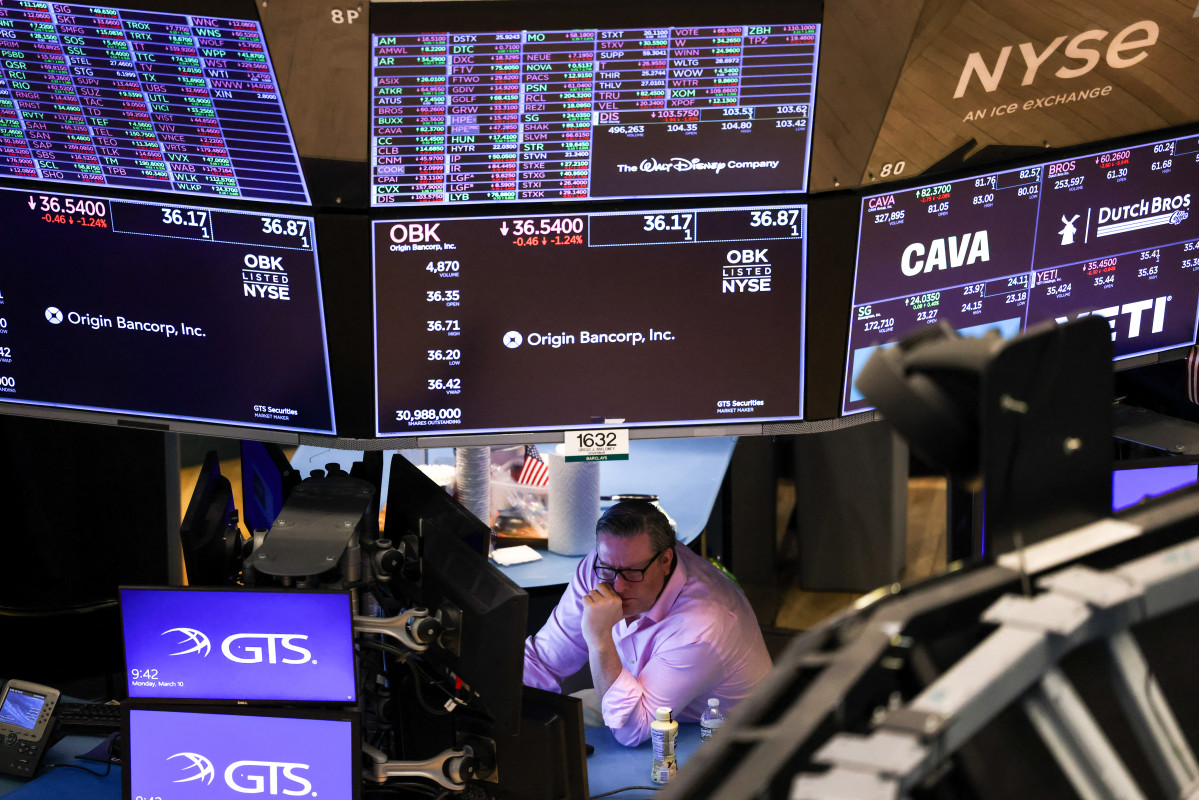 Bank of America warns shifting politics and AI spending may reshape stock market leadership 2026
Photo by CHARLY TRIBALLEAU on Getty Images
Russell 2000 flexes as Big Tech cools
- 2026 YTD (as of Feb. 9, 2026): Russell 2000 +7.64% vs. S&P 500+1.36%
- 2025: Russell 2000 +12.81% vs. S&P 500 +17.88%
- 2024: Russell 2000 +11.54% vs. S&P 500 +25.02%
- 2023: Russell 2000 +16.93% vs. S&P 500 +26.29%
- 2021: Russell 2000 +14.82% vs. S&P 500 +28.71%
- 2020: Russell 2000 +19.96% vs. S&P 500 +18.40% Source: Ycharts
Bank of America thinks market leadership is quietly changing
BofA’s Hartnett argues that the forces dominating the early 2020s are losing their edge.
More Wall Street
- Goldman Sachs issues urgent take on stock market for 2026
- Analyst who nailed 2023 bull run sets S&P 500 target for 2026
- Longtime fund manager sends blunt message on P/E ratios
For years, the mega-cap tech space thrived on asset-light businesses that generated truckloads of cash and returned it to shareholders through share buybacks.
Consequently, these stocks earned premium valuations as their model was clean, predictable, and scalable.
Related: Bank of America resets Amazon stock price target after earnings
However, AI is changing that dynamic.
The infrastructure needed to support it has effectively turned hyperscalers into massive spenders. Even if we see strong growth, the financial profile will likely take a hit due to the long-cycle buildout.
Politics is adding another layer.
Affordability is becoming a major driver of investment.
Policymakers are focused on lowering costs for people for stuff they care about the most, like energy, credit, housing, healthcare, and, naturally, the obvious incumbents sit in the crosshairs.
That’s where the small-and mid-cap stocks come in. These stocks aren’t just cheaper, but are positioned differently.
In fact, Jeremy Siegel, professor emeritus at Wharton, said in a recent CNBC interview that the market’s broadening of leadership appears a lot more durable now.
Small- and mid-cap stocks are more domestic and cyclical, and are much more sensitive to incremental flows when investors dial back on concentration risk.
That same logic applies to REITs and emerging markets, fitting a broader rotation away from U.S. mega-caps toward under-owned, asset-backed areas.
Related: Ernst & Young drops blunt reality check on the economy
The breadth/rotation scoreboard
- S&P 500 value vs growth (ETF proxies):iShares S&P 500 Value ETF (IVE) +3.33% YTD vs iShares S&P 500 Growth ETF (IVW) −4.03% YTD (NAV total return as of Feb. 5, 2026).
- Equal-weight vs cap-weight:Invesco S&P 500 Equal Weight ETF (RSP) +5.59% YTD vs SPDR S&P 500 ETF Trust (SPY) +1.28% YTD (trailing returns as of Feb. 6, 2026).
- Top 10 concentration: Thetop 10 stocks make up 40.99% of the S&P 500 market cap (Jan. 2026).
Crucially, Hartnett feels this is more of a conditional trade, and only works if we see a stabilization in rates, credit doesn’t tighten further, while policy pressure remains focused on incumbents.
Leadership shift shows up fast in YTD ETF returns
To show what the “Main Street” leadership looks at this time, here’s a quick read on sector ETFs. For perspective, these aren’t single stocks; they’re essentially tailor-made bundles that track a specific corner of an industry.
So, the numbers below are YTD total returns through Feb. 6, 2026, lined up against Big Tech (VGT) and the broad-market S&P 500 (SPY) to ascertain the rotation away from the status quo.
- Regional banks (KRE): +13.61% vs Big Tech (VGT): −1.89% vs S&P 500 (SPY): +1.28%.
- Homebuilders (XHB): +13.90% vs VGT: −1.89% vs SPY: +1.28%.
- Industrials (XLI): +11.64% vs VGT: −1.89% vs SPY: +1.28%.
- Energy (XLE): +19.10% vs VGT: −1.89% vs SPY: +1.28%.
- Utilities (XLU): +1.55% vs VGT: −1.89% vs SPY: +1.28%.
- REITs (VNQ): +4.25% vs VGT: −1.89% vs SPY: +1.28%. Source: Totalrealreturns, Yahoo Finance
Related: Top bank revamps gold price target for rest of 2026