
Bank of America (BAC) just sent a clear message to Washington following renewed talk of capping credit-card interest rates at 10%.
CEO Brian Moynihan didn’t mince words, saying that although the idea may sound consumer-friendly, a hard cap will likely compel banks to limit credit, especially for those who need it most.
It couldn’t have come at a worse time, though, with a big chunk of the big banks, including BofA, posting impressive quarterly numbers on Wednesday, Jan. 14.
BofA and Citi, in particular, stood out with beats across both lines, while Wells Fargo disappointed somewhat on net interest income compared to expectations.
However, even with some beats, bank stocks dragged on the back of Washington’s credit-card curveball.
- BAC stock dropped 3.8%.
- WFC stock lost nearly 4% to 5% in value depending on the time of day.
- Citi stock was also choppy, with reporting ranging from modest dips to a few percent drop.
Like Moynihan, the development didn’t sit well with other major bank CEOs.
Citigroup CEO Jane Fraser said that the cap would likely have a detrimental impact on credit access and consumer spending.
Additionally, JPMorgan CEO Jamie Dimon said that the price controls will chip away at profit margins and that “the provision of the service will change dramatically.”
Naturally, this sets the stage for an all-too-familiar tussle between politics and financial reality. Consumer relief on paper might carry major consequences; the market can’t just ignore it.
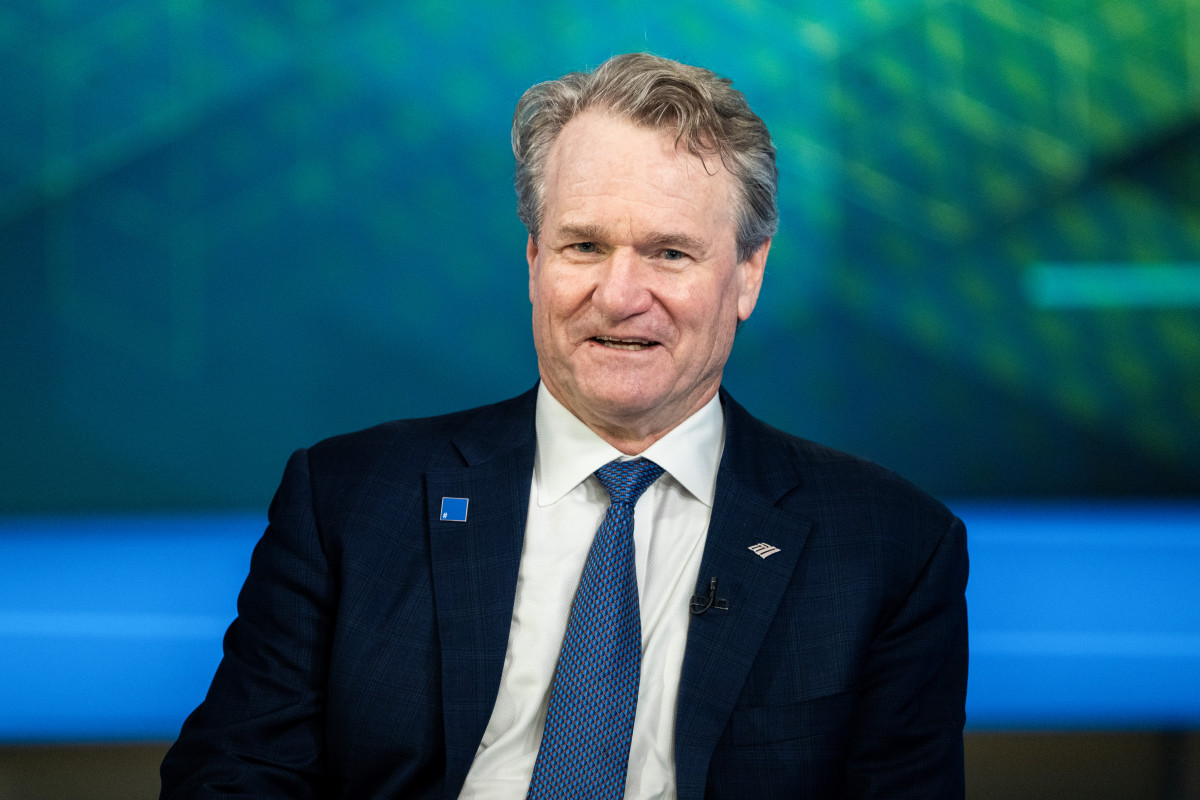 Bank of America CEO Brian Moynihan warns a 10% credit-card cap could dramatically restrict consumer credit access.
Photo by Bloomberg on Getty Images
President Trump floats a 10% credit-card rate cap
U.S. President Donald Trump added fresh fuel to a familiar debate in a Jan. 9 post on Truth Social, The Guardian reported.
From a political standpoint, the appeal is obvious.
Credit card APRs are clearly elevated (north of 20%), and capping them at 10% is a straightforward promise aimed at affordability.
However, its simplicity glosses over the complex trade-offs beneath the headline.
A 10% credit-card interest rate cap would slash credit
In a post-earnings interview with CNBC, BofA CEO Moynihan laid out bluntly what he thinks of the proposed 10% cap on credit card APRs.
He argued that the hard cap would effectively “pull the credit back dramatically” as credit-card portfolios carry sizable real losses (citing a 3% to 3.5% charge-off rate). So essentially, the math stops working when you’re unable to price for risk.
Also, he pointed to the unintended consequences of the move, including that people who need credit the most will be forced to turn to expensive payday lenders or other less-regulated options.
On top of that, he warned that only a sliver of the population might have access to credit.
For perspective, according to FICO’s Score Credit Insights report (Fall 2025 edition), the percentages of the U.S. population that fall into different credit-score ranges are as follows.
- Credit score of 700-749: 15.4%
- Credit score of 750-799: 23.0%
- Credit score of 800-850: 24.8%
Though those numbers may seem counterintuitive at first, Moynihan’s point speaks to underwriting and the economics of lending under a 10% cap, not just the raw distribution of the scores.
Bank of America’s Q4 earnings snapshot
BofA wrapped up another solid quarter, comfortably beating estimates across both lines.
For perspective, this was the bank’s second consecutive quarterly beat and its third in the past four quarters.
- Revenue:$28.4 billion (+7% YoY); FTE revenue about $28.5 billion versus $27.94 billion consensus (beat).
- Earnings: Net income $7.6 billion (+12% YoY); EPS $0.98 (+18% YoY) versus $0.96 estimate (beat); share count down about 4% YoY.
- Net interest income:$15.9 billion (+10% YoY); net interest yield up 7 bps to 208 bps; loans +8% and deposits +3%.
- Efficiency/credit: Expenses $17.4 billion (just under +4% YoY) drove 330 bps operating leverage; net charge-off ratio 44 bps (down 10 bps YoY); CET1 11.4%; $8.4 billion returned to shareholders.
- Guidance: 2026 net interest income growth 5% to 7% with about 200 bps operating leverage; Q1 net interest income roughly +7% YoY and Q1 expenses about +4% YoY; 2026 effective tax rate around 20%. Source: Seeking Alpha
Strong Bank of America results, and a shrug at the stock
Despite the geopolitical developments, Moynihan didn’t hesitate to call Q4 a “very good quarter” and a “very good year” for BofA, and the numbers backed up the view.
As for the stock’s sluggishness, Moynihan largely shrugged off the concerns. He noted that most big banks were down roughly 5% to 6% year to date at the time, adding that a similar wobble early last year still gave way to double-digit gain.
MoreEconomic Analysis:
- CPI inflation data rocks stocks
- Trump’s bold new tax promise has families asking one big question
- Longtime fund manager sends blunt message on P/E ratios
- Mortgage rates tick lower as the Fed trims key rate
- Both high-and low-income holiday shoppers are following this trend
- November BLS jobs data show the good, bad, and ugly
Zooming out, Moynihan also painted a positive picture of the economy.
He noted that loans and deposits grew by 8% and 3%, respectively, and internal data showed consumers spent 5% more in 2025 and early 2026, running even higher.
Moreover, with wages growing at an encouraging pace and optimism in small businesses, BofA raised its GDP growth forecast for 2026 to a strong 2.6%.
Related: Nvidia CEO delivers biblical-scale reality check on AI