
Stocks have had an impressive rally since April 9, when President Donald Trump paused most of the reciprocal tariffs he had announced only days earlier on April 2, so-called Liberation Day.
The higher-than-hoped tariffs had sent stocks reeling as investors scurried to reset economic models and cut earnings outlooks. The reprieve, while temporary, provided the perfect match to light what had become a deeply oversold stock market, launching a rally so significant that the S&P 500 has risen about 25% in the matter of only three months.
What’s particularly remarkable is that the rally in stocks has come despite evidence that the U.S. economy is weakening, increasing risks of stagflation or recession. Unemployment has increased over the past year, and sticky inflation will likely worsen as the impact of remaining tariffs is felt.
💰Don’t miss the move: Subscribe to TheStreet’s free daily newsletter💰
That’s not a very encouraging backdrop for stocks, which typically generate the best returns when the economy grows and households and businesses are more interested in spending.
Given that stocks have recovered nearly all of their nearly bear market losses from this spring, there’s considerable debate on what happens next.
Bulls argue that the damage done during the 19% decline in the S&P 500 between February and April’s low priced in the risks, clearing the way for durable gains that support buying dips. Bears point to arguably rich valuations and a sputtering economy.
Related: Bank of America delivers bold S&P 500 target
Many on Wall Street have offered their two cents, including popular hedge fund manager Bill Ackman. Ackman, who is worth $8.2 billion, good enough to rank #413 on Bloomberg’s Billionaires Index, is the founder of the hedge fund Pershing Square, which has $18 billion under management.
This week, he dropped a one-word message to investors about the stock market, and given his substantial experience, it may be worth considering what he thinks.
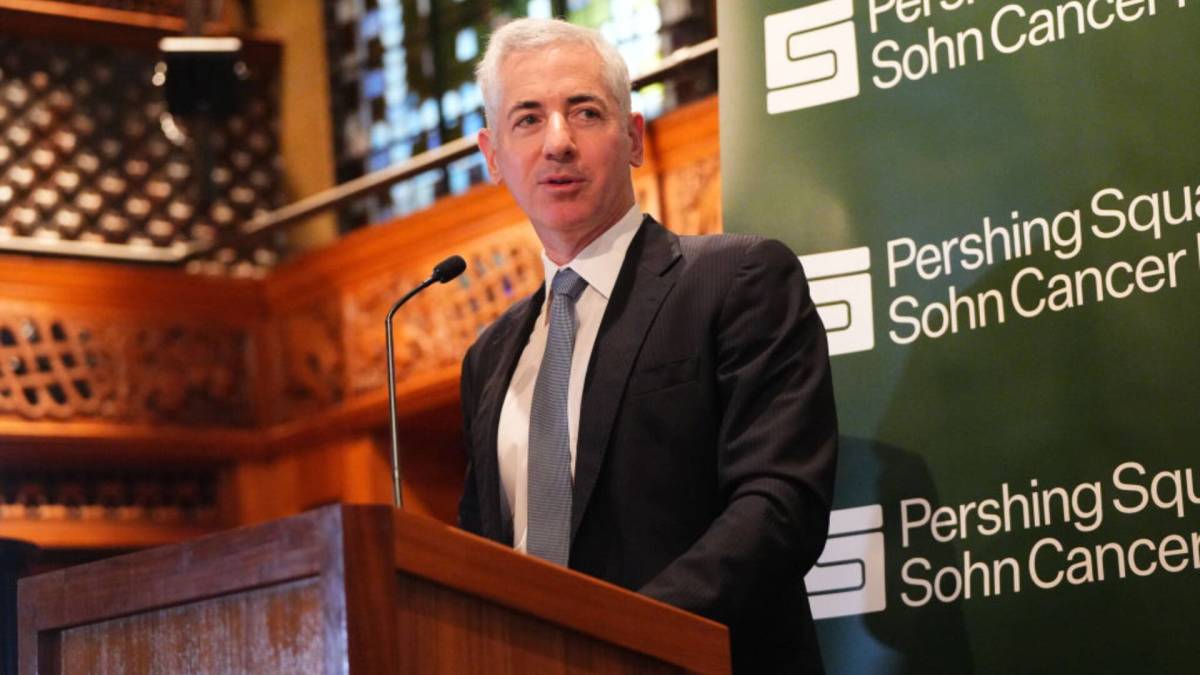 Hedge fund manager Bill Ackman manages Pershing Square, a hedge fund with $18 billion under management.
Image source: Siskin/McMullan via Getty Images
Stocks look past economic risks, sidelined Fed
There’s a considerable difference in opinion on what could happen to the economy next. Some think tariffs will take a stiff toll on already cash-strapped consumers later this year, reducing economic activity alongside a drop in businesses’ spending as CEOs await clarity on trade deals. Others believe that the tariff risks are temporary and largely overblown.
The unemployment rate remains relatively low at 4.1%; however, that’s up from 3.4% in 2023. Also concerning is a spike in layoffs. Companies have announced over 696,000 layoffs this year through May, up 80% year over year, according to Challenger, Gray, & Christmas’s number crunching.
Related: Legendary fund manager has blunt message on ‘Big Beautiful Bill’
The rise in unemployment follows the most hawkish pace of Federal Reserve interest rate hikes in history. The Fed raised interest rates by 5% in 2022 and 2023 to lower inflation, a strategy that worked, given CPI inflation has retreated from 8% to below 3%.
Inflation progress and job losses prompted the Fed to switch to rate cuts late last year, shaving 1% off the Fed Funds Rate. However, inflation has since leveled off, and new concerns over the impact of tariffs on inflation have shifted the Fed to the sidelines, putting it firmly in wait-and-see mode.
That’s not good news for stocks, given that higher interest rates weigh down corporate profit, and stocks typically follow earnings over time.
The Fed’s holding pattern has drawn sharp criticism from the White House, ostensibly because President Trump recognizes that lower rates could blunt some of the drag on the economy caused by tariffs.
President Trump has called Fed Chairman Powell “Mr. Too-Late” and a “numbskull” for not reducing rates. Powell has remained steadfast, arguing that patience is warranted.
The Fed’s hesitation on monetary policy is concerning, though, given that the Fed and the World Bank estimate that the U.S. GDP is falling to 1.4% this year from 2.8% last year.
Related: Secretary Bessent has blunt message on ‘Big Beautiful Bill’ debt problem
If Powell doesn’t move on rates and the economy weakens further, Congress may not be much help, given that the country’s huge deficit and mountain of debt may hamstring fiscal policy, especially after passage of the One Big Beautiful Bill Act.
America’s deficit exceeds $1.8 trillion, accounting for 6.4% of gross domestic product. Overall, total public debt outstanding is roughly 122% of GDP, far north of the 75% level seen in 2008 during the Great Recession.
The backdrop is a threat to earnings growth. Still, the stock market has looked beyond the risks, possibly assuming that trade negotiations will bear fruit, inflation expectations will retreat, tariff risks are overblown, and corporate earnings will grow, rather than shrink.
Bill Ackman offers a blunt view on markets
Bill Ackman co-founded Gotham Partners in 1992, so he has been following Wall Street closely for over 30 years. This means he’s navigated the Internet boom and bust, the Great Recession, Covid, and the 2002 bear market.
More Experts
- Fed official sends strong message about interest-rate cuts
- Billionaire fund manager sends surprising message on trade deficit
- Hedge-fund manager sees U.S. becoming Greece
In short, Ackman has been-there, done-that chops, making his take on markets worth attention.
Despite the stock market’s big run since early April, there may be more fuel to take stocks higher.
Many investors sold stocks this spring amid soaring tariff-driven volatility, opting for the relative safety of money market accounts yielding 4% or more. That move looked really smart in early April, but it doesn’t look nearly as wise now, given the S&P 500’s move.
Nevertheless, ongoing concerns regarding the economy and President Trump’s mercurial nature have kept many investors from jumping back in, something that could change if FOMO kicks in or stocks pull back, giving investors a do-over.
The Federal Reserve Bank of St. Louis reports that the total financial assets parked in money market funds were nearly $7.4 trillion at the end of the first quarter, up from $6.44 trillion the prior year.
Meanwhile, the Investment Company Institute says $7.07 trillion remained in money market funds as of July 10, up from $7.02 trillion on June 25.
Barchart, a financial market data and services provider, shared the first-quarter data on X this week, and it caught Ackman’s eye.
The hedge fund manager shared the chart on X, bluntly concluding, “Bullish.”
Ackman’s quick reply suggests he believes that the increase in money stashed in money market funds over the past year could make its way back into risk assets, propping up the stock market.