Speaking at the World Governments Summit in Dubai, billionaire Ray Dalio kept it simple.
Despite the negative chatter after gold’s recent pullback, Dalio feels that the shiny yellow metal is gold is still “the safest money.”
He followed up by saying that the global system is effectively edging closer to a “capital war,” in which money itself becomes a source of conflict.
Over the past month, there’s been a ton of activity in precious metals, with gold and silver continuing to rise despite sharp pullbacks. Despite the volatility, Gold is still trading nearly 8% higher month-over-month.
It’s important to note that it hit an all-time high of $5,608.35 in January before stumbling on the back of Fed-driven dollar strength, but buyers returned anyway.
Also, I covered Dalio recently after Davos, where he took a similar view, arguing that allocating 5% to 15% of a portfolio to gold makes sense given market fragility.
In Dubai, he essentially reiterated his view, brushing aside concerns that gold is losing relevance.
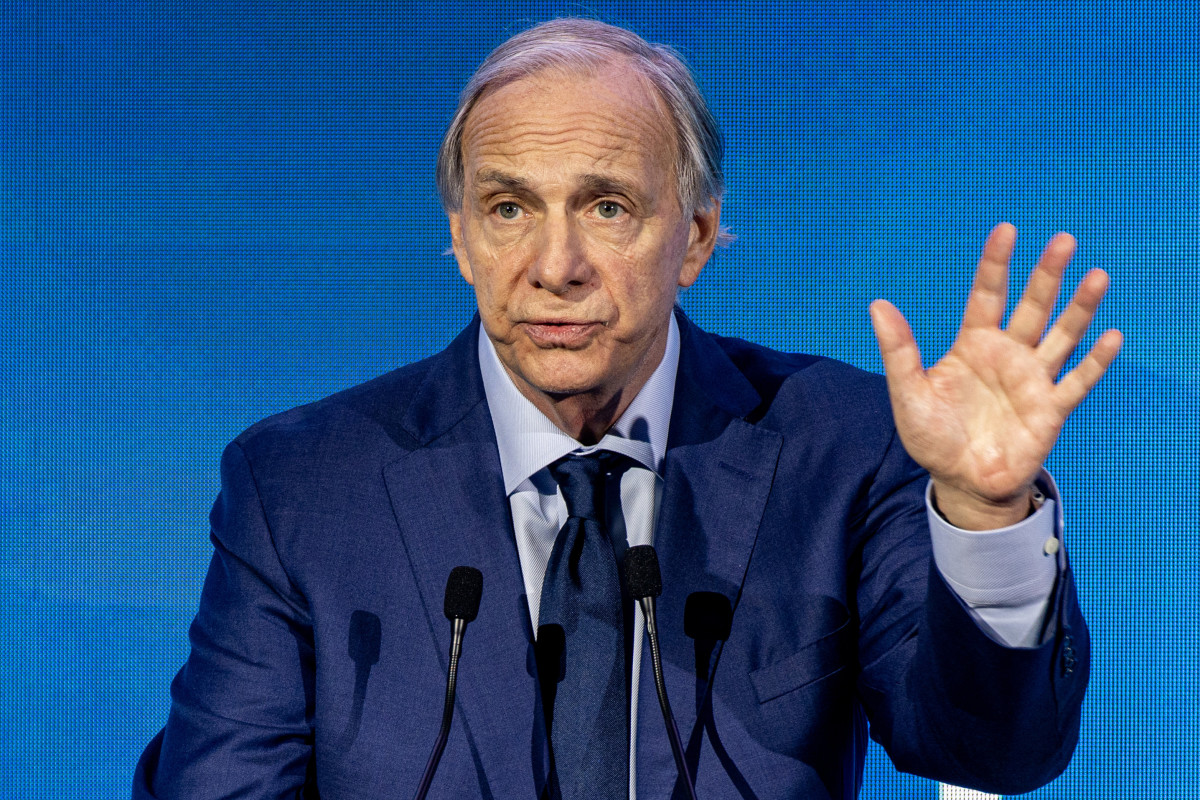 Ray Dalio says gold remains the safest money as global debt pressures raise risk of capital conflict
Photo by Bloomberg on Getty Images
Wall Street’s latest gold price targets
Using spot gold about $4,931/oz (Feb. 5, 2026) as the baseline:
- J.P. Morgan: $6,300/oz (end-2026), about 27.8% upside.
- Wells Fargo Investment Institute: $6,100 to $6,300/oz (end-2026), about 23.7% to 27.8% upside.
- UBS: $6,200/oz, about 25.7% upside (also $5,900/oz (end-2026), about 19.6% upside).
- Bank of America: $6,000/oz (by spring 2026), about 21.7% upside.
- Goldman Sachs: $5,400/oz (end-2026), about 9.5% upside.
Dalio’s gold take hits differently
Dalio’s sharp take on gold and markets resonates because he isn’t just a TV pundit filling airtime.
More Gold:
- Gold, silver surge after record drop flashes technical signal
- Silver and gold tumble triggers major reset for mining stocks
- J.P. Morgan revises gold price target for 2026
The legendary fund manager founded Bridgewater Associates in 1975, turning it into a macro machine that. At its peak, it became the most valuable hedge fund globally, managing roughly $154 billion in assets as of December 2020.
Dalio speaks much more freely these days, after stepping down as Bridgewater’s CEO in 2017, leaving the chairmanship in 2021, and fully handing over control by late 2022. Needless to say, his views remain blunt and sharp, focusing on debt cycles, currencies, and the plumbing of financial markets.
Moreover, as per Forbes, Dalio boasts a net worth of roughly $15 billion–$16 billion, placing him in the upper echelon of investors.
Related: Deutsche bank reaffirms gold price target into late 2026
Gold vs. bitcoin vs. stocks since 2020
- 2020: Gold +25.75%; Bitcoin +303.09%; S&P 500 (total return) +18.40%.
- 2021: Gold -3.73%; Bitcoin +59.71%; S&P 500 (total return) +28.71%.
- 2022: Gold +2.08%; Bitcoin -64.27%; S&P 500 (total return) -18.11%.
- 2023: Gold +13.14%; Bitcoin +155.41%; S&P 500 (total return) +26.29%.
- 2024: Gold +27.20%; Bitcoin +120.98%; S&P 500 (total return) +25.02%.
- 2025: Gold +64.60%; Bitcoin -6.33%; S&P 500 (total return) +17.88%.
- Compounded return (2020–2025): Gold +192.7%; Bitcoin +1,116.1%; S&P 500 (total return) +132.3%. Sources: Ychart, StatMuse
Gold as insurance in a world edging toward capital conflict
Dalio’s case for the shiny yellow metal hinges on how polarized and fragile the global financial system has become.
Related: Palantir CEO delivers curt 8-word message to investors
He feels that gold isn’t a momentum asset (as it’s currently being treated), but rather what he considers the world’s “second-largest reserve currency”.
In saying that, he argues that policymakers and large capital allocators are essentially making a category mistake by failing to consider portfolio positioning.
So clearly this isn’t about price targets, but about what gold effectively protects against an environment marked by rising debt, geopolitical strain, and weaponized capital flows.
Furthermore, Dalio mentions a looming “capital war” of which the conditions are effectively in place.
These include a mutual distrust between capital holders and issuers, sanctions, and the normalization of capital controls. In such a case, assets linked to a particular government or currency become incredibly vulnerable.
In that situation, gold functions much more like insurance than an investment.
So it could lag in good times but offer outsized returns when the system goes awry, as it has over the past year.
Related: Morgan Stanley delivers blunt verdict on Fed pick Warsh