
Every company that runs away with a market eventually needs one thing it can never admit to wanting: a real rival.
Competition is what keeps a leader sharp, keeps customers from feeling trapped, and keeps regulators from circling. A monopoly looks great on a spreadsheet and terrible in a headline.
For most of the past decade, the rocket business has had exactly one runaway leader and a long line of companies promising to close the gap. Elon Musk‘s SpaceX launches more often, lands more boosters, and charges less than anyone alive.
The company that looked most likely to become a genuine second source was Jeff Bezos‘s Blue Origin, with its heavy-lift New Glenn rocket and Bezos funding much of it by selling Amazon (AMZN) stock.
Then, on the night of May 28, Blue Origin’s best answer to SpaceX erupted into a fireball on its launch pad in Florida. The timing is what makes this more than a bad night. SpaceX is days from the largest stock market debut in history, and its only serious challenger just lost the rocket built to chase it.
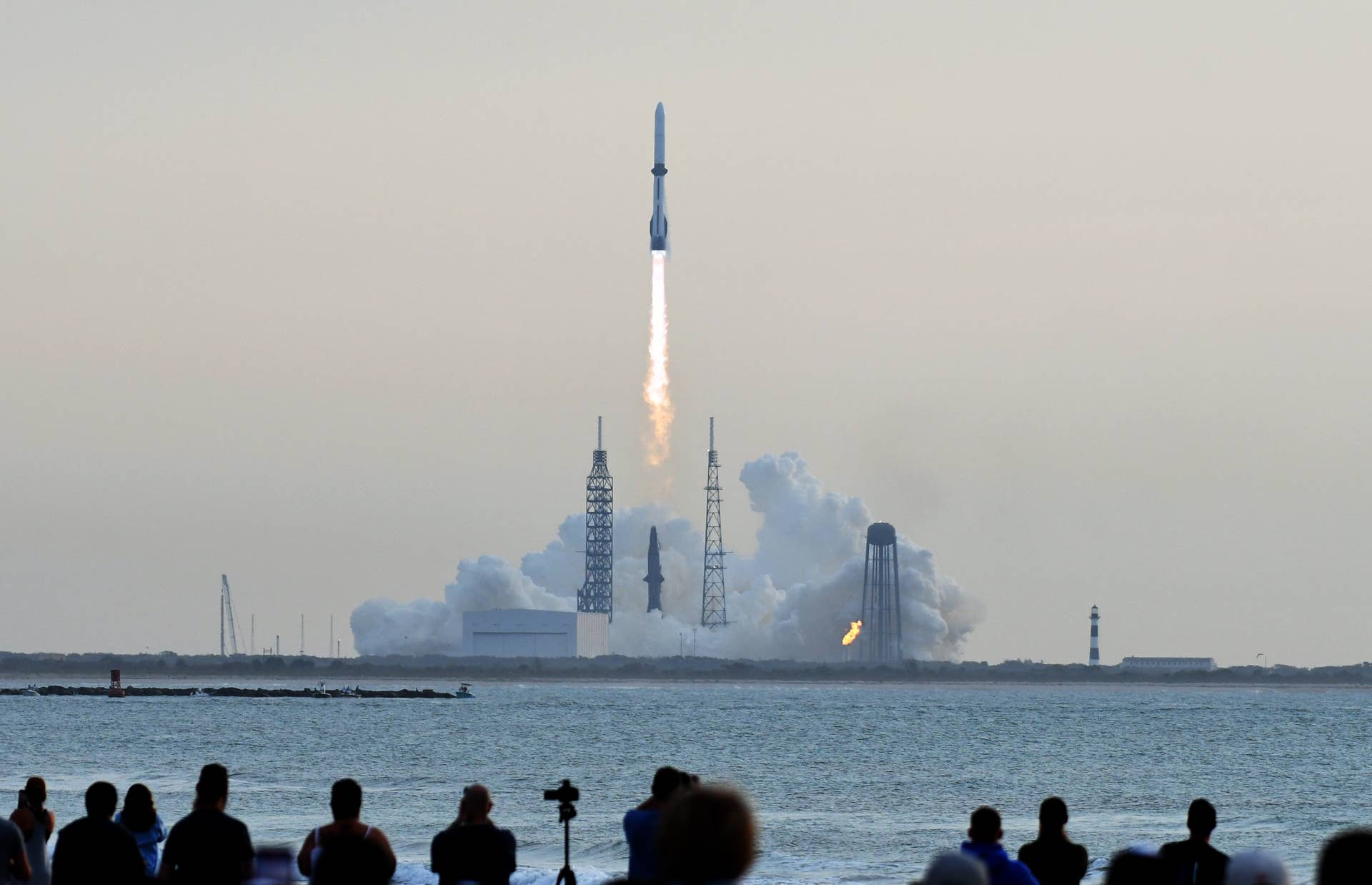 Blue Origin Launches New Glenn Rocket with Communications Satellite from Cape Canaveral.
How one explosion widened SpaceX’s lead in the launch market
New Glenn was running a static fire test, a routine engine firing done before launch, when it blew up at Launch Complex 36 at Cape Canaveral on May 28, according to Spaceflight Now. No one was hurt. The blast destroyed the rocket and appears to have badly damaged the only orbital pad the company has.
More Tech Stocks:
- Morgan Stanley sets jaw-dropping Micron price target after event
- Nvidia’s China chip problem isn’t what most investors think
- Quantum Computing makes $110 million move nobody saw coming
Bezos kept his public tone level, calling it a “very rough day” in a post on X.
Chief Executive Dave Limp says the recovery will be fast. Blue Origin plans to “fly again before the end of this year,” he said, according to TechCrunch. Many in the industry had assumed a return to flight would not come before 2027, the same outlet reported.
My read, after lining up the two timelines, is simple. The gap was already wide. The explosion made it wider at the exact moment SpaceX could least afford a rival, which is to say, right before it asks the public to value it.
Related: Jeff Bezos lands bold new NASA moon win over Elon Musk
What SpaceX’s launch dominance means for your portfolio
Here is why a private rocket company’s good fortune should reach a retail investor at all. SpaceX is about to stop being private.
SpaceX filed its initial public offering, or IPO, paperwork on May 20 and could debut on the Nasdaq as soon as June 12 under the ticker SPCX, with Goldman Sachs (GS) leading the deal, according to CNBC. The company was valued near $1.25 trillion after merging with Musk’s artificial intelligence unit xAI in February, and is reportedly aiming for $1.75 trillion or higher at the listing, according to CNBC.
To feel that number, set it against the public market. At roughly $1.7 trillion, SpaceX would list larger than all but a handful of American companies, in the same tier as Apple (AAPL), Microsoft (MSFT), and Nvidia (NVDA).
That matters for your money even if you never buy a single share. When a company that size joins the market, the index funds inside almost every 401(k) have to hold it, so a slice of most retirement accounts will quietly own a piece of it.
The scoreboard going into that debut is lopsided:
- SpaceX flew 165 Falcon 9 missions in 2025, “more than the rest of the world combined,” according to SpaceNews.
- Blue Origin’s New Glenn is still early in its flight history, and the May 28 blast wrecked the company’s only orbital launch pad, according to Spaceflight Now.
- SpaceX reported $18.67 billion in revenue for 2025, up about 33% from the year before, according to Fortune.
- Starlink, its satellite internet unit, drives more than two-thirds of that revenue, according to Fortune.
The risks still strapped to SpaceX before the bell rings
None of this makes the stock a sure thing, and I would not want anyone reading a launch-market story as a buy signal. SpaceX is growing fast and bleeding cash at the same time.
The company still loses money on operations, and it carried an accumulated deficit of $41.3 billion as of March 31, according to Fortune.
Its own next rocket is not flying cleanly either. Starship’s twelfth test on May 22 ended with the booster slamming into the ocean after engines failed to relight, and the Federal Aviation Administration grounded the vehicle pending a mishap investigation, according to TechCrunch.
The whole story also rides on one man. Musk runs SpaceX, Tesla (TSLA), and the absorbed xAI at once, which true believers call focus and skeptics call concentration risk.
Where the launch race goes after the smoke clears
Blue Origin will rebuild. Bezos has the money and the motive, and a second pad is already under construction, though that project is in early stages, according to TechCrunch.
The question is how many months the only credible heavy-lift rival spends grounded. Every one of those months is a month SpaceX prices its IPO, signs more contracts, and stretches the one figure that compounds, flight count.
So watch the launch pad in Florida, not the ticker. The day New Glenn flies again is the day this becomes a two-horse race instead of a coronation.
Related: Jeff Bezos’ Blue Origin rocket explodes as space tech stocks tank