
Aerospace giant Boeing (BA) reported Q2 earnings that bested analyst expectations, which showed continued improvement in its core business.
The company reported $22.75 billion in revenue (versus $21.72 billion expected by analysts), with nearly 48% of that revenue coming from its once-troubled commercial airplanes division.
The company’s loss per share continued to decline, falling to -$1.24 per share (versus -$1.31 expected) as it has been able to increase production and stabilize its business.
The company is now producing the max number of 737 MAX jets allowed under its agreement with the Federal Aviation Administration (FAA). That agreement currently allows it to make 38 737s per month. It is seeking a waiver that would allow it to produce 42 jets per month, pending approval.
Making matters better, the company was able to reduce its cash burn, which towered at $4.3 billion in this quarter last year. By contrast, its burn was $200 million in this quarter, a massive improvement.
Boeing hit a 52-week high in the premarket trade on the news, with its stock up 2% before the bell.
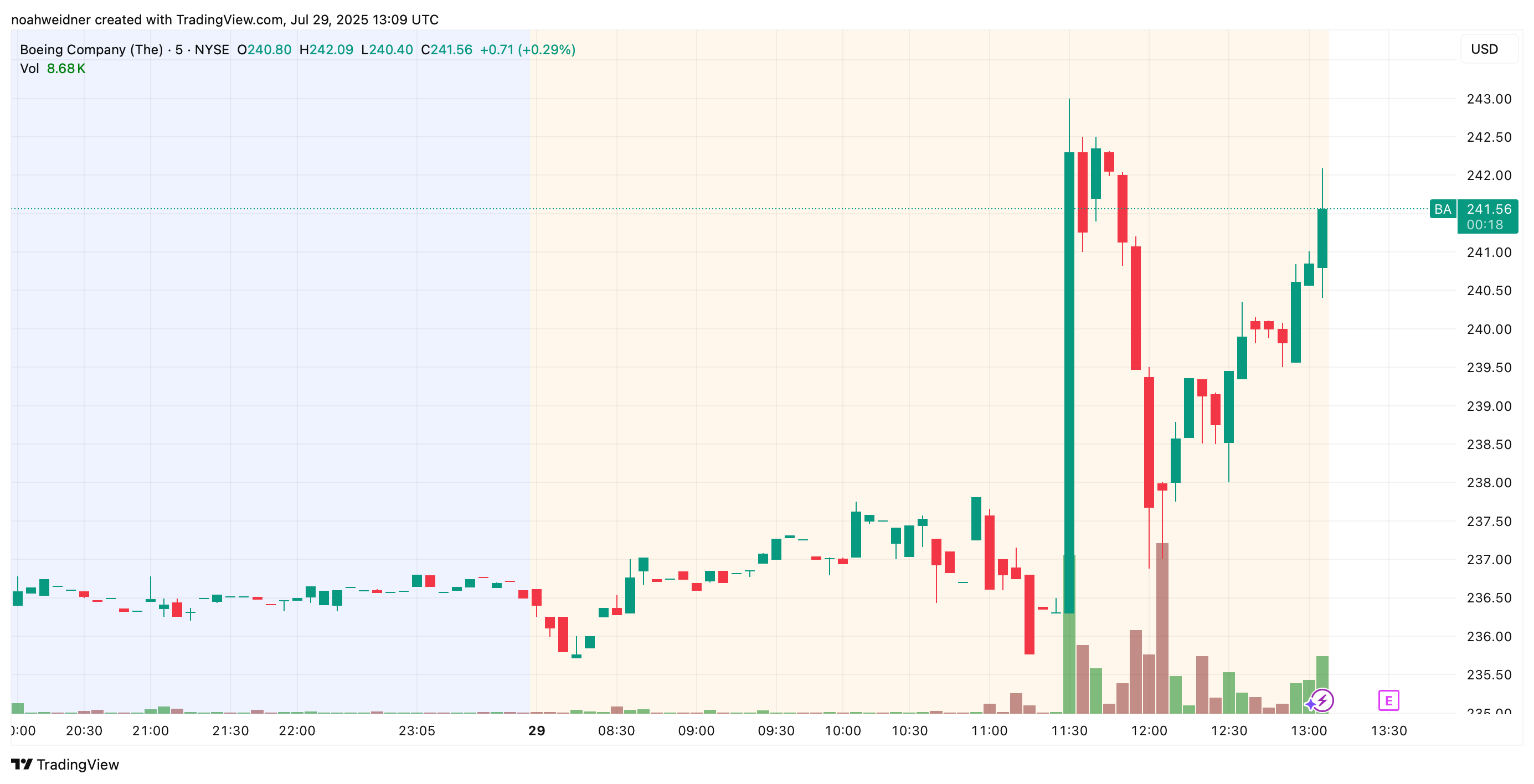 Boeing after hours and pre-market chart (Jul. 29, 2025)
TradingView
Trump’s Favorite
This time last year, Boeing was fighting demons. Under the guidance of new CEO Kelly Ortberg, who has been in the role for nearly a year, the business has gone from one of 2024’s most disappointing performers to one of 2025’s top turnaround plays.
It isn’t just cost-cutting and discipline, either. In recent months, Boeing has become a favorite bargaining chip of President Trump, who used the industrial giant in trade negotiations.
The windfall, of course, has been to Boeing’s benefit. In May, Boeing reported the highest number of gross orders since Dec. 2023, with 303 gross orders. 146 of which were for the 737 MAX.
210 of them came from Qatar Airways, which bought Boeing’s largest and most expensive production aircraft, the 787 Dreamliner and 777X aircraft, in an effort to warm to President Trump.
In fact, the orders were so plentiful that the U.S. durable goods report for May saw a 16.4% year-over-year jump, a product of Boeing’s big month. Although, analysts agree it was likely a one-time thing.
Making matters even better, it was also able to skirt out of potentially massive damages after a judge dismissed a criminal case against the aerospace company in July, substituting a $1.1 billion settlement for those affected by two fatal 737 MAX crashes.
Turbulence Ahead
Despite the company’s strong showing, Boeing still has to thread the needle as it seeks to escape the overhang created by disasters with its 737 MAX model. Not just the two fatal crashes, but a blowout of a wall plug in Jan. 2024, which saw the company’s star product grounded.
Some of the problem is still in the air. Last month, the National Transportation Safety Board (NTSB) issued a warning about the MAX, recommending changes to engines on certain planes to avoid smoke from entering the cabin.
Meanwhile, on the ground, the company faces the threat of a new strike at its St. Louis facility after a union there rejected a trade deal. A strike at its larger Everett base derailed production late last year, spurring a massive loss.
Finally, Boeing still needs to see the smallest and largest variant of its MAX jet certified, the MAX 7 and 10. Per recent reports, that process will be punting into 2026. Yet another delay, and a longer comeback, for the aviation giant.