
Love may be lovelier the second time around, but what about business?
Well, package delivery giant FedEx (FDX) and e-commerce and entertainment heavyweight Amazon (AMZN) are about to find out.
💸💰Don’t miss the move: Subscribe to TheStreet’s free daily newsletter 💰💸
The two companies inked a multi-year agreement where FedEx will deliver large packages to Amazon’s residential customers.
The two parties signed a partnership deal in late February that provides Amazon “cost favorability” when compared to using United Parcel Service UPS, Business Insider reported, citing an internal document.
“FedEx joins our other third-party partners like UPS and the USPS, that work alongside our own last mile delivery network to help us balance capacity to best serve customers,” Amazon spokesperson Steve Kelly told Retail Dive in an emailed statement.
In January, UPS (UPS) , which has long been a third-party delivery partner of Amazon, agreed that the e-commerce giant would trim the volume of Amazon packages it handles by more than 50%.
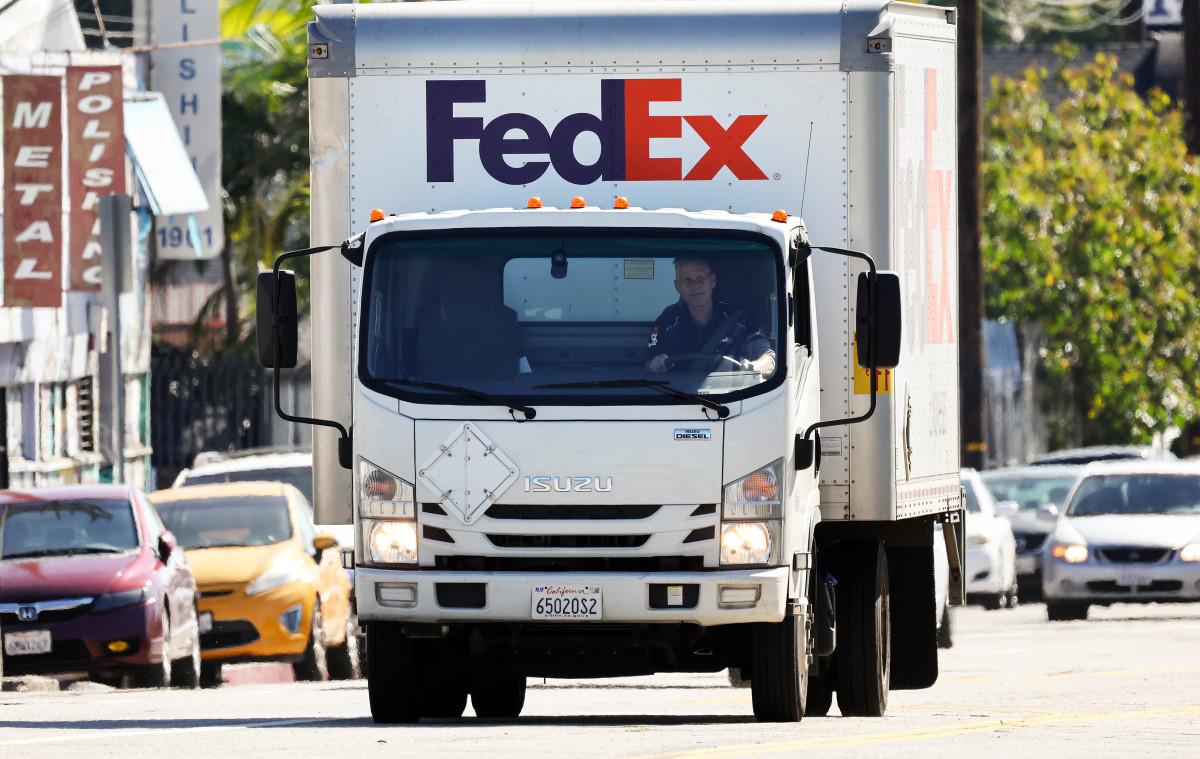 FedEx is scheduled to post quarterly earnings next month. (Photo by Mario Tama/Getty Images)
FedEx says deal makes financial sense
Back in 2019, FedEx said that it wouldn’t be renewing its ground delivery contract with Amazon.
“This change is consistent with our strategy to focus on the broader e-commerce market,” FedEx said at the time.
More Economic Analysis:
- Fed inflation gauge sets up stagflation risks as tariff policies bite
- U.S. recession risk leaps as GDP shrinks
- Like it or not, the bond market rules all
But things have a way of turning around.
“We only want deals that are financially accretive to FedEx,” Chief Commercial Officer Brie Carere said during the BofA Industrials, Transportation & Airlines Key Leaders conference. “We would not go back and open a deal after walking away five years ago if it did not make financial sense.”
UPS said last month that it will cut 20,000 jobs this year, about 4% of its global workforce, due to increased use of technology and the plan to trim its Amazon business.
UPS CEO Carol Tome said that most of the Amazon business that it is giving up is “not profitable for us, nor a healthy fit for our network.”
The UPS package volume from Amazon was already down 16% in the just-completed quarter, which was a bigger drop than UPS had forecast for the period. UPS said it will close 73 US buildings by the end of June as the next part of that “glide down” plan.
The package delivery sector got a severe jolt when President Donald Trump unveiled his tariff plan last month. Tariffs raise the cost of imported goods, potentially leading to decreased consumer demand and reduced shipment volumes.
The administration rolled back most of the 145% tariff rate that Trump imposed, and slash them to 30%, while China pledged to roll back most of the counter tariffs it announced against the U.S.
Analyst cites Amazon deal
More recently, the White House has slashed tariffs on cheap Chinese goods from shopping sites like Temu and Shein — to as low as 30%, below the 54% rate included in President Trump’s executive order earlier this week, Reuters reported on May 14.
As part of a temporary deal with China, Trump lowered “de minimis” tariffs on low-value packages down to 54% from 120%.
Related: Billionaire Steven Cohen sends hard-nosed message on US economy, stocks
But the majority of these packages are shipped through commercial carriers like United Parcel Service, FedEx and DHL, which can skip “de minimis” fees and pay the White House’s lower 30% tariff on China instead.
FedEx is scheduled to report quarterly results next month. The company missed Wall Street’s third-quarter expectations in March.
FedEx said it expected full-year revenue to come in flat to slightly lower year-over-year, worse than its prior forecast of “approximately flat.” The company also lowered its forecasts for the third quarter in a row.
CEO Raj Subramaniam said the company faced “a very challenging operating environment, including a compressed peak season and severe weather events.”
FedEx shares are down nearly 18% since January and the stock is off 10.5% from a year ago.
Bank of America lowered the firm’s price target on FedEx to $270 from $272 and kept a buy rating on the shares.
BofA said Carere noted the deal will be financially accretive with yields and weights above system-average in its domestic market.
Following the meetings, the firm lowered its FY25 and FY26 EPS estimates 3% and 1%, to $17.70 and $20.75, respectively.
Last month, Truist lowered the firm’s price target on FedEx to $275 from $305 and kept a buy rating on the shares as part of a broader research note on Transportation & Logistics.
The firm is reducing its estimates and price targets to reflect a more muted macro backdrop, stating that the T&L sector has already effectively been in a freight recession for over 30 months, the analyst tells investors in a research note.
Unlike during economic downturns, the overall industry tonnage index remained relatively stable through 2024 and into 2025, the firm said, supported by continued growth in U.S. GDP, retail sales, and e-commerce volumes, but while demand for goods movement persisted, pricing across the truckload market came under significant pressure.
Related: Veteran fund manager unveils eye-popping S&P 500 forecast