
Nvidia (NVDA) stock investors have spent months worrying that the relentless AI boom is leaning too heavily on the chipmaker’s own balance sheet.
The AI giant sells the GPUs, but it was also investing in clients and supporting financing structures linked to the same ecosystem, scooping up those chips. That birthed the AI circular financing debate and raised questions about how much capital giants such as Nvidia might ultimately have to commit to keep AI spending moving.
Now that setup is changing.
Nvidia recently lined up a new $500 billion-plus financing platform, which laid to rest many of those fears as Wall Street capital increasingly steps in, according to Reuters.
BofA feels that shift could change how investors think about one of Nvidia’s biggest risks.
Why BofA thinks Nvidia’s financing problem is fixable
One of the big concerns looming over Nvidia is how much of the AI boom it can ultimately finance itself.
That concern isn’t ill-founded, though, as Nvidia has effectively backed the same ecosystem that buys its chips. The tech giant has committed nearly $70 billion of investments across OpenAI, Anthropic, Safe Superintelligence, Intel, CoreWeave, Nebius, and other AI infrastructure partners, according to BofA.
More Nvidia:
- Nvidia just made a move Wall Street wasn’t ready for
- Nvidia just locked down deal that changes AI race
- Nvidia stock is doing something it hasn’t done in years
That entails complicated structures, including GPU sale-leasebacks and commitments to rent back unused capacity from neocloud operators.
However, BofA just addressed that “circularity” concern.
According to the bank’s analysts, Nvidia’s new financing structure materially reduces that risk. Nvidia has signed agreements with Apollo, BlackRock, Blackstone, Brookfield, Goldman Sachs, and KKR, looking to mobilize more than $500 billion in third-party capital for AI infrastructure.
So instead of Nvidia compromising on its own balance sheet strength, independent pools of capital would finance GPUs, power, and data centers. Outside investors will effectively be carrying the brunt of the financing risk.
That begs the question, though, of why financiers would be comfortable doing that.
BofA argues that Nvidia GPUs have remarkably robust residual value.
Its GPUs are transferable between operators, rented to different clients, and kept economically useful through Nvidia’s CUDA software ecosystem. In essence, those financiers could treat Nvidia GPUs as investable infrastructure assets.
“In AI, compute is revenue,” CEO Jensen Huang said at the time of the financing deal. “NVIDIA compute is uniquely suited for this role. It is broadly adopted, flexible across models and workloads, fungible and transferable across customers and operators, and continuously improved through CUDA software.”
This is especially true if funding is the bottleneck in the AI buildout. If so, bringing hundreds of billions of outside capital into the ecosystem extends Nvidia’s growth runway, rather than merely shuffling financing.
The risk doesn’t disappear, though.
MOUs aren’t exactly deployed capital. Ultimately, someone needs to generate sufficient economic return from the AI infrastructure to repay the money.
Additionally, more complex financing can make that AI ecosystem a lot less transparent, while questions about energy availability, regulation, and the eventual return on AI spending remain unanswered.
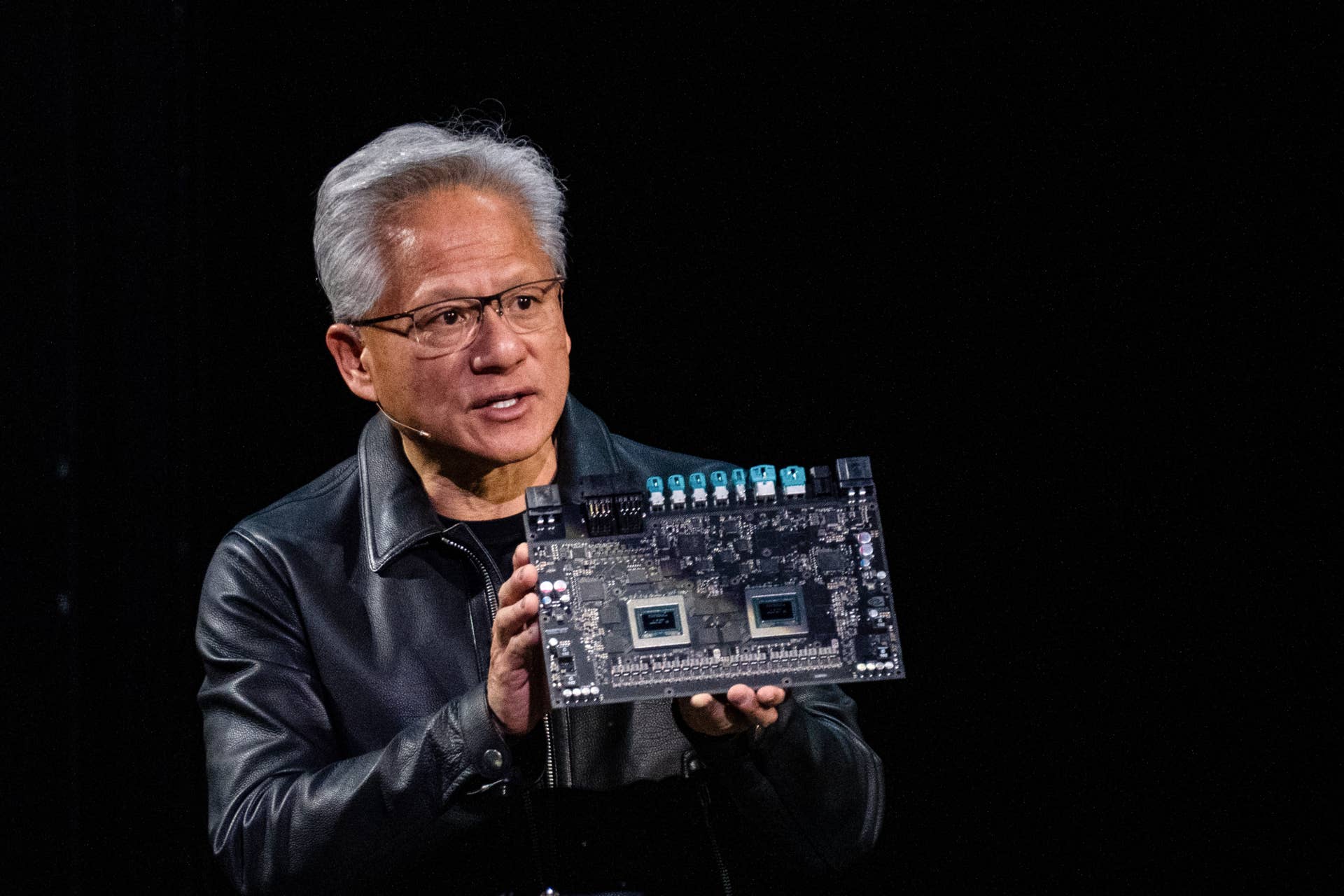 BofA says Nvidia’s new financing structure could reduce a major investor concern.
Kent Nishimura/Bloomberg via Getty Images
Why does BofA think Nvidia stock is already too cheap?
Bank of America sees Nvidia stock rising to $350, implying 59% upside from the stock’s current price of nearly $219.70.
Nvidia stock traded at $219 on Aug. 11, according to Yahoo Finance.
For perspective, according to Seeking Alpha, Nvidia shares jumped 16% in the past six months compared with gains of 11.5% for the S&P 500. Though things have been relatively sluggish over the past year, over a three-year period, the stock is up 417%, beating the S&P 500’s 73% gain.
Interestingly, the bank’s analysts argue Nvidia is trading at a “significantly depressed valuation,” which feels like a strange description for a company worth more than $5 trillion.
That said, BofA’s valuation on Nvidia is based on 26 times calendar-2027 estimated earnings, excluding cash. Although this sounds pricey, it’s near the bottom of the company’s historical 25x to 56x forward P/E range.
Moreover, according to Seeking Alpha data, Nvidia stock is trading at over 13-times forward sales estimates, 33% lower than the five-year average. Also, it’s trading at 25 times forward cash flow, 44.4% below its five-year average.
Despite the aggressiveness of the target, it’s especially stretched by Nvidia’s own history.
At the heart of it is Nvidia’s tremendous position in AI computing, its expected 65% to 70% share of a $1.7 trillion-plus AI systems market by 2030, and projected EPS growth above 46%.
BofA also estimates that Nvidia can generate a whopping $470 billion of free cash flow across calendar 2026 and 2027.
Against that backdrop, its nearly $70 billion of committed ecosystem investments equal just around 15% of projected two-year free cash flow.
Nvidia can therefore theoretically fund its strategic investments and still continue to return a ton of capital to shareholders.
The bank notes that the estimates assume nearly $73 billion of buybacks in 2026 and $106 billion in 2027, equivalent to around 36% to 37% of free cash flow. Nvidia has pledged to return more than 50% of free cash flow.
So if the new third-party financing model lowers the amount of cash Nvidia must commit to customers, a lot more free cash flow becomes available for buybacks.
What does BofA’s Nvidia call mean for investors?
For Nvidia fans, BofA’s bull case effectively boils down to a simple idea that the AI behemoth could extend the capex boom without having to bankroll it itself.
AI capex is critical to advancing Nvidia’s efforts, and even though the big names in tech have the financing firepower, others often do not.
Consequently, that $500 billion financing platform widens that funnel. As more customers gain capital access, Nvidia is able to sell more systems while outsourcing the financing issue.
Nevertheless, moving risk doesn’t eliminate it.
Third-party investors need customers that have enough in the tank to continue paying their bills. At the same time, AI applications need to offer sufficient economic value to back up the infrastructure supporting them.
In addition, BofA also flagged China restrictions, competition from custom chips, unpredictable data-center sales, and a potential slowdown in capital returns as risks to Nvidia’s dominant AI position.
For now, BofA is looking at Nvidia as a business that can generate roughly half a trillion dollars of free cash flow over two years, while maintaining its dominant AI market share.
At the same time, it is able to push financing risk onto external capital providers, yet continue trading at a forward multiple near the bottom of its historical range.
For investors, the next big test is Nvidia’s Aug. 26 earnings call. Investors will want more clarity on how much balance-sheet exposure Nvidia will retain under the new financing structure.
“The fundamentals are still strong” — biggest market opportunities right now (16:27)
