
Warren Buffett spent his final annual meeting as chief executive officer delivering a warning about the U.S. fiscal outlook rather than a farewell, CNBC reported from the May 3, 2025, Berkshire Hathaway annual meeting.
At age 96, he has stepped back from Berkshire’s leadership but remains on the board as chairman emeritus. Greg Abel assumed the role of chief executive officer, and his son Howard Buffett is replacing him as chairman.
His departure came with a blunt message about the country’s finances. Buffett told shareholders in May 2025 that fiscal recklessness in Washington could destroy the currency Americans use to save, spend, and invest.
Federal borrowing crosses $40 trillion as interest costs break records
The national debt surpassed $40 trillion on Aug. 18, 2026, five months after it cleared $39 trillion. Annual net interest payments on the national debt have reached $1 trillion, a threshold first crossed in fiscal 2025, according to Treasury Department data.
The government is adding debt at a pace of $1 trillion every five months, the Peter G. Peterson Foundation reported, a rate that works out to roughly $6.7 billion in new borrowing each day.
Peterson Foundation CEO Michael Peterson warned that the milestone lands directly on household budgets. The cost of government borrowing does not stay in Washington, he said.
<strong>…Every trillion we add to our debt contributes to higher interest rates and inflation, increasing the mortgages, car loans, and credit card bills of all Americans.</strong>
The inflation Peterson described erodes the purchasing power of each dollar. Savers holding cash lose ground, even when their bank balances stay flat, a dynamic that Buffett has warned about for decades.
Federal debt sat below $20 trillion in 2016, meaning the balance has doubled in a decade, the Treasury Department data showed.
Total federal debt now exceeds 120% of gross domestic product, the Federal Reserve data showed, a level of overall government borrowing not seen since World War II.
Washington ran a $1.966 trillion deficit in the first 11 months of fiscal 2026, the Monthly Treasury Statement for August 2026 confirmed.
Fiscal analysts echo Buffett’s warning as interest costs climb
Buffett has watched the federal government run deficits in all but a handful of the past 55 years. Interest on that debt now exceeds what Washington spends on national defense, the Congressional Budget Office (CBO) estimated.
His concern has built over those decades as the gap between what Washington collects and what it spends has widened. The currency risks he described at the 2025 meeting were the product of that long accumulation.
Maya MacGuineas, president of the Committee for a Responsible Federal Budget, echoed Buffett’s concern, saying that the balance does not sit solely on the government’s books.
That burden works out to roughly $117,000 for every American, the Peterson Foundation showed. The government has not recorded a budget surplus since 2001, Treasury Department data shows.
More Warren Buffett:
- Warren Buffett reveals he broke his own investing pattern
- Warren Buffett has a blunt take on today’s market
- Warren Buffett pulls no punches on stock market for 2026
Every dollar the government spends on interest is a dollar unavailable for defense, infrastructure, or public services, the Peterson Foundation reported. Those trade-offs grow steeper as borrowing costs climb.
The Federal Reserve Bank of Minneapolis’s inflation calculator shows the toll. A dollar held since 1970 has lost roughly 88% of its buying strength by 2026, making $100 today worth what $11.61 bought 56 years ago.
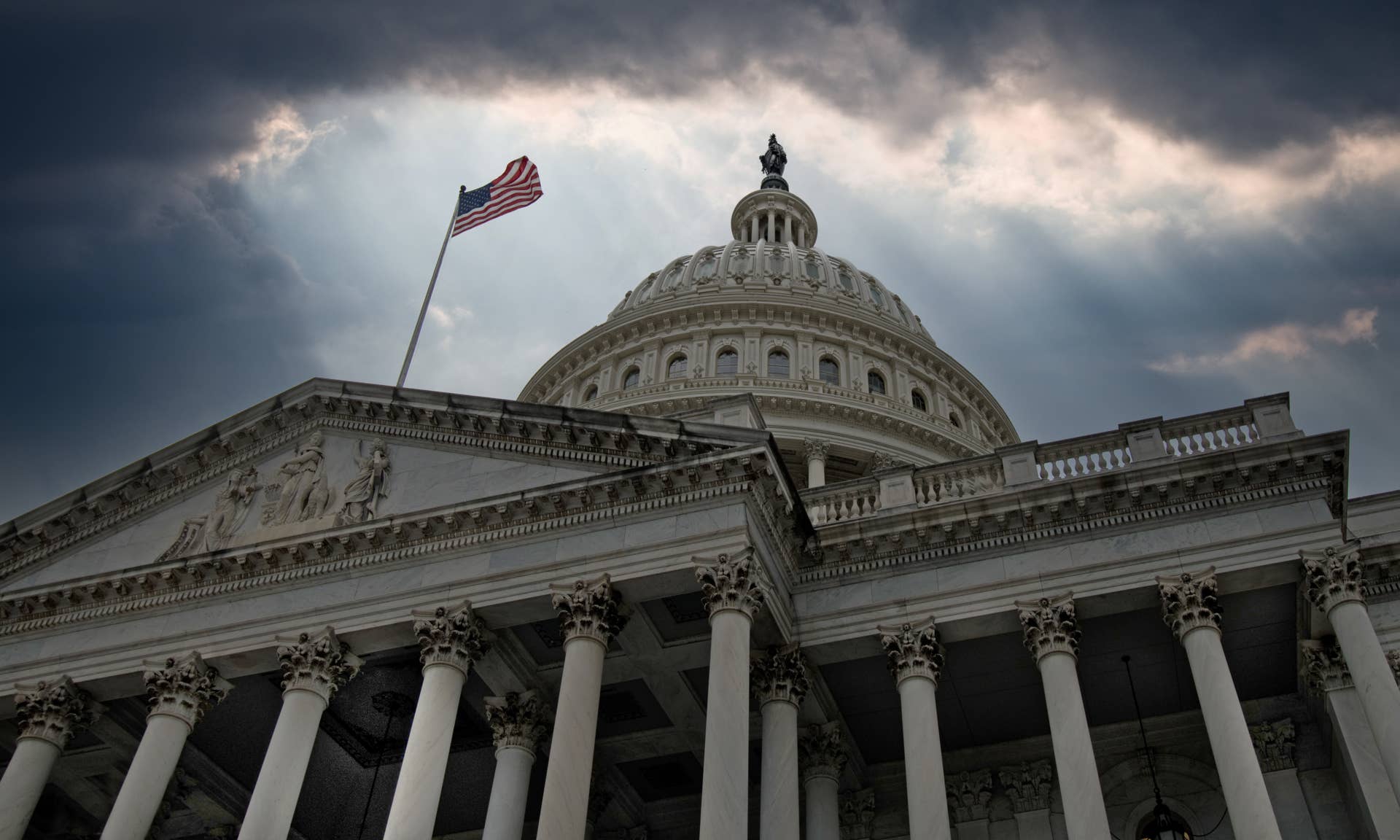 Buffett’s debt warning is gaining fiscal backing as rising interest costs, persistent deficits, and inflation reshape America’s financial outlook.
Douglas Rissing / Getty Images
What Berkshire’s equity bet signals for cash-heavy savers
Buffett may fear the dollar’s trajectory, but he is not retreating from American assets. In his 2024 and final shareholder letter, he pledged to keep Berkshire’s capital overwhelmingly in equities.
At Berkshire’s 2025 annual meeting, reported by CNBC, he told shareholders that persistent borrowing threatens the currency ordinary Americans depend on.
“We wouldn’t want to be owning anything that we thought was in a currency that was really going to hell, and that’s the big thing we worry about with the United States currency,” Buffett told attendees, CNBC reported.
“I recommend the S&P 500 index fund, and have for a long, long time, to people,” Buffett said at Berkshire Hathaway’s 2021 annual meeting, CNBC confirmed. That puts him on the opposite side of savers keeping their wealth in bank accounts or certificates of deposit.
What Buffett’s dollar warning means for your savings
Buffett’s parting message from Berkshire was an observation rooted in six decades of watching fiscal data. The debt milestone and annual interest confirmed the trajectory he warned against, Yahoo Finance reported.
MacGuineas has warned that rising interest costs threaten to crowd out government spending and flow through to the borrowing rates.
Peterson warned that the country shows no sign of slowing the pace of new borrowing, and the national debt could reach $50 trillion within six years if current policies continue.
Berkshire’s answer to persistent dollar erosion has been to keep capital in American equities, a strategy Buffett described in his 2024 shareholder letter as a preference for productive businesses over cash-based holdings.
