
Bitcoin Magazine
 Cardone Capital’s Bitcoin-REIT Hybrid: Targeting 22-32% Returns by Blending Cash-Flowing Properties and BTC Holdings
Real estate investor Grant Cardone is positioning his Cardone Capital to challenge the traditional real estate investment trust (REIT) sector by integrating Bitcoin directly into large-scale multifamily deals. With roughly $5 billion in real estate assets under management across about 15,000 units, Cardone claims the hybrid approach can deliver superior returns while onboarding new investors to Bitcoin.
In a recent interview at Consensus 2026, Cardone laid out his strategy for disrupting the multi-trillion dollar Realestate Investment Trust sector, also known as REITs, companies that own, operate, or finance income-producing real estate. Established under U.S. law in 1960, they must distribute at least 90% of taxable income as dividends to shareholders, providing investors with liquidity and yields without direct property ownership. According to Cardone, publicly traded REITs and the broader industry control over $4.3–4.5 trillion in U.S. real estate assets.
Cardone highlighted a key structural constraint during his Consensus Miami 2026 appearance: traditional REITs like Camden, AvalonBay, and others “can never ever hold Bitcoin on their balance sheet.” This limitation, rooted in the industry’s 1960s-era rules focused on real estate assets and income, creates what he calls a “glitch” in the market, a competitive opening.
Cardone’s Bitcoin Origin and Hybrid StrategyCardone first encountered Bitcoin when he was paid 115 BTC for a speaking engagement in Las Vegas, which he still holds. He has since evolved this into a hybrid model at Cardone Capital. Rather than tokenizing real estate on the blockchain, the firm acquires institutional-quality, cash-flow-positive multifamily properties at significant discounts and pairs them with Bitcoin inside a dedicated LLC.
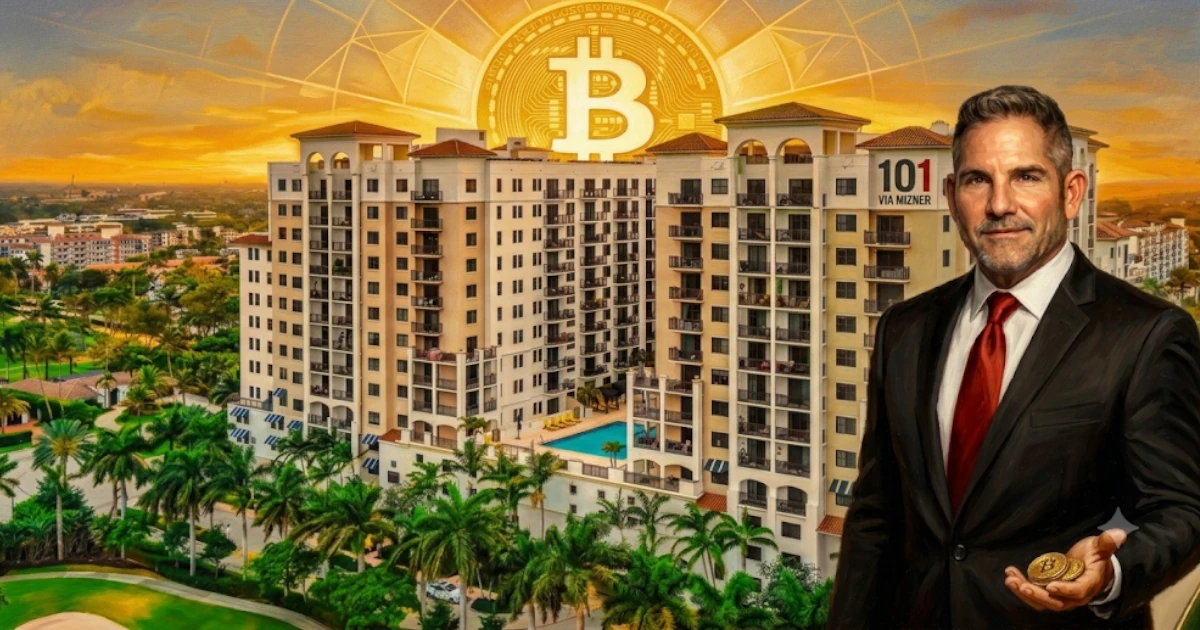
In one prominent example, Cardone Capital purchased a 366-unit property at 101 Via Mizner in Boca Raton from a Blackstone-related lender for $235 million in cash. The property, described as irreplaceable and valued at approximately $400 million replacement cost, was combined with about $100 million in Bitcoin, creating a total ~$335 million investment vehicle.
Replacement cost refers to the expense of building a comparable property today. Cardone targets assets trading at significant discounts to this benchmark. Instead of simply capturing the real estate discount, the firm allocates Bitcoin to “stuff it into the discount gap” and move the overall cost basis of the property higher. In the Boca deal, Cardone says this structure generated a $50 million tax write-off.
Commercial real estate of this sort should provide stable cash flow. Cardone suggests the Boca property is expected to return 4% per year, alongside depreciation benefits, and periodic refinancing opportunities every 7–10 years. Bitcoin adds upside potential and liquidity characteristics. He stated, “We believe by combining real estate and Bitcoin and having time… I’ll end up with somewhere between a 22 and a 32% return on an asset class that has been boring, consistent, and ancient.” The investment horizon of real estate properties of this sort is often in decades, a long-term mindset that gives Bitcoin plenty of time to grow past its short-term volatility.
In turn, this vehicle exposes new investors to Bitcoin in a risk-controlled and novel way. According to Cardone, about 80% of investors in the Boca fund reportedly had zero prior Bitcoin exposure, aligning with Cardone’s goal of “onboarding people into Bitcoin that have had zero exposure.”
Real estate is, of course, a complicated business with known trade-offs such as long hold periods typical of institutional real estate and execution risks in scaling retail participation via crowdfunding. Cardone says he has completed road shows with banks but prefers direct-to-consumer raises leveraging his audience.
Disruption PotentialCardone claims to have assembled roughly $1 billion in real estate and around 2,000 reported Bitcoin, accumulated over the last 17 months, with six deals currently in contract. He aims to disrupt the REIT sector, noting that even capturing 5–10% of the market could create significant value. Plans include a potential public listing of the hybrid structure, relying on his roughly 20 million online followers, with about 20,000 current investors.
This approach builds on Cardone Capital’s earlier Bitcoin activity, including purchases during market dips and cash-flow-backed accumulation.
Cardone views the current environment as “the greatest time in the history of the world to make money,” with Bitcoin as a beneficiary. “People gotta live someplace. You cannot live in your Bitcoin account,” he said, underscoring the enduring need for real assets alongside digital ones.
This hybrid model represents one prominent effort to bridge traditional real estate with Bitcoin treasury strategies, potentially expanding access and returns for investors. Further developments will depend on execution, market cycles, and regulatory considerations for such structures.
This post Cardone Capital’s Bitcoin-REIT Hybrid: Targeting 22-32% Returns by Blending Cash-Flowing Properties and BTC Holdings first appeared on Bitcoin Magazine and is written by Juan Galt.