
OpenAI’s ChatGPT has clearly run rampant across the tech sphere, becoming the poster child of generative AI.
Since its groundbreaking debut in November 2022, ChatGPT’s adoption curve has been nothing short of extraordinary, crossing 100 million users in just two months, quicker than TikTok or Instagram ever managed.
By early 2025, OpenAI had reported an eye-popping 400 million weekly active users, up from 300 million at the end of 2024, with reports suggesting the latest number was in the vicinity of 800 million.
Extrapolated, that’s over 3 billion monthly active users, a scale that effectively dwarfs virtually every rival chatbot combined.
Now, the AI giant behind the world’s fastest-growing app is looking to usher in an entirely new phase, one expected to reshape the power balance among Big Tech, investors, and AI itself.
What’s next isn’t another model upgrade, but a move that redefines how ambition is priced in the AI age.
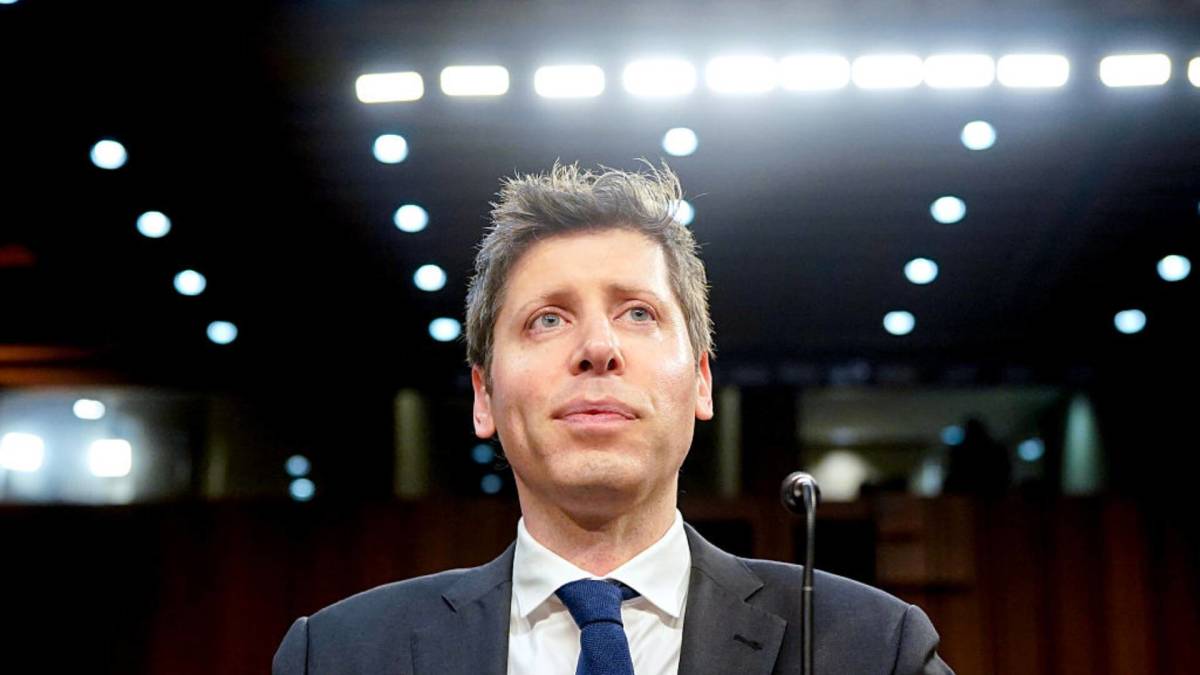 ChatGPT maker OpenAI is said to be weighing a landmark trillion-dollar IPO.
Image source: Howard/Bloomberg via Getty Images
OpenAI eyes IPO that could hit $1 trillion
OpenAI’s next big leap might not be a model drop, but a market debut.
Reuters reports that the ChatGPT maker is quietly laying the groundwork for an IPO, potentially valuing the business at up to $1 trillion, making it perhaps the largest IPO in history.
Reports suggest that the company has already discussed raising nearly $60 billion or more, with a potential filing expected late 2026 or early 2027, depending on growth and market conditions.
More Tech Stocks:
- Senior analyst lifts Palantir stock price target with a catch
- Nvidia just scored a massive AI win, but CEO Huang has regrets
- Apple’s iPhone 17 story just took an unexpected turn
- Analysts revamp Salesforce stock forecast after key meeting
However, some advisers feel it could happen even sooner.
The development comes at a time when OpenAI just rewired its structure. It recently filed for reorganization, which separates its nonprofit foundation from its for-profit arm.
The OpenAI Foundation now has 26% of the OpenAI Group, a stake that could rise dramatically if certain milestones are achieved.
Related: Nvidia’s next big thing could be flying cars
Meanwhile, Microsoft’s 27% ownership (following a $13 billion investment) could potentially be worth more than $270 billion on paper, an incredible return and validation of its AI-first strategy. Additionally, heavy hitters such as SoftBank, Thrive Capital, Dragoneer, and Abu Dhabi’s MGX would likely see substantial gains.
The numbers back the story.
Revenues for the AI behemoth surged from under $1 billion in 2022 to an estimated $12 billion in 2025.
Still, losses remain steep, at about $5 billion on $3.7 billion in revenue last year. CEO Sam Altman admits it’s a deliberate burn: “We’re building a durable business and advancing our mission so everyone benefits from AGI.”
OpenAI’s trillion-dollar debut could rewrite IPO history
If OpenAI’s rumored $1 trillion IPO takes shape, it could potentially dwarf every listing in the stock market’s rich history.
The company’s plan to effectively raise a whopping $60 billion or more might shatter IPO records, crowning OpenAI perhaps one of the most valuable publicly traded firms on earth.
Related: Apple CEO’s iPhone 17 pitch has clear message for users
Nevertheless, it has been a breakneck climb.
It started in 2015 as a nonprofit AI lab, but OpenAI transitioned to a “capped-profit” hybrid by 2019, which led to Microsoft’s massive $1 billion investment.
According to reports, the chatbot’s popularity in late 2022 catapulted OpenAI’s market valuation from $29 billion in early 2023 to $500 billion by late 2025.
Now, insiders are weighing in on the next logical step, a power-packed IPO that will redefine what scale looks like in the AI age.
The 10 biggest IPOs ever
- Saudi Aramco (2019): Raised $25.6 billion, valuing the oil giant at $1.7–$1.9 trillion.
- Alibaba Group (2014): Pulled in $21.8–$25.0 billion, effectively pegging the Chinese eCommerce giant at $168 billion.
- SoftBank Corp Mobile (2018): Raised $23.5 billion in Tokyo, valuing the telecom giant at a head-turning $63 billion.
- Agricultural Bank of China (2010): Landed $22.1 billion through dual Shanghai–Hong Kong listings.
- ICBC – Industrial & Commercial Bank of China (2006): Collected $21.9 billion, valued at $180 billion.
- AIA Group (2010): Raised $20.5 billion in Hong Kong, valuing the insurance player at $30.5 billion.
- Visa (2008): Nabbed $17.9 billion, valuing the payments giant at around $44 to $50 billion.
- NTT DoCoMo (1998): Scored $18.4 billion in Tokyo for its wireless carrier unit.
- General Motors (2010): Raised $18.1 billion in a comeback listing following a bailout.
- Enel SpA (1999): Collected $17.4 billion, valuing the Italian utility player at $55 billion.