
For most of the past four months, the story around Chevron (CVX) has been told through oil prices, Hormuz disruption data, and supply shock warnings.
CEO Mike Wirth has been a fixture of that coverage, warning about inventory drawdowns and the inadequacy of the futures market’s pricing. The conversation this week shifted to a different question: What is Chevron actually worth when you stop looking at oil headlines and start looking at the balance sheet?
The answer, based on Wirth’s own Q1 2026 earnings commentary and the company’s financial disclosures, makes a specific case that is getting harder to ignore now that the Iran deal has shifted the near-term energy backdrop.
Chevron currently trades at approximately 11 times forward earnings with a 3.42% dividend yield, backed by 39 consecutive years of uninterrupted dividend increases and $16.6 billion in free cash flow generated in fiscal 2025, CNBC reported.
Wirth touts Chevron’s strong shareholder returns
The specific quote from Wirth that investors should note came on the Q1 2026 earnings call. “This disciplined performance supports dependable cash generation, enabling us to continue returning significant capital to shareholders, while investing in advantaged long-lived assets,” he said.
Chevron had just completed its 16th consecutive quarter, returning more than $5 billion to shareholders, a streak that covers the full span of the Iran conflict and the Hormuz disruption it triggered.
More Oil and Gas:
- Goldman Sachs quietly resets oil price forecast for 2027
- JPMorgan sends another message on strait of Hormuz, oil prices
- Exxon CEO delivers blunt message on oil prices and the economy
That consistency represents a key data point. Whatever Wirth has been saying publicly about oil market fragility and geopolitical risk, the financial performance underneath those comments has continued uninterrupted.
The company’s record operating cash flow in fiscal 2025 reached $33.9 billion, which covered the dividend payment of approximately $13.6 billion more than twice over on a cash basis. This is despite an earnings payout ratio that looks elevated at 103% due to the drag from the Hess acquisition completed in July 2025.
Why the Hess acquisition changes how Chevron’s earnings look
The 103% earnings payout ratio that appears in Chevron’s recent financials is the number most likely to alarm an investor looking at the stock for the first time. It suggests the company is paying out more in dividends than it earns, which would ordinarily be a red flag for dividend sustainability.
The context is that the Hess deal, which added Guyana, Bakken, and Gulf of America assets to Chevron’s portfolio, introduced integration costs and depreciation charges that compressed reported earnings without affecting the actual cash the business generates.
The more relevant metric is the free cash flow payout ratio, which runs at approximately 82% against $16.6 billion in FCF and $13.6 billion in dividends.
Supported by operating cash flow coverage of roughly 2.5 times, a debt-to-equity ratio of 0.25, and net debt-to-EBITDA of 1.08, the financial structure gives Chevron room to maintain its payout across a wide range of oil price scenarios, Chevron SEC filings show.
How the Hormuz deal changes Chevron’s risk profile
Much of the risk language surrounding Chevron this year has centered on the same Hormuz disruption Wirth addressed at the Bernstein conference in May and on Bloomberg Surveillance later that month.
His warnings about “shock absorbers being steadily drawn down” reflected genuine supply concern, and Chevron’s less than 5% Middle East production exposure was consistently cited as making the company more insulated than peers.
With the U.S.-Iran agreement announced June 14 and the Strait of Hormuz expected to reopen, the geopolitical risk premium that had been priced into the energy sector is beginning to recede.
For Chevron specifically, that shift cuts both ways. The oil prices that supported its cash generation may soften, but the disruption overhang that has kept the stock from rating higher may also lift.
The 11x forward earnings multiple reflects a stock priced for risk more than for its underlying earnings quality.
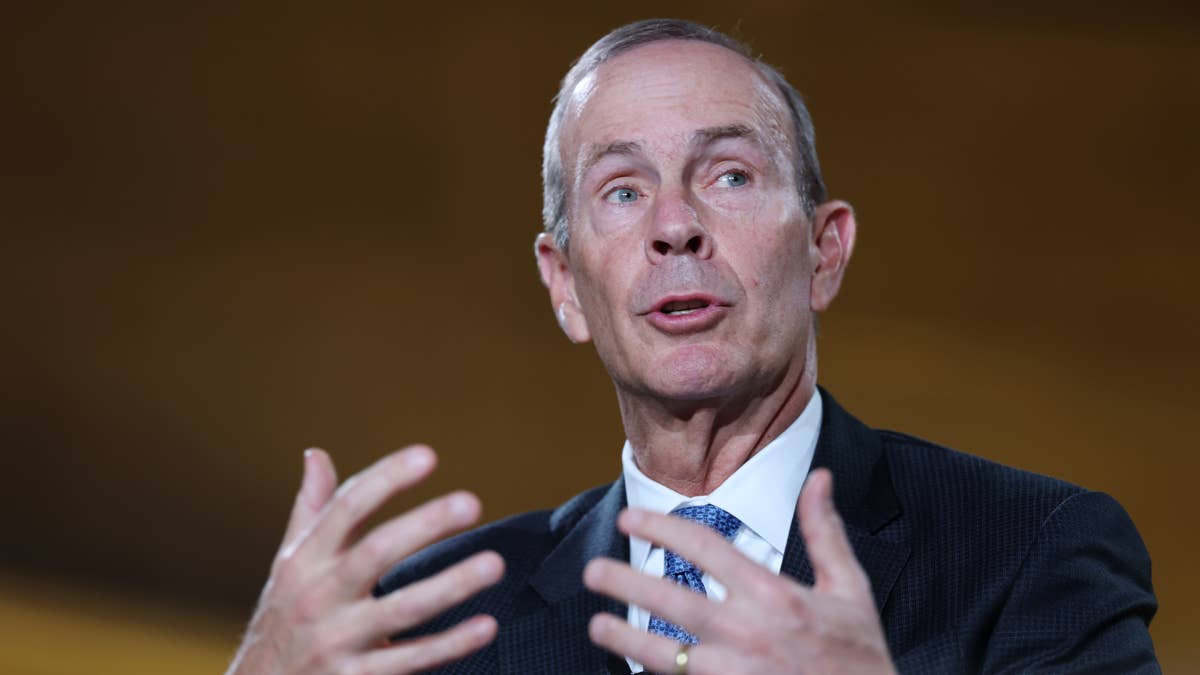 The 103% earnings payout ratio that appears in Chevron’s recent financials is the number most likely to alarm an investor looking at the stock for the first time.
Anna/Getty Images
What the dividend track record signals about management’s confidence
Chevron has increased its dividend for 39 consecutive years, a streak that encompasses the 2014 to 2016 oil crash and the 2020 pandemic-driven demand collapse. In both cases, the company maintained its payout when peers cut theirs, a decision that required burning through cash rather than protecting the balance sheet in the short term.
Wirth’s language on the Q1 2026 call, characterizing capital returns as “dependable” rather than contingent, is consistent with that historical posture.
The January 2026 dividend increase of 4% to $7.12 per share was the most recent move in that streak. The company’s $3 to $4 billion structural cost reduction program, which is still in progress, is designed to protect the dividend’s underpinning, even if Brent were to fall to the $70 range now being discussed in the context of the Iran deal.
Below $55, according to the analysis of Chevron’s disclosures, is where the payout would face meaningful pressure, a scenario that has become materially less likely with the conflict resolution underway.
What investors should watch now that the backdrop is shifting:
- Brent crude’s direction from current levels will be the most direct driver of Chevron’s free cash flow in the next two quarters, and the $70 near-term range being discussed by some analysts would still support the dividend while testing the buyback program, 24/7 Wall Street confirmed.
- The Hess integration timeline matters for when reported earnings normalize. Chevron SEC filings show the acquisition closed in July 2025. Once the acquisition drag diminishes, the earnings payout ratio should fall back below 100%, removing one of the most visible concerns about dividend sustainability.
- Regarding Chevron’s Venezuela exposure, Wirth has said the company could ramp output by 50% within 18 to 24 months under better fiscal conditions from the current output of approximately 800,000 barrels per day, CNBC reported. This is an upside optionality that does not depend on Hormuz and could support production growth, regardless of how the Middle East situation evolves.
- Chevron has maintained its dividend through 16 consecutive quarters of the current disruption cycle while returning over $5 billion to shareholders each quarter. That streak, if it continues through the reopening period, would represent one of the more durable capital-return records in the sector across an unusually volatile stretch of energy-market history.
The message Wirth is sending about Chevron stock itself
Wirth’s public commentary over the past four months has been primarily about the oil market. His Q1 earnings language was about Chevron, and the distinction is notable. The Bernstein and Bloomberg Surveillance appearances addressed a macroeconomic uncertainty that is now partly resolving, while the Q1 call addressed what the business can sustain across that uncertainty.
A company trading at 11 times forward earnings with 39 years of uninterrupted dividend growth and $16.6 billion in annual free cash flow is not being priced as a quality business. It is being priced as an oil market bet.
Wirth’s consistent message about capital discipline, dependable returns, and structural cost reduction effectively argues that those two framings are not the same thing. The market may also be conflating short-term energy price uncertainty with long-term fundamental weakness in a business that has shown neither.
Related: Chevron CEO sends blunt message on oil, the economy