
Quietly, Venezuela is starting to become investable again. Despite insiders like ExxonMobil CEO Darren Woods initial hesitation (he previously called it uninvestable), big oil is kicking tires and evaluating opportunities in Venezuela, including Chevron.
The Latin American nation has reacted to the U.S. move to essentially take control by making its vast oil resources available again to outside investment.
During the tenures of Hugo Chavez and Nicolás Maduro, the state controlled the energy industry and did it badly.
The Venezuelan state basically ran the industry into the ground, and the country, once among the richest in South America, became worse than economically stagnant. Conditions were so bad, people left.
Moreover, the United States had imposed strict sanctions against Venezuela that limited investments in the country.
Trump involvement opens doors in Venezuela
When the Trump Administration was able to take Maduro and his wife into custody on drug charges in early January, it also moved to eliminate or trim the sanctions to get Venezuela’s energy industry moving again.
From the U.S. point of view, that meant enticing global companies to come in, put money to work and get people working.
President Donald Trump organized a summit on Jan. 9 to see if companies were willing to invest up to $100 billion in Venezuela.
Also read: Exxon Mobil’s future rests on massive play (it isn’t Venezuela)
The Trump Administration followed up by permitting Shell, BP, Chevron, Eni and Repsol to negotiate with the Venezuelans.
The energy companies had their own agendas. Some like refiner Valero were more than happy to get permission to start buying Venezuelan crude. It is often quite heavy but can be refined into diesel, jet fuel and other products, including gasoline.
Among their biggest concerns was getting politics and graft out of the energy business.
As a big demand: Guarantees that their investments would not be expropriated. That was the biggest concern for ExxonMobil, which has had its holdings in Venezuela expropriated twice by the government.
Exxon is also heavily involved in the major offshore Guyana discoveries.
Venezuela’s government enacted new laws designed to address those issues.
More Oil and Gas:
- Valero targets billion-dollar Venezuela oil windfall
- Goldman Sachs reveals top oil stocks to buy for 2026
- U.S. economy will show resilience, despite rising oil prices
Chevron and Shell cut new Venezuela deals
Two deals have come together for Venezuela. Chevron, which was producing oil under a license from the Biden Administration, has worked out a land swap with Petroleos de Venezuela, S.A., the state-owned company known best as PDVSA.
The result will be a vast increase in Chevron’s acreage in the Orinoco region. That’s the oil-rich region in the eastern portion of the country that many believe is the future for the energy industry going forward.
Chevron has long been interested in the area, but development has been held up by political and economic turmoil.
Related: Valero targets billion-dollar Venezuela oil windfall
In exchange, PDVSA will acquire valuable natural gas acreage in western Venezuela and two interests in Venezuela’s Loran gas field off the coast. The gas field is being developed jointly by Venezuela and Trinidad and Tobago.
The second deal involves Shell Oil, which wants to be involved in Venezuela’s Dragon offshore gas fields. Shell already has investments in Trinidad and Tobago. Shell would tie a new Venezuelan operation into the Trinidad business.
Dollar amounts of the deals weren’t available.
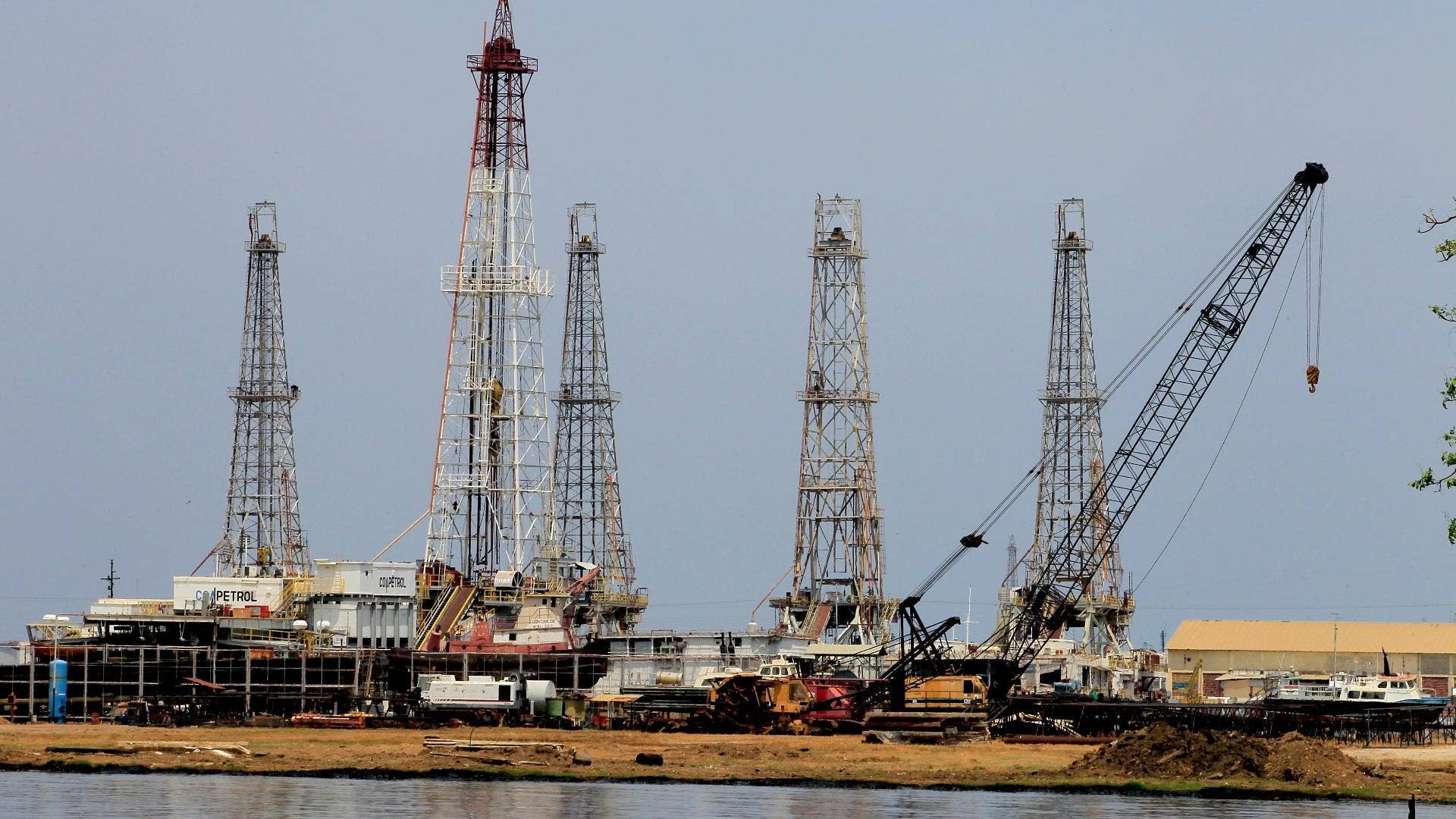 Drilling rigs at Cabimas along Lake Maracaibo.
Jose Bula Urrutia/Getty Images
Environmental worries still in play
It should be noted that environmental groups are skeptical that the new investments will not damage Venezuela’s environment.
Sloppy drilling and production processes over many years had badly damaged the fisheries and shoreline around Lake Maracaibo, where Venezuela’s first energy discoveries were made as early as the 1920s.
Most of the damage has not been cleaned up.