
Americans have lost their confidence in the safety of food sold to them by grocery stores.
The timing of Gallup’s annual survey, however, may have impacted the results.
This year’s survey was conducted as a major U.S. cyclospora outbreak that began in June started to wane and officially ended on Sept. 11. Likewise, the 2024 reading came amid numerous food recalls and serious illnesses linked to contaminated produce and other foods.
“Americans’ confidence that food sold at most grocery stores is safe to eat has fallen to its lowest level Gallup has recorded, with 65% now very or somewhat confident. That is down from 73% last year and 72% in 2024, and well below the 81% recorded in 2019,” according to a Gallup poll.
- Confidence in grocery store food has dropped below 70% for the first time.
- 47% are confident in the federal government to ensure food safety, a new low.
- 73% have avoided certain foods after a recall or advisory, up from 53%.
Retailers have taken different steps to address this, and Costco has an aggressive set of standards for its vendors that members likely know nothing about.
Costco has clear food standards
RTMNexus CEO Dominick Miserandino told TheStreet that Costco members expect more from the brand.
“Costco has built its business on the idea that it carefully selects products for its members. That creates a higher expectation. When consumers pay for a membership, they’re not just buying access to lower prices. They’re buying into a level of trust. One food safety problem can undermine that confidence quickly,” he told TheStreet.
More Costco
- Costco helps members solve a key problem, but at a cost
- Costco quietly made a big pricing change
- Costco beats Aldi, Kroger, and Publix where shoppers care most
The warehouse club shared some of its standards on its sustainability website.
“Costco buyers work with our suppliers to continually improve our sourcing practices. This enhances the quality and value of Kirkland Signature products, provides a fair return to people in the supply chain, and facilitates access to global or regional markets,” the company wrote.
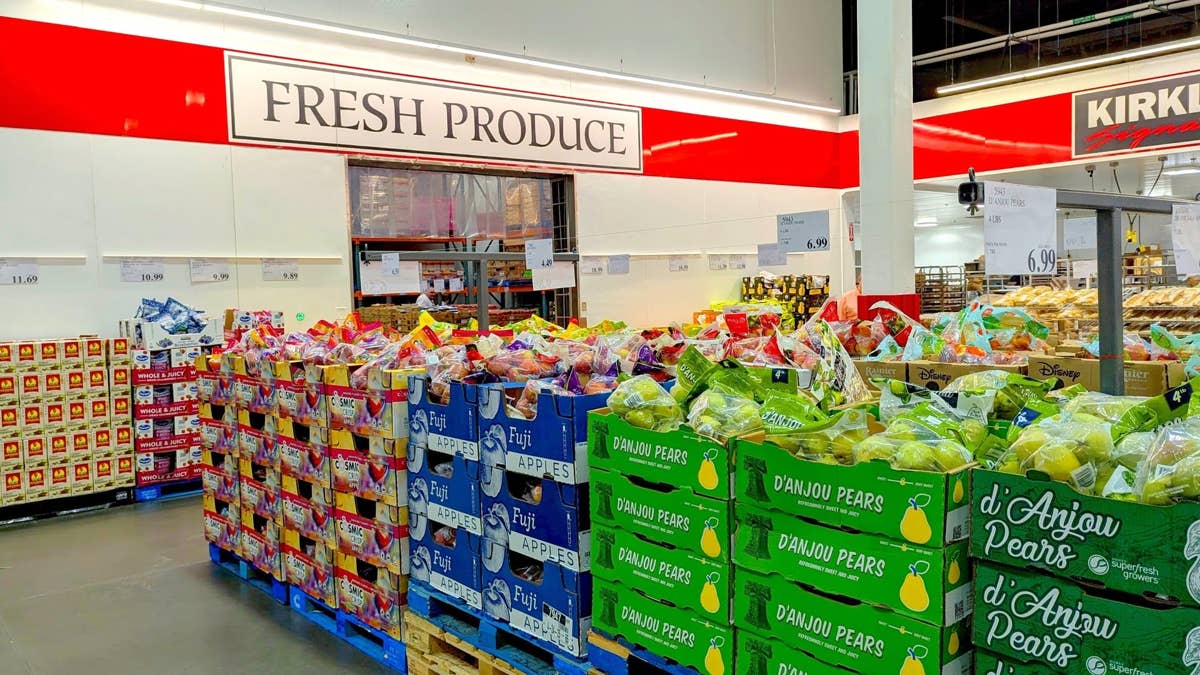 Costco has strict standards for its food vendors.
Shutterstock
Costco shares its food standards
Costco has a guide for its vendors called the “Global Food Safety Audit Expectations,” last updated in September 2025. These are some of the rules it shares with its suppliers.
Surprise inspections
- No warning: Costco’s audits “must be unannounced and conducted within a 60-day audit window.” Before this version, the window was 90 days.
- No hiding: Suppliers can’t block out dates to dodge an auditor. Blackout dates are “strictly limited to non-production days.”
- Costco can watch: A Costco employee can shadow the outside auditor for the entire inspection.
What gets a supplier flagged immediately
- Pests: “Evidence of decomposed pests in the interior of the facility (including decomposed pests in traps).”
- Sick workers: “Employees with sores, infected wounds, or other infectious illnesses are observed in contact with raw materials.”
- Faked paperwork: “Falsification or fabrication of documents or records.” The standard says bribery, corruption, and deception can get a supplier terminated.
- Bad water: “Facility water is not from a potable source.”
Keeping junk out of your food
- Detectors required: Manufacturers must have a system that catches foreign objects, such as metal detectors, X-ray, sieves or optical sorters.
- Frequent checks: The detectors must be tested “at ≤ 2 (two) hour intervals during the production run.”
- Caps aren’t enough: “Caps are not an adequate hair cover or hair restraint.” Hairnets are required around exposed food “regardless of risk level.”
Testing and tracing
- Ground beef: It is tested for the deadliest E. coli strain at “N=60 per 2000 pounds.” That rule is in the companion appendices file.
- Held until tested: High-risk food stays off trucks until test results clear it.
- Two hours to find everything: Suppliers must “account for 100% of the product in a two-hour timeframe.”
- Water: Municipal water must be tested yearly and private wells “quarterly.”
Audits and inspections, however, are no guarantee of safety.
“We’ve seen examples of facilities that have received favorable audits, only to be linked to foodborne illness outbreaks,” Ben Chapman, a food safety researcher at NC State, told NC State News.
Costco communicates with members
Costco also has a plan to alert members when a product has been recalled.
The warehouse contacts members via email, text, or phone, sometimes even a day or two before the recall is announced by the FDA or USDA.
Craig Wilson, former vice president of food safety at Costco, told Consumer Reports “the company can move more quickly than a federal agency because it hears directly from its supplier.”
GlobalData Managing Director Neil Saunders thinks that all retailers selling fresh food need to dedicate themselves to safety.
“Food for sale being safe to eat is one of the most basic and foundational aspects of grocery retail. Highly publicized issues and recalls erode confidence in the whole industry, regardless of where the problem originated,” he posted on RetailWire.
He thinks that Costco is one of the retailers that has stood out in this area.
“However, the reputation of individual grocers can offset some of the damage. Whole Foods, for example, has relatively high levels of trust because its commitment to quality and sourcing is genuine and most people know it to be so. The same holds true for Costco. Interestingly, grocers with high private label penetration have more skin in the game as the products are directly associated with their brands,” he added.
Related: Kroger and Albertsons shoppers caught in an $8 billion breakup fight
