
A few weeks ago, I was standing in line at Target when I made a decision that felt almost automatic. I opened Uber Eats and ordered the same items I was holding in my cart from the store I was physically in, then left the checkout line altogether. The difference wasn’t price. It was time.
By the time I reached my car, the order was already being picked. I went home and waited for delivery rather than re-entering the queue.
The only real tradeoff came later, when a shopper substituted toilet paper for the paper towels I selected. Even with that imperfection, the experience still felt better than standing in line.
That small decision reflects a broader shift in retail behavior. The checkout process is no longer just the final step of a purchase; it is increasingly the moment that determines whether the purchase happens in-store at all.
“One of the most crucial elements contributing to a customer’s opinion of a retailer is their experience in the checkout line. Customers begin making an assessment of a store from the moment they walk through the door, but that judgment can shift based on the encounters they have from start to finish, especially at the finish,” according to Retail Customer Experience.
That kind of behavior is what makes checkout speed a make-or-break moment in the shopping journey rather than just an operational detail.
- Close to 50% of all customers will purposely avoid a retailer or brand in the future if they had to wait longer than five minutes.
- One-third of customers forced to wait for over five minutes have abandoned the checkout line.
- Nearly half of those surveyed avoid a store because of someone else’s negative experience.
- After 2.5 minutes, customers will become frustrated if there is no progress in the line.
- If a checkout process is being actively managed, customers are more willing to tolerate the wait time. Source: Retail Customer Experience
Slow checkout can ruin an otherwise pleasant shopping experience, and Costco has taken significant steps to improve its performance in that area.
Costco makes multiple checkout investments
It is not just Costco where this is showing up. Across large retailers, the checkout experience has become a key pressure point as shoppers increasingly split between in-store browsing and app-based fulfillment.
That’s an issue Costco has decided to address, however.
Costco has typically used a very traditional checkout where store employees check your membership card, then scan all your items by hand.
The warehouse club tested self-checkout, but ultimately removed it from most stores.
Now, the membership-based chain has added a number of changes to its warehouses that improve the checkout experience.
“In digital, we continue to make strides with our road map to deliver a more seamless experience for members in warehouse and online. In the warehouses, we’re achieving meaningful improvements in the speed of checkout, employee productivity, both as a result of our mobile wallet enhancements, pharmacy pay ahead and the rollout of employee pre-scan technology,” CEO Ron Vachris shared during the chain’s second-quarter earnings call.
Costco has also been testing an even faster checkout program.
“We’re also piloting automated pay stations that will allow members to pay for their pre-scanned orders seamlessly, with an average transaction time of around 8 seconds. Early results show this is improving the flow of traffic, and we’ve received great member feedback,” he added.
These improvements position checkout speed as an operational metric on par with price and inventory efficiency.
Faster checkout equals happier Costco members
Because of its membership-based business, Costco’s biggest concern isn’t sales; it’s membership retention. Creating a better checkout experience helps drive renewals as people don’t like standing in line.
Vachris made it clear that Costco wants to deliver a better experience for members in his remarks during the Q1 earnings call.
“This isn’t about technology for technology’s sake. It’s about using technology to strengthen the fundamentals that make Costco who we are. Increasing member loyalty, driving top-line sales, and improving efficiency in our operations so that we can bring goods to market at the lowest possible price,” he said.
More Costco:
- Costco reveals shift in shopper spending behavior
- Costco’s latest food court treat has fans divided
- Sam’s Club, BJs gain traction in area Costco dominates
The investment has paid off, and that’s before the new pilot tech.
“The warehouses that are first to adopt this pre-scan technology have shown checkout speed improvements of up to 20%. And across our U.S. warehouses overall, we achieved record levels of checkout productivity in the final weeks of the quarter,” he added.
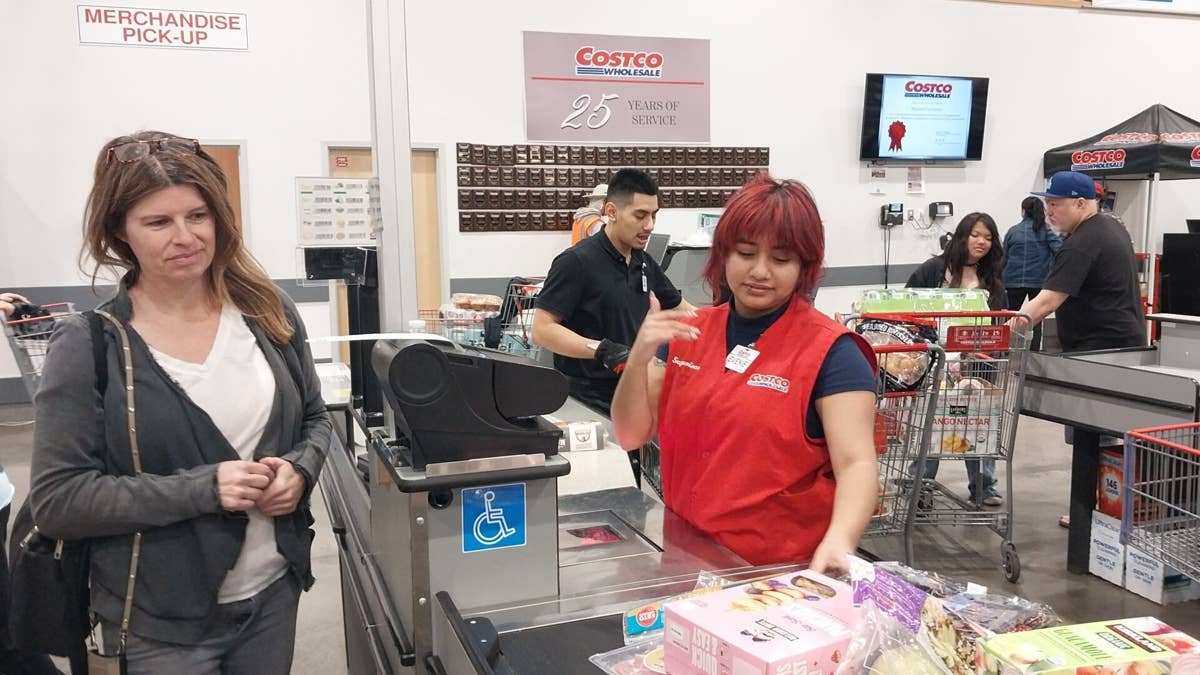 Costco has been experimenting with new checkout models.
Shutterstock
Analysts see checkout as a pain point
Mark Hunter, an experienced retail operator and member of RetailWire’s Brain Trust, thinks that technology is not the answer.
“The front-end will always be a source of frustration. Some will argue self-scan is the solution yet at the same time self-scan is certainly not the fastest compared to a manned express-lane that has no line. The key is in providing the consumer with enough distractions they do not notice they’re waiting in line,” he wrote on RetailWire.
GlobalData Managing Director Neil Saunders thinks that retailers need to be thoughful in their checkout investments.
“When it comes to ordering and checkout, one size does not fit all. Consumers want choice and that means retailers need to have manned checkouts (at sufficient capacity) as well as self-checkouts and other options,” he shared on RetailWire.
He also noted that the current version of self-checkout many retailer use is not adequate.
“More thought needs to be applied to the process. As currently configured, self-checkout in most U.S. grocery stores is inefficient. Shoppers schlep [a]round, putting stuff in their carts, unload it and scan it, and then put it in bags,” he added.
Related: Another mall retailer quietly closed over 150 locations
