
Costco has made keeping prices low a core piece of its promise to members. It can afford to do that because people pay for access to its warehouse clubs.
That membership payment, $65 for Gold or $130 for an Executive membership, which comes with 2% cash back up to $1,250, supports the chain’s bottom line, allowing it to take a slimmer margin on items it sells, compared to rival retailers.
The problem, and it’s one that has impacted me many times, is that its goal is to bring down the cost per item. When I buy a pack of 12 toothbrushes, and use them over three years, I saved money over buying individual toothbrushes from rival retailers.
Where consumers can go wrong is when they buy a giant bottle of 500 Tylenol, or a package with 200 K-Cups, and some of the product goes bad before they use it.
Costco has very clear internal logic on prices and how it sets them, keeps them low, and even lowers them. CFO Gary Millerchip talked about those things during the chain’s first-quarter earnings call.
Costco shares its pricing philosophy
Costco uses its house brand, Kirkland Signature, to help keep prices down. Kirkland Signature alone generated $86 billion in sales last year, making it bigger than many top national brands and highlighting Costco’s scale and pricing power.
Millerchip was asked about that during the Q1 earnings call.
“I think all of the lower price examples you gave were Kirkland products. So are most of your heaviest price investments on your private brand products?” Truist Financial analyst Scott Ciccarelli asked.
Millerchip responded.
“The second part of your question around Kirkland Signature, you know, I think it’s more a reflection of, you know, we tend to have a, obviously, a very strong understanding of the cost involved in those items, and we want to be always the first to lower prices for our members and the last to increase them,” he shared.
Costco partners with big-name brands to create Kirkland Signature products.
“Buyers and our category managers who look at those items, whenever we see an opportunity either to work with our partners or to find ways to buy more effectively, want to be looking for those opportunities,” the CFO added.
The warehouse club is well-known for asking its suppliers to find ways to lower costs, then passing those savings on to members, Millerchip explained.
“In most of those cases, that’s us really working very closely with our suppliers to look at what we’re seeing in the cost base and working creatively to either increase buying globally, so that we can improve our economies of scale or looking at ways to operate more efficiently, without ever compromising on the quality of those,” Millerchip shared.
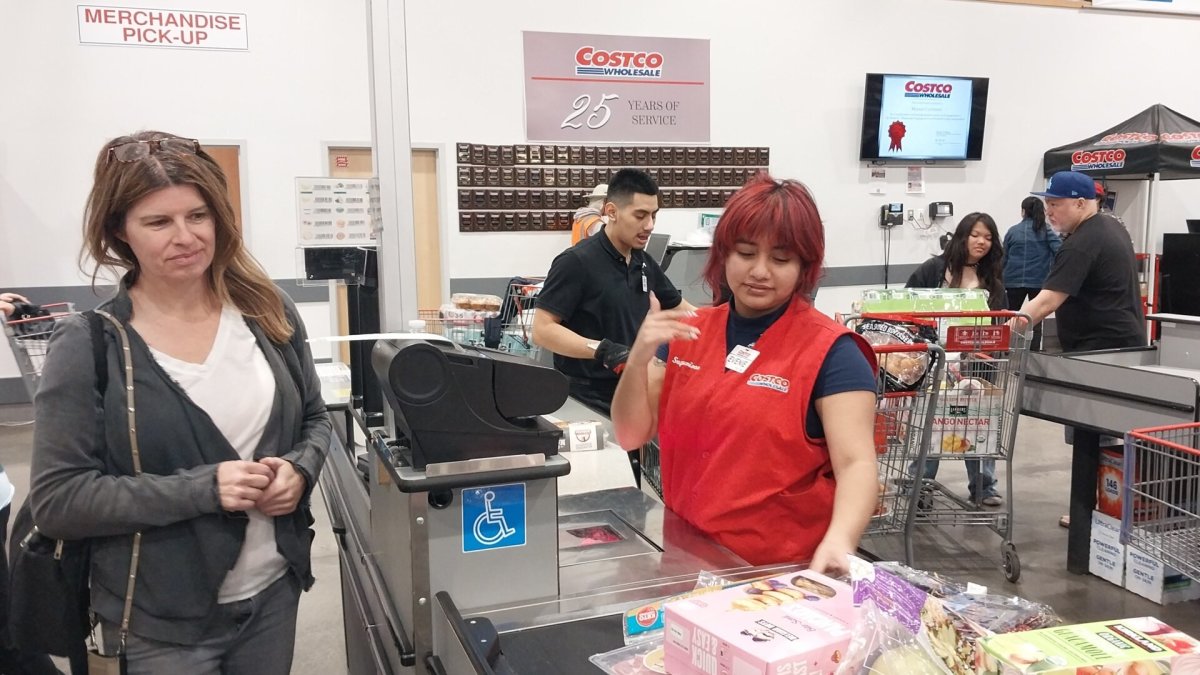 Costco’s house brand, Kirkland Signature, has helped it keep prices down.
Shutterstock
Key facts on Costco pricing
- Membership model underpins low pricing: Costco’s recurring membership fees provide a stable revenue stream that allows the company to operate on very thin product margins and focus on volume sales rather than markups. This subsidizes lower prices for members, according to Nasdaq.com.
- Bulk buying and purchasing power: By purchasing products in large quantities and limiting its SKU count (about 4,000 per warehouse), Costco negotiates deeper discounts with suppliers and passes those savings on to members, reported The Motley Fool.
- Slim markups and cost discipline: Costco intentionally keeps product markups very low (often capped well below typical retail levels), which reinforces its value proposition of everyday low prices, rather than relying on frequent promotions, according to Latterly.org.
- Operational efficiency and no‑frills stores: Costco’s warehouse‑style presentation and minimal overhead (no elaborate displays, limited advertising) reduce operating costs, helping keep prices down, shared Marketing Scoop.
- Economies of scale and supplier leverage: The company’s size and loyalty with its high membership renewal rates give it strong bargaining power with manufacturers, further lowering the net cost of goods, according to Nasdaq.com.
Kirkland Signature has been a driver for Costco
The Wall Street Journal did a deep dive into Costco’s succes with its house brand, which showed just how massive Kirkland Signature has become.
“Costco went against industry standards in 1995 with the creation of its private label, Kirkland Signature. With $86 billion in sales last year, Kirkland is now a bigger brand than Procter & Gamble and Kraft-Heinz. Compared with other mass retailers like Target and Walmart, which have multiple brands, club channels like Costco and Sam’s Club are winning the private-label food and beverage space by consolidating,” the newspaper shared in a YouTube video.
The warehouse club has strict caps on how much it marks up items.
“Costco’s move was designed to preserve margins. With its focus on value, Costco caps its markups at 14% for outside brands and 15% for store brands,” RetailWire shared.
Craig Sundstrom, a member of RetailWire’s Brain Trust, said that the strategy works for Costco.
“A single name offers simplicity, and when you’re mostly selling something simple like paper towels or commoditized food like canned corn, that’s likely to overwhelm other concerns,” he wrote.
It may not work for other retailers, he added.
“But someone like Macy’s, or even Target, that is trying to convince customers its own offerings are as good as a variety of branded products, often needs to go to great length to imitate those brands, artsy name and all,” he shared.
Gary Sankary, a 50-year retail veteran, agrees with his Brain Trust colleague.
“However, watching big boxes cycle through the process of introducing and retiring their owned brand labels every few years to convince customers that new is better, at the same time, is confusing and, in many cases, dilutes their brand, shortening their lifecycle even more,” he posted.