
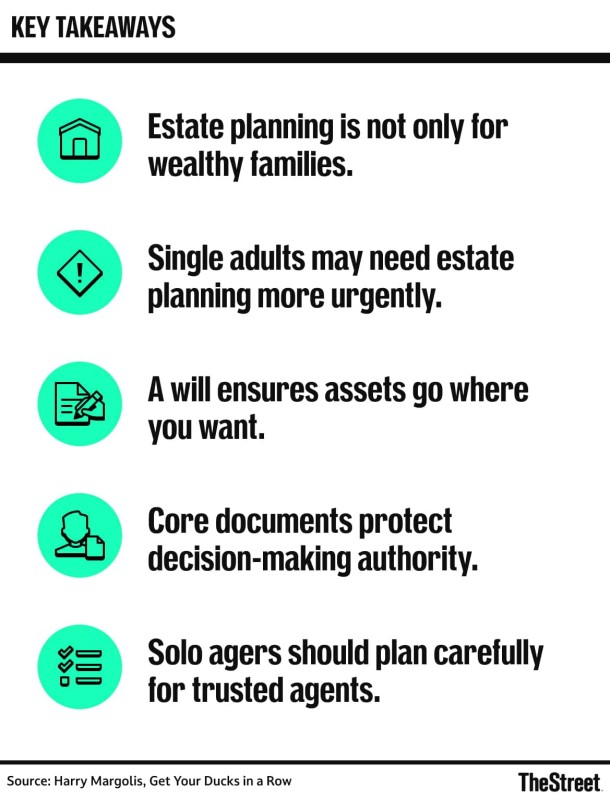
Many people assume estate planning is only necessary for families with significant assets, spouses or children.
But in a recent interview, Harry Margolis, author of “Get Your Ducks in a Row,” said the opposite can often be true. Individuals who are single, have modest assets and no children may actually have a greater need for a clear estate plan.
Without one, critical decisions about finances, health care and the distribution of assets may be left to state law or to people who were never chosen for those roles, he said.
For households planning their financial future, the key issue is control: Who will handle your affairs if you become incapacitated, and who will carry out your wishes after you die?
Below is a transcript of that interview, edited for clarity and brevity.
Do single people with few assets need a will?
Robert Powell: Do you need an estate plan if you have little in the way of assets, you’re single and have no children?
Here to talk with me about that is Harry Margolis, author of “Get Your Ducks in a Row.” Harry, welcome.
Harry Margolis: Good to see you again, Bob.
Why estate planning matters, even without family
Robert Powell: This is a question I often get. I’m sure you hear it as well. If someone is single, has modest assets and no children, what’s the point of having an estate plan?
Harry Margolis: In many ways, that’s exactly why you need one.
When you’re single and don’t have children, you don’t have the natural people in place – a spouse or kids – to step in and handle things if you can’t manage them yourself. That could happen if you become physically or cognitively disabled, or after you pass away.
Different states have different rules. Some states presume certain people can serve as your health care agent or manage financial matters. Other states require that you appoint someone directly.
But if you don’t have family members who would naturally fill those roles, it becomes even more important that you formally appoint someone to do so. You can do that through a power of attorney and a health care proxy or health care power of attorney.
What happens if you die without a will
Harry Margolis: The same issue arises with your assets.
Even if you don’t have a lot of assets, the state still needs to determine who receives them when you pass away. If you die without a will, the state follows what are called the rules of intestacy.
These rules essentially follow your family tree. If you are married, your spouse typically receives some or all of your estate. If you have children, they receive the rest.
If you are single and have no children, your estate usually goes to your parents, if they are living. If not, it may go to siblings, nieces and nephews, cousins or other relatives.
That distribution may or may not reflect what you actually want. With a will or trust, you can choose where your assets go instead of leaving that decision to the state.
Why a will with beneficiary designationsstill matters
Harry Margolis: Even if most of your accounts have beneficiary designations, it’s still important to have a will.
Also worth reading
- Retirees may want to rebalance as markets broaden, volatility rises
- Why “breaking even” on Social Security is the wrong goal
- The $83,250 secret every solo entrepreneur needs to know for 2026
- Medicare mistakes seniors wish they’d known sooner
- Elon Musk says stop retirement saving: Experts call it ‘nonsense’
- Social Security benefits could drop 7% in 2032
Someone still needs to handle the administrative responsibilities after your death. That includes tasks such as cleaning out your apartment or house, selling property if you own a home, and filing your final income tax return.
A will allows you to appoint someone to serve as the executor or personal representative who will carry out those duties.
Key estate planning documents for single individuals
Robert Powell: So it sounds like the basic estate planning documents are similar to what anyone would need: a will with an executor, a durable power of attorney for financial matters, and one for health care decisions. Perhaps HIPAA releases as well. Anything else?
Harry Margolis: That’s generally the core of it.
One complication for people who are sometimes called “solo agers” is that they may not have someone obvious to appoint for those roles.
In those cases, some nonprofit organizations or church groups may be willing to serve as an agent under a health care proxy or power of attorney, or as the personal representative of the estate.
Lawyers are sometimes willing to serve as executor or personal representative because that role is largely administrative. But many attorneys are reluctant to act as health care agents.
Those responsibilities can be very personal and time-consuming, and if the attorney is billing by the hour, it could significantly reduce the estate.
Bottom line for solo individuals
Robert Powell: So the bottom line is that even if someone is single, has modest assets and no children, they still need an estate plan with the same core components as any other plan.
Harry Margolis: That’s right.