
Faced with tariffs and other geopolitical unknowns, the European Central Bank (ECB) on Thursday adopted a “wait-and-see” approach to interest rates.
That’s the same action the Federal Reserve has been undertaking, leaving President Donald Trump infuriated over the lack of U.S. rate cuts this year.
💵💰Don’t miss the move: Subscribe to TheStreet’s free daily newsletter💰💵
ECB President Christine Lagarde said the central bank held interest rates steady despite describing the economy as being in “a good place” and as “resilient.’’
Inflation is “more uncertain than usual due to trade tensions,’’ Lagarde said at a press conference following the ECB meeting.
Related: Former Fed Chair sends stern message on economy, Fed
Those trade tensions are also what some Fed watchers say will prompt the Federal Open Meeting Committee (FOMC) to keep the Federal Funds Rate steady at 4.25% to 4.50% July 29-30.
But not all FOMC members are in agreement on this monetary policy action.
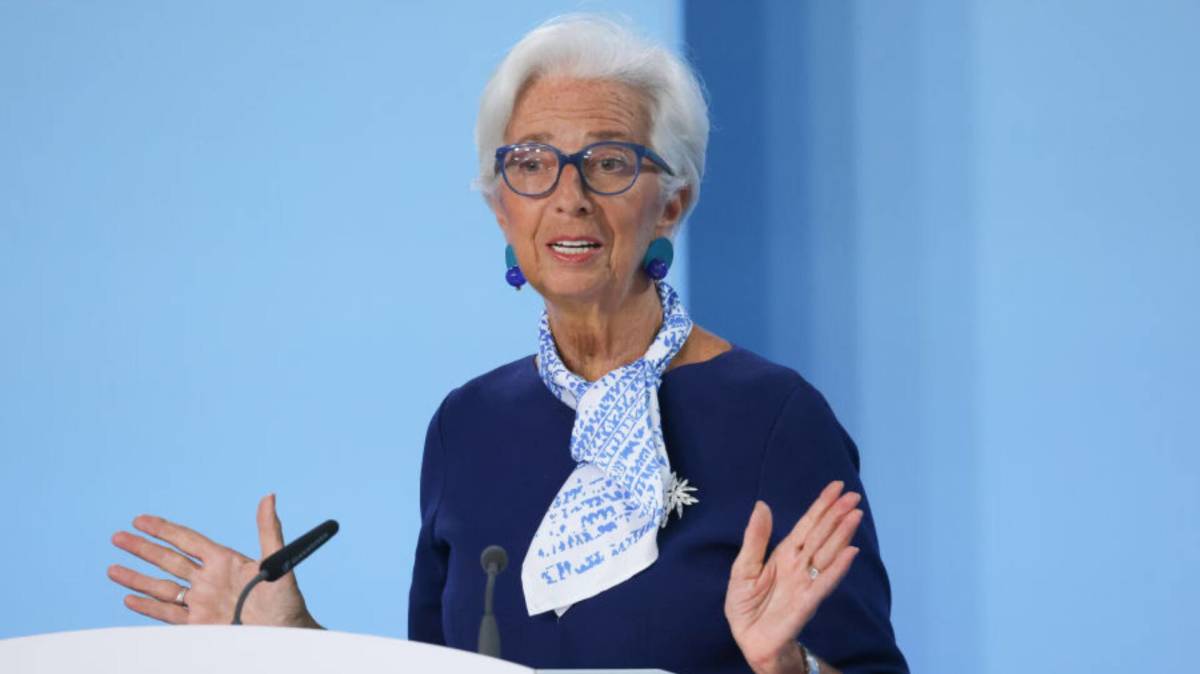 ECB President Christine Lagarde said today that the central bank held interest rates steady despite describing the economy as being in “a good place” and as “resilient.’’
ECB keeps 3 key interest rates unchanged
As expected, the European Central Bank left interest rates unchanged after cutting them eight times in a year.
Inflation is currently at the 2% medium-term target.
Last month, the ECB cut its policy rate to 2%, halving it from 4% a year earlier in that post-pandemic eurozone economy.
With inflation expected to stay at the 2% rate, the ECB’s policy-making Governing Council painted a balanced picture of the EU economy, with the near-term uncertainty over trade offset by future public investment.
News reports had been indicating a possible deal based on a 15% tariff on U.S. imports of EU goods before the Aug. 1 deadline set by Trump.
“We are attentive to where the negotiations are heading (but) we take the news one day at a time,” Lagarde told the press conference.
“The sooner this trade uncertainty is resolved, the less uncertainty we will have to deal with and that will be welcomed by many economic actors including ourselves,’’ she said.
Related: June inflation numbers reset Fed interest rate cut expectations
Higher tariffs could be inflationary by disrupting existing supply chains or they could slow investment, growth and inflation.
Eurozone economy appears balanced
The ECB’s policy-making Governing Council painted a balanced picture of the economy, with near-term uncertainty over trade offset by public investment further down the road.
“Partly reflecting the Governing Council’s past interest rate cuts, the economy has so far proven resilient overall in a challenging global environment,” the ECB said in a press release. “At the same time, the environment remains exceptionally uncertain, especially because of trade disputes.”
Reports have suggested a possible deal based on a 15% tariff on U.S. imports of EU goods.
Lagarde said the ECB remained in a “wait and watch” position regarding future interest rate decisions.
Fed shares ECB tariff inflation concerns
The tariffs, announced on “Liberation Day’’ in April, are the highest in nine decades, ranging from 10% to 50% on imported goods and services.
More Economic Analysis:
- GOP plan to remove Fed Chair Powell escalates
- Federal Reserve official gives green light to July rate cut
- Trump deflects reports on firing Fed Chair Powell ‘soon’
- Former Federal Reserve official sends bold message on ‘regime change‘
The Trump administration and its allies say the tariffs’ impact will be transitory, meaning it will represent a one-time hit to prices but not multiply and ripple through permanently.
Hence, Trump has demanded an interest rate cut as high as 3% starting with next week’s FOMC meeting.
The president has said the current interest rates are holding back the American economy from robust growth and hurting the wallets of Americans looking to buy a house or borrow money for other causes.
The Federal Reserve has one job
The Fed’s dual congressional mandate is to maintain 2% inflation and keep unemployment rates stable with steady GDP growth. It uses interest rates as a tool to manage monetary policy.
The Federal Open Meeting Committee is the Fed’s 12-member policymaking panel headed by Fed Chair Jerome Powell.
The FOMC has been holding the Federal Funds Rate steady at 4.25% to 4.50% in anticipation of inflation bubbling up this summer and perhaps even this fall from Trump’s tariffs and trade wars.
The Federal Funds Rate is the price the Fed charges U.S. banks to borrow money overnight. This in turn sets the pace for short-term costs of borrowing money like credit cards and auto and student loans.
The 10-year Treasury Bond yield is the benchmark for longer-term interest rates like the 30-year fixed mortgage, currently hovering around 6.8%. The market expectations for how the Fed will set rates in the future influences long-term rates.
Trump’s been calling Powell a rotating list of personal and professional vulgar names as well as threatening to fire him, which is likely illegal unless it can be found for cause.
Fed to consider tariff inflation impact
And while past tariffs in modern U.S. history have proven to shock prices in the short term, they also tend to settle back down over the long run, according to some economists.
Federal Reserve Gov. Christopher Waller has said he is in favor of an interest rate cut next week. Both he and Powell are Trump appointees.
“I believe we should cut the policy rate at our meeting in two weeks,” Waller said in a speech in New York June 17.
Related: JPMorgan drops blunt forecast on future interest rate cuts