
When Donald Trump invited a bevy of top oil executives, including ExxonMobil, to a Jan. 9 White House meeting on rejuvenating Venezuela’s oil industry, he promoted the idea of vast oil-and-gas reserves ready for exploitation, with profits and prosperity for all.
There was support, though not wild-and-crazy support, for the idea. This week, U.S. Energy Secretary Chris Wright is in Caracas, Venezuela, to advance the initiative and hopefully address the concerns of ExxonMobil CEO Darren Woods.
In January, Woods delivered a blunt opinion on the idea, calling Venezuela “uninvestable,” without a vast overhaul of the country’s laws and regulations governing energy production.
And that was just the start. Venezuela needed a workable transition to democracy, Woods told the president. It needed to be able to show international investors their cash would be put to proper use and that personnel they might send to Venezuela would be safe and welcome.
And the money and effort must be wins for three groups:
- Exxon and its shareholders
- The Venezuelan government
- The Venezuelan people
Exxon had history in Venezuela, starting in the 1940s. Its operations had been nationalized twice, Woods said. And he wanted to be sure the legal structures would be workable.
Related: Venezuela oil debate reveals big mystery
The president was not amused. But Woods did say — and repeated it at Exxon’s fourth-quarter earnings call — that the company will send a technical team to Venezuela to assess the condition of the nation’s oil industry and the state of oil reserves to “understand what would be involved to help the people of Venezuela get production back on the market.”
It’s not clear if the team has been organized to make the trip. But a number of companies are sending people to look. They include U.S. Energy Secretary Chris Wright, who was in Venezuela this week with energy executives to talk up the country’s investment potential and meet with acting President Delcey Rodriguez and other officials.
Oil-services giant Halliburton, which left Venezuela in 2019, expects to be involved. SLB Corp., another oil-services giant, never left the country and could scale up operations quickly, officials have said.
Maybe deals will get done or, as President Trump likes to say, “frameworks of deals” will get struck. But the complexities are enormous and will delay matters.
For example, acting President Rodriguez is just that. Contracts she might sign might not be enforceable, Ingrid Brunk, chair of international law at Vanderbilt Law School, told Bloomberg News.
And the condition and nature of Venezuela’s resources are a huge issue. Patrick Pouyenne, CEO of TotalEnergies, the French oil giant, told reporters this week that Venezuela wasn’t a high priority for his company. The country was “too expensive and too polluting,” he said, according to a CNBC report. The oil was heavy with high levels of sulfur, making refining expensive. Total left Venezuela in 2022 to concentrate on lighter crudes with less sulfur.
And there’s this problem: The industry has made Venezuelans rich and ruined them. Corruption has been so rampant that workers haven’t been paid. Businesses died. The economy is close to collapse; millions of Venezuelans have fled to other countries.
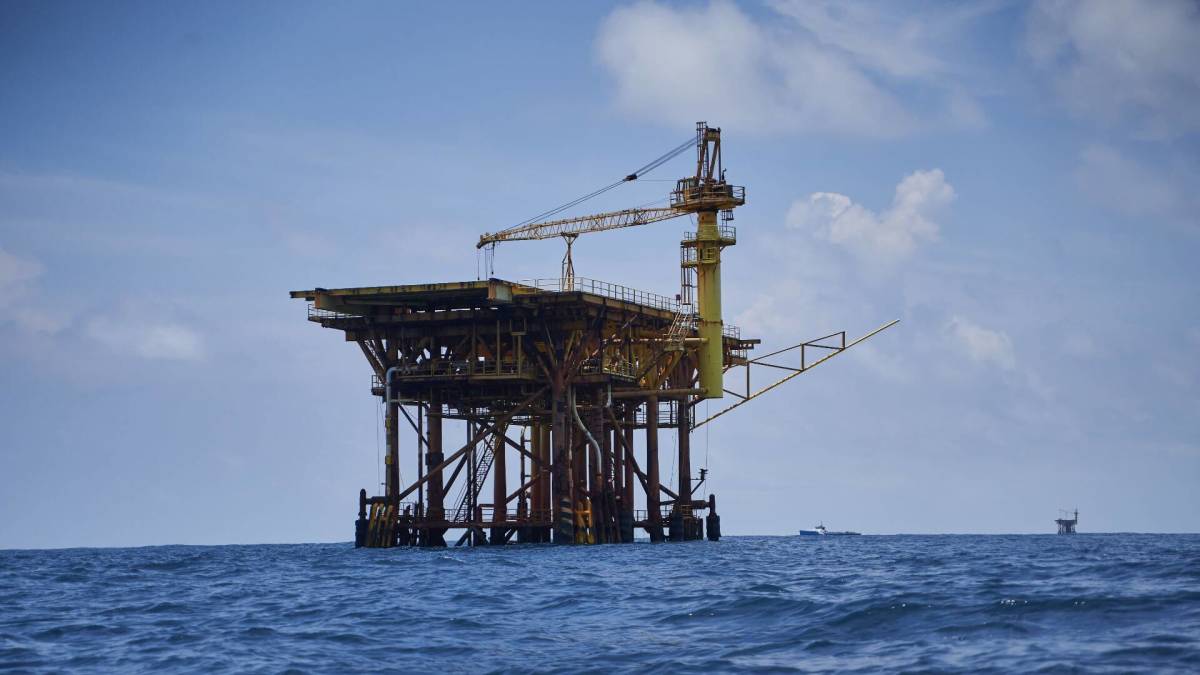 Oil rig in the Gulf of Mexico
Venezuela problem: There’s lots of oil right now
Venezuela’s oil reserves are officially estimated at about 303 billion barrels, making them, in theory, the largest in the world. The reserves are probably not that huge, but they are big.
Oil is so important to the country that there is a sculpture of an oil rig in the palm of a hand right in front of the Caracas office of Petróleos de Venezuela SA (PDVSA), the state-owned oil company.
But there’s a problem.
Exxon, TotalEnergies, and a great many companies do not need Venezuela right now. The world has plenty of oil and natural gas supplies. Because it has been controlled by dictators for years, Venezuela’s oil has gone to Cuba, occasionally China, and smaller countries.
The world’s second-largest oil company after Saudi Aramco, Exxon Mobil has oil and gas reserves, proved or estimated, that will last at least 12 years, analysts say, likely much longer. And that’s good enough to support Exxon’s stock price, now about $155 and up more than 29% so far in 2026.
Chevron (shares up 22% in 2026) actually does operate in Venezuela and, after ramping back to pre-restriction levels, is producing 250,000 barrels a day of heavy crude that’s refined at company refineries in Mississippi and California. It hopes to boost production to 500,000 barrels a day by 2030.
More Oil and Gas:
- Energy giant sends blunt $20 billion message on dividend growth
- 147-year-old oil giant just raised dividend 4% in 2026
- Top energy stocks to buy amid Venezuela chaos
Oil companies must drill
The oil business has two big components:
- Upstream: where the oil comes from.
- Downstream: refineries that turn crude oil into gasoline, jet fuel, lubricants, and plastics.
Like any business, oil companies must have something to sell. That’s oil and gas.
Energy companies will spend many billions more exploring for oil and gas. The spending obviously involves drilling, but it also largest investments in computer capacity to analyze exploration data. Exxon’s projected capital spending plans in 2026 total $27 billion to $29 billion.
Exxon Mobil, Chevron and CNOOC, the Chinese oil giant, are the primary partners in the enormous Stabroek Block, a region off the coast of Guyana, next to Venezuela.
Exxon and Chevron both say Guyana is a key to their futures. The find has cost more than $60 billion to develop so far.
Venezuela has argued that half of Guyana is really in Venezuela, even though the border between the countries was set in 1899. In 2023 and 2024, Nicolas Maduro, the Venezuelan president seized by the Trump administration, wanted to invade Guyana to seize those rich oil reserves.
Perhaps seizing Maduro was about keeping him out of that oil.
Sometimes, companies will just acquire another.
Related: Energy stocks surge as basket tops proprietary ranking
Devon Energy (DVN) recently announced it will acquire Coterra (CTRA), a Houston oil-and-gas producer, for $21 billion in stock. It will create a company with an enterprise value $58 billion that concentrates on exploration and production in the Permian Basin of Texas and New Mexico.
Sizeable, yes, but Exxon’s current enterprise value is about $675 billion. (Enterprise value is the market capitalization of a company’s stock, plus its outstanding debt, less its cash and equivalents.)
Why is oil up in 2026? Saber-rattling
Because oil is a critical global material, prices react to global events. Crude oil is up a bit more than 13% so far in 2026, to between $65 per 42-gallon barrel and $70 a barrel. That’s largely because the Trump Administration is again threatening to attack Iranian military installations and nuclear facilities.
One naval aircraft carrier group is already in the region, and a second has been told to prepare to deploy to the Middle East, The Wall Street Journal reported late on Feb. 11.
In June 2025, U.S. attacks on Iran pushed crude nearly to its 2025 high of $79 a barrel. At Feb. 11’s close, Brent crude, the global benchmark, is down 14.7% from that 2025 high. Light sweet crude, the U.S. benchmark, is down 17.6%.
Still, those prices can support the industry. Prices crashed during the Covid-19 pandemic, then exploded in the aftermath, creating global inflation problems.
The worst crash in recent years came in 1986, when Saudi Arabia refused to support prices. They fell 60% and damaged energy-dependent countries and communities around the world.
For several years, in the late 1980s, Louisiana suffered the highest unemployment rate in the United States.
Related: ConocoPhillips CEO sends strong message on Venezuela oil future