
Basketball legend Michael Jordan and Pokémon character Charizard have at least one thing in common.
They are both among the most targeted trading cards for counterfeiting.
According to Professional Sports Authenticator (PSA), the leading third-party card grading and authentication company, the 1986 Fleer Michael Jordan #57 saw the most counterfeit submissions in 2024, followed by the 1979 O-Pee-Chee Wayne Gretzky #18 and the 2000 SkyBox Impact Tom Brady #27 — the latter a somewhat surprising target given both its relative abundance and generally lower open-market price.
The high market value of these cards makes them particularly attractive targets for counterfeiters. Prices for bona fide 1986 Fleer Michael Jordan #57 rookie cards range from roughly $2,000 to more than $200,000, depending on condition and grading.
The 1999 Pokémon Base Set 1st Edition Charizard, widely considered the “holy grail” of Pokémon card collecting, is viewed as the most counterfeited non-sports card, with bona fide versions typically ranging from about $10,000 for lower-graded copies to $250,000 to $400,000 or more for pristine examples.”
People not familiar with collectible cards might wonder what’s the big deal, but the multi-billion-dollar hobby, according to market observers, attracts millions of collectors worldwide.
“The hobby had been gradually growing for a while,” Joe Orlando, executive vice president of Heritage Auctions, the largest collectibles auctioneer in the world, said in an interview.
“It had been going through what I would describe as modest growth over the past 10 to 20 years prior to the pandemic. But with the pandemic people were looking for something to do. They were looking for an escape.”
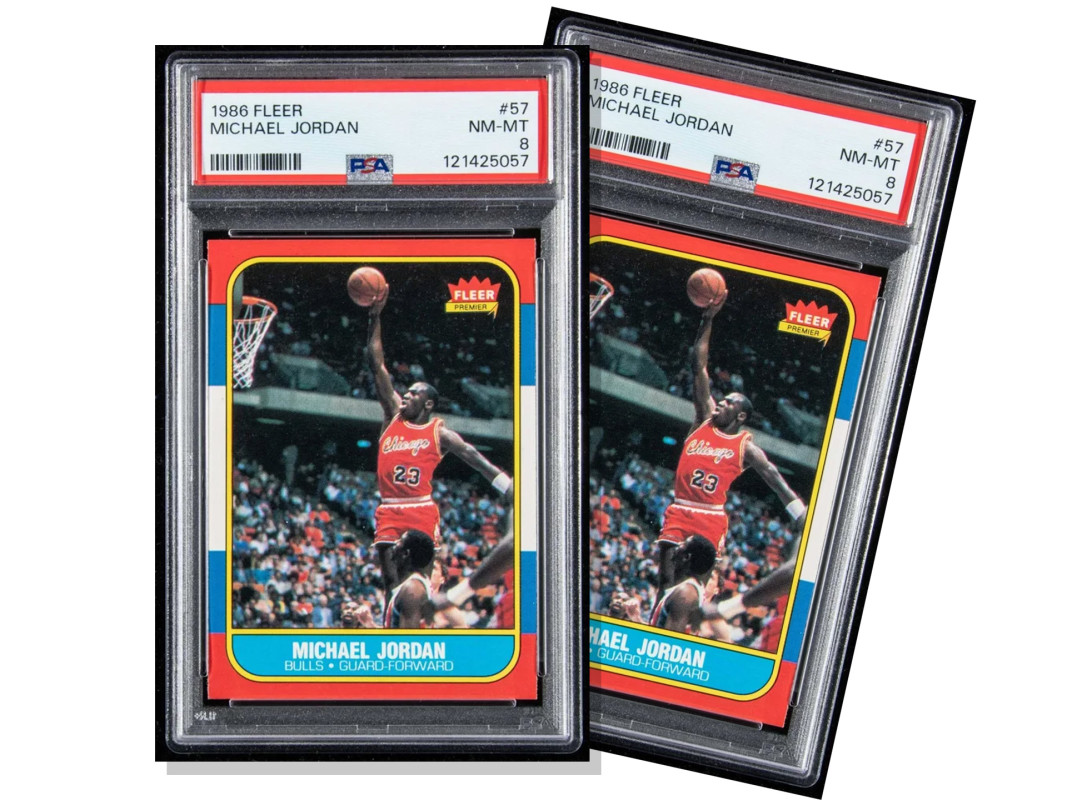 The 1986 Fleer Michael Jordan #57 is a prime target for counterfeiters.
Topps
Cases reveal staggering sums
Orlando said that many people who had become disconnected from the hobby in adulthood have rekindled their love for it, “and then a lot of new people jumped in, and we saw a level of coverage by the mainstream media that we had really never seen before in the hobby.”
Unfortunately, rapid growth, high prices, and grading premiums have created incentives for fraud.
Related: Deal fever returns: 2026 looks hot for M&A
“The market has exploded over the past 4 or 5 years,” he said. “But the other side of it, again, is sometimes that will attract the bad participants because they’re looking to capitalize on that energy, on the price escalations, to produce counterfeit products.”
Analysts said that the 1989 Upper Deck baseball card set made it more difficult for counterfeiters by introducing premium, high-tech security features that were unprecedented in the trading card industry at the time.
“It’s certainly much more difficult to counterfeit the higher-end cards of today because of this trading card design, but that doesn’t mean someone won’t attempt it,” Orlando said.
Indeed, investigations into counterfeit cards have revealed staggering sums.
In July, Brett Lemieux posted a lengthy statement on Facebook describing a massive counterfeiting operation involving fake autographed memorabilia and trading cards.
Lemieux claimed the scheme could be worth up to $700 million, according to Sports Illustrated.
The operation involved forged cards of high-profile athletes such as Tom Brady, Kobe Bryant, and Patrick Mahomes, as well as fake certifications from trusted companies.
Lemieux was later found dead at his home in Westfield, Indiana, from a self-inflicted gunshot wound, police said.
More recently, Anthony Curcio of Redmond, Washington, was convicted on wire fraud and conspiracy charges on January 28 for selling customers sports and Pokémon trading cards with fake grades purportedly issued by the PSA.
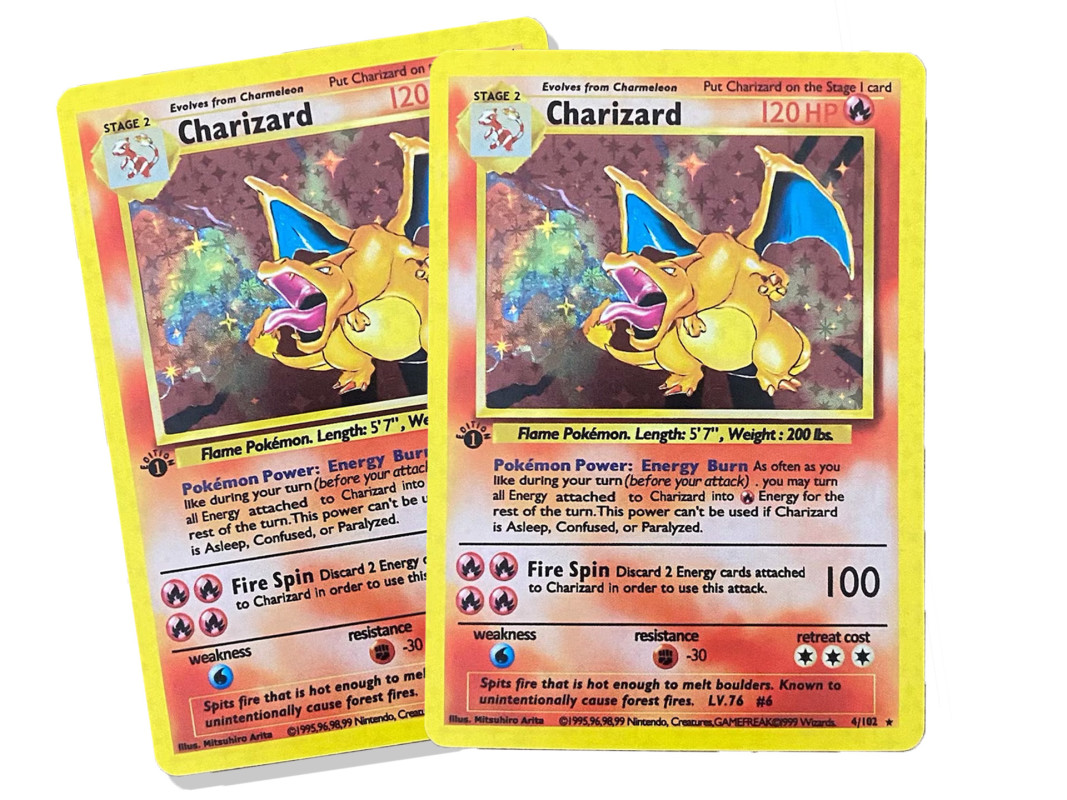 Counterfeiters have also trained their sights on the 1999 Pokémon Base Set 1st Edition Charizard.
Expert gives advice for collectors
In total, federal prosecutors said, Curcio and Iosif Bondarchuk, who pled guilty to wire fraud and conspiracy charges, tried to cheat buyers of over $2 million through their sales and attempted sales by misrepresenting the grade of numerous trading cards.
The two men sold trading cards with fake PSA grades on different online marketplaces and auction sites, such as eBay, as well as in person at card shops, card shows, and in-person trades with victims.
More economic analysis:
- CPI inflation data rocks stocks
- Trump’s bold new tax promise has families asking one big question
- Longtime fund manager sends blunt message on P/E ratios
- Mortgage rates tick lower as the Fed trims key rate
- Both high-and low-income holiday shoppers are following this trend
- November BLS jobs data show the good, bad, and ugly
The scheme focused on selling vintage rookie sports cards — particularly Michael Jordan rookie cards — and Pokémon cards that would sell for thousands or even hundreds of thousands of dollars if they had received a PSA 9 or 10 grade.
A PSA grade can have a significant impact on a card’s market value, at times increasing its value merely because it has been authenticated and graded, the government said.
Curcio even tried to pass off one Michael Jordan rookie card three times, each time with a different forged grade.
“Millions of Americans participate in our collectibles markets, and they should be free from fraud and manipulations,” U.S. Attorney Jay Clayton said in a statement.
Orlando advised people interested in collectible cards to make sure their purchases have been certified by a reputable 3rd-party authentication service.
“And this may sound like common sense, but it’s very important that you buy from and deal with reputable sellers, whether it’s an auction house or a retail seller,” he said. “If a mistake is made, we are going to do the right thing and stand behind what we sell and take care of the situation because we are interested in preserving our reputation.”
And finally, there’s the oldest piece of advice in creation.
“As the saying goes, if a deal seems too good to be true, it usually is,” Orlando said.
Related: When cars drive themselves: Robotaxis, regulations & reality