
As restaurant closures rise across the U.S., plant-based concepts are facing even steeper challenges and shutting down at a rapid rate.
Rising food and labor costs, high rents, and more cautious consumer spending have strained even established brands in the post-pandemic economy. But for vegan and vegetarian restaurants, the additional challenge is that mainstream chains now offer many of the same plant-based options that once set them apart.
The closure of Amy’s Drive Thru underscores how difficult that environment has become.
Amy’s Drive Thru closes its last restaurant
Amy’s Drive Thru has officially closed its final remaining location, which operated inside San Francisco International Airport for seven years and served thousands of travelers daily.
The space will be taken over by The Melt, a San Francisco-based fast-casual chain, in May 2026, according to KRON4.
The airport closure follows the shutdown of the brand’s last standalone drive-thru restaurant in Rohnert Park, California, which closed on March 8, 2026, according to a post on Amy’s Instagram.
“From day one, our mission was simple: to serve delicious, organic food that everyone could enjoy. As the first organic, vegetarian drive-thru in the nation, we’ve shared countless meals, smiles, and memories with you — and that’s something we’ll always be proud of,” said Amy’s in a statement.
The company also expressed gratitude to its employees and confirmed that remaining ingredients would be donated to local food banks to reduce waste.
Amy’s loyalty program and mobile app were discontinued at the end of January 2026, signaling earlier signs of a broader wind-down, but its Instagram remains active as of the date of publication.
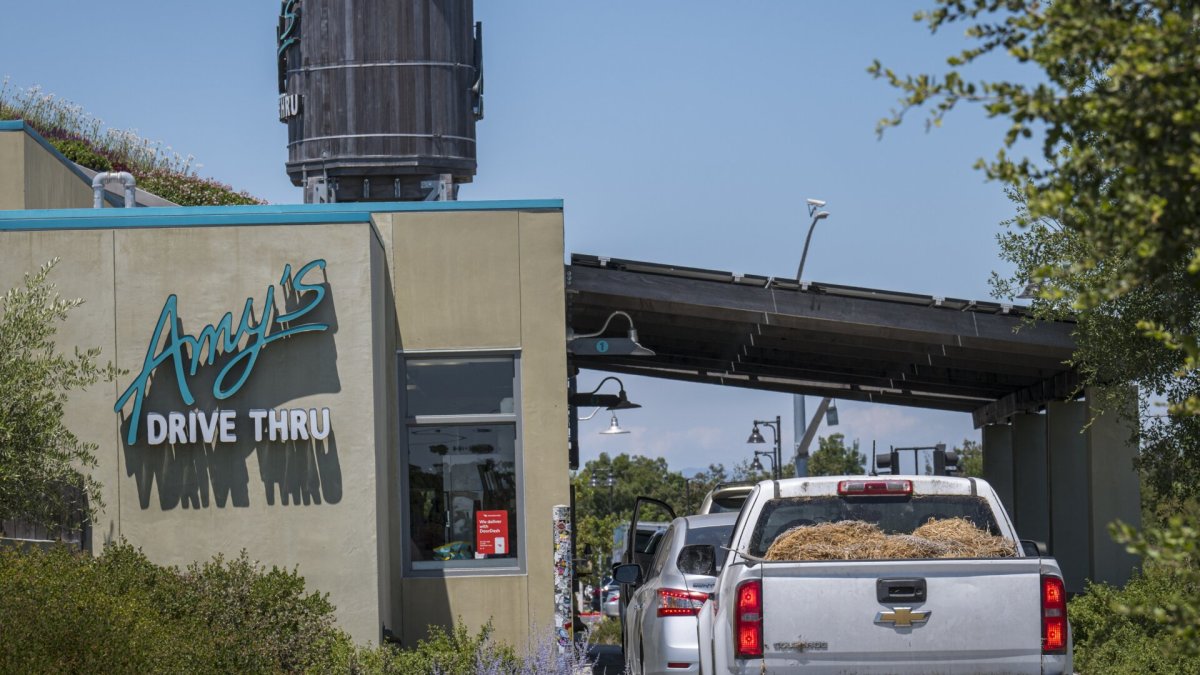 Amy’s Drive Thru closes its last remaining location.
David Paul Morris/Bloomberg via Getty Images
From frozen-food leader to fast-food concept
Amy’s Kitchen, founded in 1987, built a national reputation as a pioneer in vegetarian frozen meals before expanding into foodservice in 2015 with the launch of Amy’s Drive Thru.
This concept aimed to pioneer one of the first fully vegetarian, organic, and non-GMO fast-food restaurant chains in the U.S., offering a menu of plant-based comfort foods, including burgers, chik’n tenders, pizza, fries, and milkshakes.
At its peak, Amy’s operated five locations across California and had plans for significant expansion.
Amy’s Drive Thru’s expansion pause and shutdowns
Amy’s Drive Thru’s closure was not sudden; it followed a multi-year pullback from earlier growth ambitions.
At one point, the company aimed to expand from five locations to 25-30 units within five years. However, after Paul Schiefer was appointed president in 2023, he halted the expansion to adopt a more cautious approach, according to National Restaurant News.
“We’re going to grow from the basis of sustainable growth, not just to show we can do it,” said Schiefer in an interview. “There are too many casualties of companies that grew in the wrong way. They didn’t build a model, playbook, or team.”
Despite efforts to refine its operating model, including small store formats and more efficient kitchen designs, the concept ultimately could not sustain its footprint.
Timeline of Amy’s Drive Thru restaurant closures
- San Francisco International Airport: Closed March 2026
- Rohnert Park, California: Closed March 2026
- Corte Madera, California: Closed August 2025
- Thousand Oaks, California: Closed February 2024
- Roseville, California: Closed February 2024
Amy’s faces tumultuous challenges
Amy’s faced internal challenges that complicated its growth trajectory.
In 2022, the California Division of Occupational Safety and Health fined Amy’s Kitchen $25,000 for health and safety violations following employee complaints about unsafe and hostile working conditions at the Santa Rosa facility, according to SFGATE.
That same year, the company laid off around 300 workers after closing its San Jose factory. Additional layoffs affecting about 300 more employees occurred in two Santa Rosa facilities two years later.
These operational hurdles forced the company to rethink its cost structure and long-term scalability. At the same time, broader industry pressures were intensifying.
A volatile environment for restaurants nationwide
Amy’s Drive Thru closure comes amid a broader wave of shutdowns across the restaurant industry.
According to the U.S. Bureau of Labor Statistics, about 17% of new restaurants close within their first year.
Long-term restaurants have an even greater chance of shutting down, with about half closing within five years and only 34.6% surviving beyond a decade, according to Oysterlink.
Costs have also surged. Prices for food away from home increased 4% in the 12 months ending January 2026, according to recent U.S. Bureau of Labor Statistics data.
Over the past five years, food and labor costs for the average restaurant have each risen by about 35%, according to the National Restaurant Association.
To offset those surges, menu prices climbed an average of 31% between February 2020 and April 2025, according to U.S. Bureau of Labor Statistics data.
However, higher prices have coincided with a slowdown in customer traffic. In a National Restaurant Association survey, 60% of restaurant operators reported lower traffic in December 2025, up from 51% in November.
More coverage on restaurant closures:
- 74-year-old BBQ chain closes key restaurant
- These reality TV restaurants are suddenly up for sale after slump
- 76-year-old restaurant chain closing another longtime location
James O’Reilly, a food industry executive with more than 15 years of experience in restaurant marketing, believes that pricing alone won’t fix demand.
“While headline economic indicators have improved and financial markets have strengthened, many restaurant consumers, particularly in lower- and middle-income brackets, have not experienced the same relief,” said O’Reilly in an interview with FSR Magazine.
Why plant-based restaurants face additional risks
Vegetarian and vegan dining is growing, but plant-based restaurants are not necessarily benefiting.
What was once a niche advantage has become widely available. Major chains including Burger King, Taco Bell, and Chipotle, as well as casual brands like Cheesecake Factory and Yard House, now offer plant-based options.
This shift has reduced the competitive advantage and differentiation of fully vegan concepts.
Pablo Moleman, co-founder of the food awareness organization ProVeg, told NL Times that mainstream adoption has effectively absorbed much of the demand that once fueled standalone vegan restaurants.
“Vegetarian food has become more normal,” Moleman said. “Ordinary restaurants have fully embraced vegetarian dishes, and that’s led to a drop in market share for dedicated vegetarian and vegan restaurants.”
David Lipschutz, a vegetarian restaurant owner, says that because plant-based restaurants target such a specific audience, location is key.
“I think, honestly, that places that are vegetarian or are vegan, they’re going to be niche concepts in very specific markets where there’s enough interest and desire and resources to support them,” Lipschutz said to CBS News. “It has to be someplace where people will respect and put their money on the table for it. And so I think it can’t just be any concept anywhere.”
Other vegan restaurant closures
- Hart House: Closed all locations in September 2024 after 2 years, according to Eater.
- Sage Vegan Bistro: Closed all locations in January 2025 after 14 years, according to the Los Angeles Business Journal.
- Plum Bistro: Closed in January 2025, alongside its sister location, after 17 years, according to Capitol Hill Seattle News.
- Native Foods: Closed its last location in November 2025, two years after becoming employee-owned, according to Block Club Chicago.
The bigger shift in plant-based dining
Amy’s Drive Thru’s closures show a broader industry transition in which demand for plant-based food is growing but is increasingly being absorbed by mainstream restaurants rather than by standalone vegan brands.
For operators, that means the challenge is no longer just increasing brand awareness and incentivizing consumers to try plant-based food; it’s finding a business model that can compete in a market where those options are now nearly everywhere.
Related: 31-year-old Italian restaurant chain closing its final locations