
You don’t need a psychic to tell you that we could be in for a rough ride in 2026.
Of course, that’s not slowing down the ESP brigade one little bit, as the internet is rife with bleak predictions of global conflict and economic ups and downs.
People are certainly worried about the economy. Consumer sentiment in December sank 29% from 2024, according to the University of Michigan’s monthly survey.
Nearly half of Americans said they are more stressed heading into 2026 than they were at the beginning of 2025, according to the 2026 New Year’s Resolutions Study from the Allianz Center for the Future of Retirement, part of Allianz Life Insurance Company of North America.
The online survey of 1,038 respondents aged 18 and older found that at the end of 2025, 48% reported being more stressed than they were at the start of the year, up from 43% a year ago.
Those feeling more pressured cited costs of day-to-day expenses, low income, insufficient emergency funds, too much debt, high health care costs, and lack of job security.
Health care costs and lack of job security in particular rose significantly from last year, Allianz said.
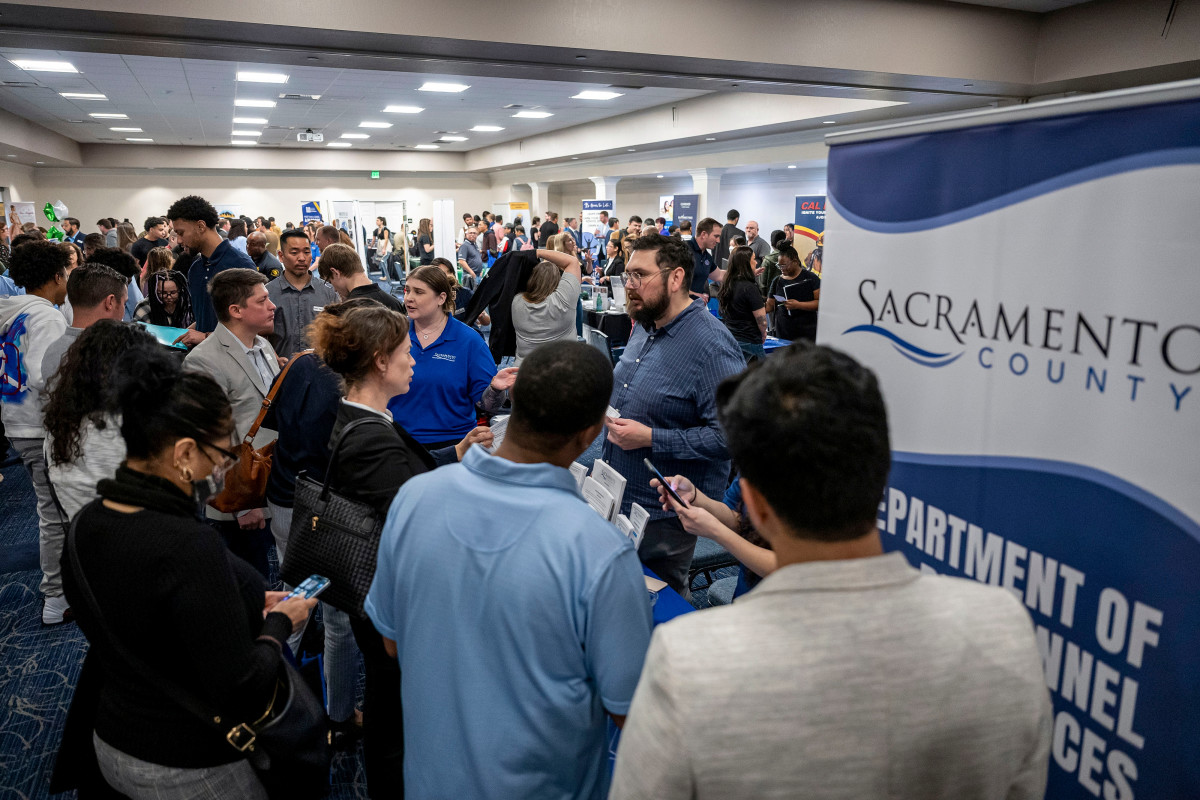 The U.S. Bureau of Labor Statistics reported a weaker job market in 2025.
Photographer: David Paul Morris/Bloomberg via Getty Images
Report notes rise of job-hugging
While more Americans said they will start or continue looking for a new job in 2026, many are planning to stay put and take part in so-called “job hugging,” where workers cling to their current, often unfulfilling, jobs due to fear and economic uncertainty.
Seventy-one percent of respondents who are not likely to look for a job said it was because it seems safer to stay where they are in the current economic environment, Allianz said.
More economic analysis:
- CPI inflation data rocks stocks
- Trump’s bold new tax promise has families asking one big question
- Longtime fund manager sends blunt message on P/E ratios
- Mortgage rates tick lower as the Fed trims key rate
- Both high-and low-income holiday shoppers are following this trend
- November BLS jobs data show the good, bad, and ugly
The Bureau of Labor Statistics (BLS) reported a weaker job market in 2025, as employers added fewer jobs this year compared with 2024. Tech layoffs continued into 2025, most notably among companies such as Amazon (AMZN), Microsoft (MSFT), and Intel (INTC).
The layoffs were primarily due to the rapid integration of AI increasing automation, a broader economic climate of uncertainty, and high interest rates, prompting cost-cutting.
The total number of U.S. bankruptcy filings across businesses and individuals saw a significant increase, with corporate filings reaching their highest level since 2010, the period immediately following the Great Recession.
Related: The most startling corporate bankruptcies of 2025 (so far)
At least 717 companies filed for bankruptcy through November, up 14% from the year-ago period, including such names as Spirit Airlines, Del Monte Foods, and Rite Aid.
U.S. health care costs have also gone up significantly in 2025, with projections showing employer costs rising by 8% to 9% and family premiums for workplace plans nearing $27,000 annually.
The average cost of employer-sponsored health care coverage in the U.S. is expected to increase by 9% in 2025, reaching over $16,000 per employee, according to an analysis from Aon. This represents a 6.4% increase in health care budgets that employers saw from 2023 to 2024.
Industry analysts cite such factors as expensive specialty drugs, labor shortages, inflation, and the looming expiration of Affordable Care Act subsidies, which are set to expire on Dec. 31.
Twenty-seven percent of the respondents to the Allianz survey said they have decreased confidence in their ability to meet their retirement goals compared to last year, with Gen X and Gen Z more likely than millennials or boomers to feel less sure about their retirement goals.
Firm: U.S. as engine of economic growth in 2026
“When feeling financially stressed, long-term goals like retirement can be the easiest to sideline because you don’t feel it in your day-to-day life,” Kelly LaVigne, VP of consumer insights, Allianz Life, said in a statement.
“But achieving long-term financial security takes time, and you may be better off consistently working toward retirement incrementally than trying to wait until you can devote a larger part of your budget to the goal.”
Related: Analyst who predicted S&P 500 rally offers 2026 warning
A Marist poll of 1,440 adults conducted in early December found that 57% of Americans surveyed are more pessimistic about what lies ahead for the world in 2026, while 43% reported being more optimistic.
This marked a turnaround from last year, when 56% of Americans reported being more optimistic about the upcoming year, while 43% were more pessimistic.
Wells Fargo analysts, meanwhile, are a bit more optimistic about the coming year.
“The U.S. economy weathered a whirlwind of change in 2025, contending with constantly evolving trade policy, a softening labor market, and the longest government shutdown on record,” the firm said in a Dec. 29 report.
“A weak start and finish to 2025 left full-year growth slightly below its pace in 2024 despite the strong performance during the middle two quarters of the year.”
Wells Fargo said that it expects noisy headlines—around tariff developments, a new Fed chair, and the midterm elections—“to add to market volatility throughout the coming year.”
“We view the U.S. as the engine of global economic expansion in 2026, supporting our preferred tilt toward U.S. assets in a diversified portfolio,” the firm said. “That leadership should help stabilize the U.S. dollar’s value.”
Wells Fargo believes strong corporate growth will power equity market gains as the economy really accelerates, and “AI and tech-related spending broadens across companies and market sectors.”
Related: RTO mandates to AI agents: How work is changing in 2026 and beyond