
There are increasing signs your wallet may crack a cool, well, smile next month.
Evolving economic dynamics on the national and global fronts have kept interest rates steady so far this year.
💵💰Don’t miss the move: Subscribe to TheStreet’s free daily newsletter💰💵
Members of the Federal Reserve Board meeting in Prague on June 23 discussed the last six months of jarring events like President Trump’s trade wars and the escalating Middle East crisis on the U.S. economy.
Related: Fed official predicts when to expect interest rate cuts
Fed Governor Michelle Bowman reminded the monetary policy conference sponsored by the Czech National Bank that at the Federal Open Market Committee (FOMC) meeting on June 18, the committee voted to keep the Federal Funds Rate at 4.25% to 4.50%.
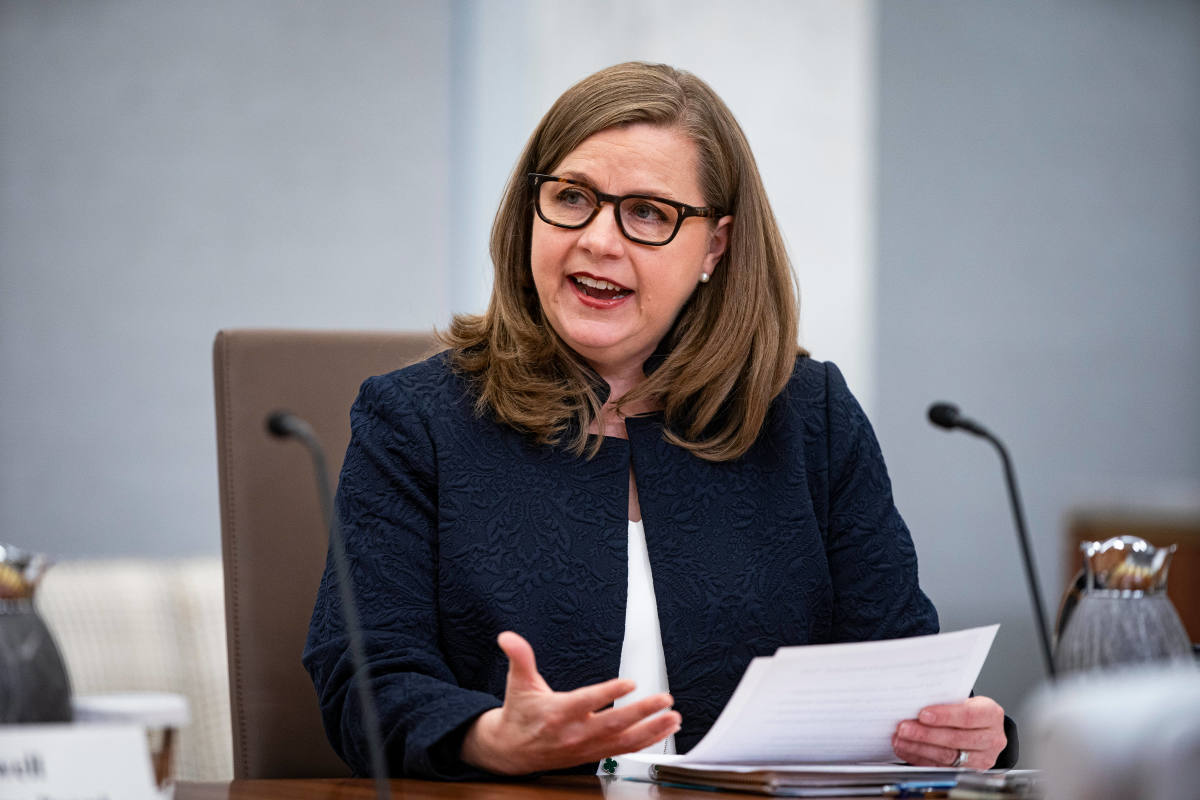 Michelle Bowman, governor of the US Federal Reserve, spoke Monday, June 23, 2025 before an international central bank conference in Prague. She is seen here in an earlier photo. Photographer: Al Drago/Bloomberg via Getty Images
Why Fed kept interest rates steady in June
Bowman indicated that the July vote may be different.
The Fed’s dual mandate is to regulate prudent monetary policy that maintains inflation (at about 2%) and unemployment relatively low to avoid a recession or worse.
The Federal Open Meeting Committee controls the Federal Funds Rate, which banks charge each other overnight to borrow money.
The funds rate is tied to the cost of borrowing money for consumers, investors and businesses. It’s everything from your mortgage and car loan to 10-year Treasury bonds.
Data over the next few months will indicate if the Fed will decide on two or fewer rate cuts in 2025, portfolio manager Chris Versace said in a TheStreet Pro post after the FOMC released its quarterly “dot plot.”
The Fed continues “to telegraph that two 25-basis point rate cuts remain on the table for this year,’’ Versace wrote.
Related: Fed official makes surprising interest rate cut prediction
Trump, prior to the nuclear strikes on Iran, excoriated Federal Reserve Board Chair Jerome Powell for the keeping the funds rate steady:
“…If he reduced them to the number they should be, 1% to 2%, that “numbskull” would be saving the United States of America up to $1 Trillion Dollars per year.
“…He’s a dumb guy and an obvious Trump hater, who should have never been there.”
Powell has said that while the economy appears stable, there is an escalating risk that Trump’s tariffs could cause a rise—though perhaps a short-term one—in inflation as the impact of the trade wars ripples through the U.S. supply chain from overseas manufacturers to American consumers.
Trump appointed Powell to a 10-year-term on the Fed Board of Governors in 2016. Powell was elected chair by the Board of Governors by the FOMC in 2018.
Neither the president nor Congress can replace the Fed Chair. In recent months, Trump has threatened to install a “shadow” chair until Powell resigns or leaves in May 2026. In addition to musings that perhaps Trump might appoint himself (which he legally can’t), Treasury Secretary Scott Bessent is also a recent frontrunner to join the Fed board.
Powell has said he has no intention to resign early.
Both Fed and market watchers had forecast that the next probable rate cut could appear at the September FOMC meeting.
Then Fed Gov. Christopher Waller gobsmacked many, saying on June 20 that a funds rate cut could come as early as the Fed’s July meetings.
“Why do we want to wait to see a crash’’ in the labor market before cutting the rates? Waller said.
TheStreet Pro veteran trader Stephen Guilfoyle adroitly alluded to Waller’s comments as appearing to sound like an “audition” for Powell’s role.
Fed governor offers strong message on interest rate cuts
Could Bowman, another Trump appointee, also be seeking Powell’s job?
In prepared remarks, Bowman said if inflation remains near its current level or continues to move closer to the 2% target, or if the data show signs of weakening in labor market conditions, it would be “appropriate to consider lowering the policy rate.”
Both Bowman and Waller said tariffs impact on the job market will need to be monitored to ensure it doesn’t cause the unemployment rate to rise.
Many of Trump’s proposed reciprocal tariffs – essentially an external sales tax to U.S. trading partners that we pay one way or another – face a July 9 deadline.
“Should inflation pressures remain contained, I would support lowering the policy rate as soon as our next meeting in order to bring it closer to its neutral setting and to sustain a healthy labor market,’’ Bowman said. “In the meantime, I will continue to carefully monitor economic conditions as the Administration’s policies, the economy, and financial markets continue to evolve.
Measures of policy and economic uncertainty have receded from recent highs, and measures of consumer and business sentiment have also improved in recent weeks after having dropped considerably, Bowman said.
More Federal Reserve:
- Fed interest rate cut decision resets forecasts for the rest of this year
- Federal Reserve prepares strong message on long-term interest rates
- Fed official revamps interest-rate cut forecast for this year
The widely watched CME FedWatch tool puts the likelihood of a July cut in the Federal Funds Rate at 22.7% on June 23, up from 10.3% on June 20.
Powell presents the bi-annual Monetary Policy Report to Congress’s GOP-led Senate Banking Committee on June 24-25.
The report confirms Powell’s assertions that the U.S. economy is in a resilient, pre-tariff status for the first six months of the year.
“Moreover, sustainably achieving maximum employment and price stability depends on a stable financial system,’’ the report said.
“Therefore, the (FOMC) policy decisions reflect its longer-run goals, its medium-term outlook, and its assessments of the balance of risks, including risks to the financial system that could impede the attainment of the Committee’s goals,” the report said.
Related: Fed’s Powell brings blunt message to Congress on interest rates this week