
Naysayers have been taking a victory lap for weeks as the Detroit Big 3 has detailed exactly how many tens of billions they’ve lost on electric vehicles.
Despite the hurdles, however, on Tuesday, Feb. 17, Ford gave more details about its plan to revolutionize the U.S. EV industry. This is because, outside of Tesla and without the tax credit, 2025 was the year domestic OEMs got real about the industry.
Ford Model e losses by year
- 2025: $4.8 billion
- 2024: $5.1 billion
- 2023: $4.7 billion
- 2022: $2.2 billion
Last week, the Wall Street Journal synthesized the pattern that had been emerging for months: U.S. automakers collectively have lost $50 billion on their EV divisions. And this was despite EVs having a record first three quarters of the year as buyers flocked to make their purchases before the government tax credit expired at the end of September.
Take Ford, for example.
Ford’s EV division, Model e, had its best month of sales ever as buyers flocked to dealerships to take advantage of the $7,500 EV tax credit, which expired in September.
However, despite those sales, Ford lost $1.4 billion on its EV division in the third quarter due to spending on new products and increased competition, according to Ford. Through three quarters, the company said it lost $3.6 billion on EVs, with about $3 billion of the loss attributed to its first-generation EV products, including the Mach-E, F-150 Lightning, Puma, Explorer, and Capri. The rest was from investments in its next-generation vehicles.
However, even after Ford announced a $19.5 billion charge for its EV division, CEO Jim Farley never said he would abandon the tech. In fact, he doubled down, saying the company was more focused than ever on turning it around, and even sharing that Ford had a plan to make its EVs profitable by 2029.
On Feb. 17, Ford debuted that plan.
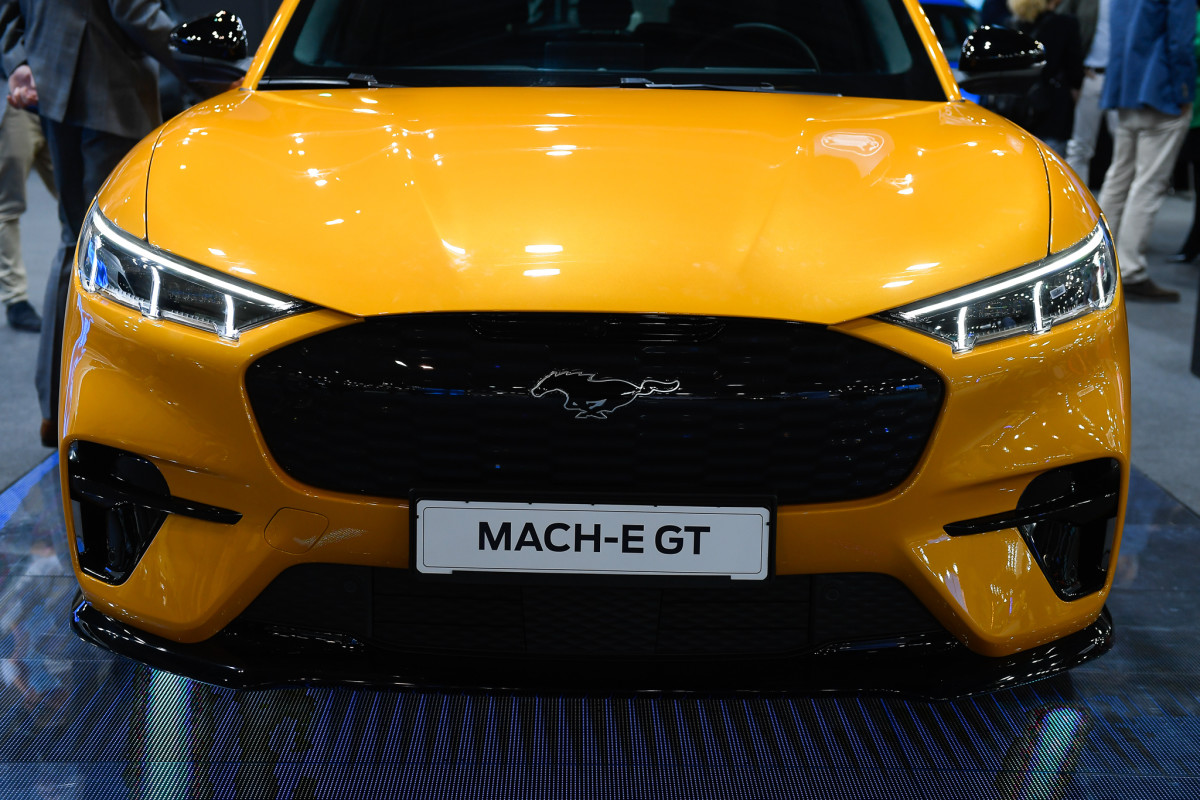
Photo by Anadolu on Getty Images
Ford debuts plan to make $30,000 EV
Ford showed its progress on the Universal Electric Vehicle project, which aims to build an EV with a price most Americans can afford.
Ford says it aims to produce a $30,000 EV in the near future. To get there, it needs to tackle the biggest cost driver for electric vehicles: their batteries.
World’s top EV markets in 2024
- China: 6.4 million EVs sold
- Europe: 2.2 million EVs sold
- U.S.: 1.2 million EVs sold
- Rest of world: 1 million EVs sold Source: International Energy Agency
According to Ford, an EV’s battery can account for up to 40% of the vehicle’s total expense, so the company reimagined EV battery tech to make them smaller and more cost-efficient.
Customers expect at least 300 miles of range, according to Ford, and to achieve that, batteries have been made bigger and heavier. But Ford says it is taking a different approach.
It gave its engineers incentives to increase battery efficiency by any means necessary. The team identified aerodynamics and vehicle weight as the two main areas where batteries were operating inefficiently.
The way EVs are currently designed increases wind drag, making the battery work harder and less efficiently. Ditto for weight, as heavier vehicles need more juice to operate.
Related: Ford F-150 shoppers may want to wait to buy
At higher speeds, air drag becomes more important. For example, if you go twice as fast, the air holds you back four times as much, and you need eight times as much power from the battery, according to Ford.
So Ford devised a “bounty” program in which its engineers assigned numerical values to efficiency gains. Teams competed against each other for the largest efficiency gains that reduced battery size and cost.
A millimeter change in the height of the roof could equate to $1.30 in battery savings costs while also making its pickup truck the industry leader in efficiency, as shown by Ford.
The video presentation shows how everything from the undercarriage to the tires to the front grill to the side mirrors was specifically designed to reduce drag and allow air to flow more freely around the vehicle.
Ford said it learned its lessons about drag from the racing circuit, and it is bringing the same philosophy to its EV division.
The new mirrors added 1.5 miles more range, the grill added 4.5 miles, and so on. Small improvements are allowing Ford’s engineers to increase the efficiency and reduce the cost of its batteries.
Ford says its new design will save it about $100 in battery costs per vehicle, but the impact on range will be exponentially greater.
According to Ford, if its new battery were married to the most aerodynamically efficient truck on the road today, the new EV would have 50 miles of driving range, 15% more than the gas car.
To reduce weight, Ford is doing something similar to Tesla, which uses large aluminum unicasts. Instead of a car section featuring many panels welded together, the unicast allows for one large, lightweight section.
The downside of this approach is that any damage to one piece of the panel could require the whole section to be replaced, potentially increasing repair costs. But the upside is a lighter, more affordable vehicle.
Ford models EV profitability strategy after China’s BYD
Despite some electing to dance on the seeming grave of the Big 3’s U.S. EV industry (Tesla is in a class by itself), anyone paying attention to comments Ford and GM have been making knows that despite losing $50 billion, they were willing to lose billions more to make EVs work.
They still believe EV tech is the future.
Related: Tesla rival inspires Ford CEO Jim Farley’s push for EV profitability
Ford CEO Jim Farley recently gave a wide-ranging interview where he detailed exactly how dedicated Ford is to making EVs work in the U.S.
When Farley was asked why, after billions upon billions of losses, he was confident that Ford could turn around its fortunes and make Model e profitable by 2029, he said he got his inspiration from a Tesla rival, Chinese electric vehicle maker BYD.
“We think to make that business profitable, we have to get to a BYD cost,” Farley told Bloomberg last month. “And so this skunkworks project called the Universe Electric Vehicle that we’re making in Kentucky, that is designed to match the BYD cost in Mexico.”
BYD cars go for between $18,000 and $53,000 USD on the high end in Mexico, where it already accounts for about 70% of EV sales, according to Bloomberg.
But a distinguishing factor for Ford is one with which BYD can’t compete.
“We are here to compete globally. We’re not going to cede our future to the Chinese. The Chinese don’t know truck customers as we do,” Farley said, referring to Ford’s industry-leading F-series pickups.
The Blue Oval revealed that it is taking a $19.5 billion pre-tax write-down on its electric vehicle division over the next two years as it shifts production away from EVs and toward hybrid and extended-range vehicles.
More Ford Model e
- Tesla rival inspires Ford CEO Jim Farley’s push for EV profitability
- Ford CEO takes subtle shot at Tesla Cybertruck after $20 billion hit
- Ford’s $5 billion problem is getting worse
“The really high-end EVs, the $50k, $60k, $70k EVs just weren’t selling,” CEO Jim Farley said in an interview Dec. 15.
The $19.5 billion write-down (only $5.5 billion of which is cash charges) is once again a win for transparency, but the company has signaled that Model e hasn’t been working for years.
Two years ago, Ford shared plans to reduce its EV production capacity by 35%.
Ford CEO Jim Farley estimates that EVs have shrunk to just about 5% of the U.S. market, so the plan is to pivot to hybrids and extended-range vehicles, for which U.S. buyers have shown more of an appetite.
Related: Popular Ford pickup faces expanded NHTSA probe over dangerous issue