
Outside of purchasing a home, buying a car is the most expensive purchase most people will make in their lifetimes. Now, companies like Tesla and General Motors are developing technologies that will add value to their vehicles beyond just transportation.
On June 9, General Motors announced that it is expanding its presence in the battery business through a partnership with Peak Energy that will develop the next generation of sodium-ion batteries that “will reshape grid-scale energy storage.”
Grid-scale energy storage is an AI-adjacent business these days because a big part of the jump in demand for energy and energy storage comes from all of the data centers you’ve seen popping up across the country.
But they aren’t the only potential customers.
Utility companies are mandated in some states to have battery storage backups, and there is also a consumer angle for people who want to store energy from solar panels or from the grid at non-peak hours, like at night.
Tesla found a natural pivot for its excess battery manufacturing capacity years ago when it began its battery storage business, and it has since become one of the company’s biggest growth drivers.
As GM pivots away from EVs due to falling demand, they are also finding a natural pivot for its production capacity.
Analysts at Morgan Stanley are bullish on the move and what it could mean for the company, according to a recent note viewed by TheStreet.
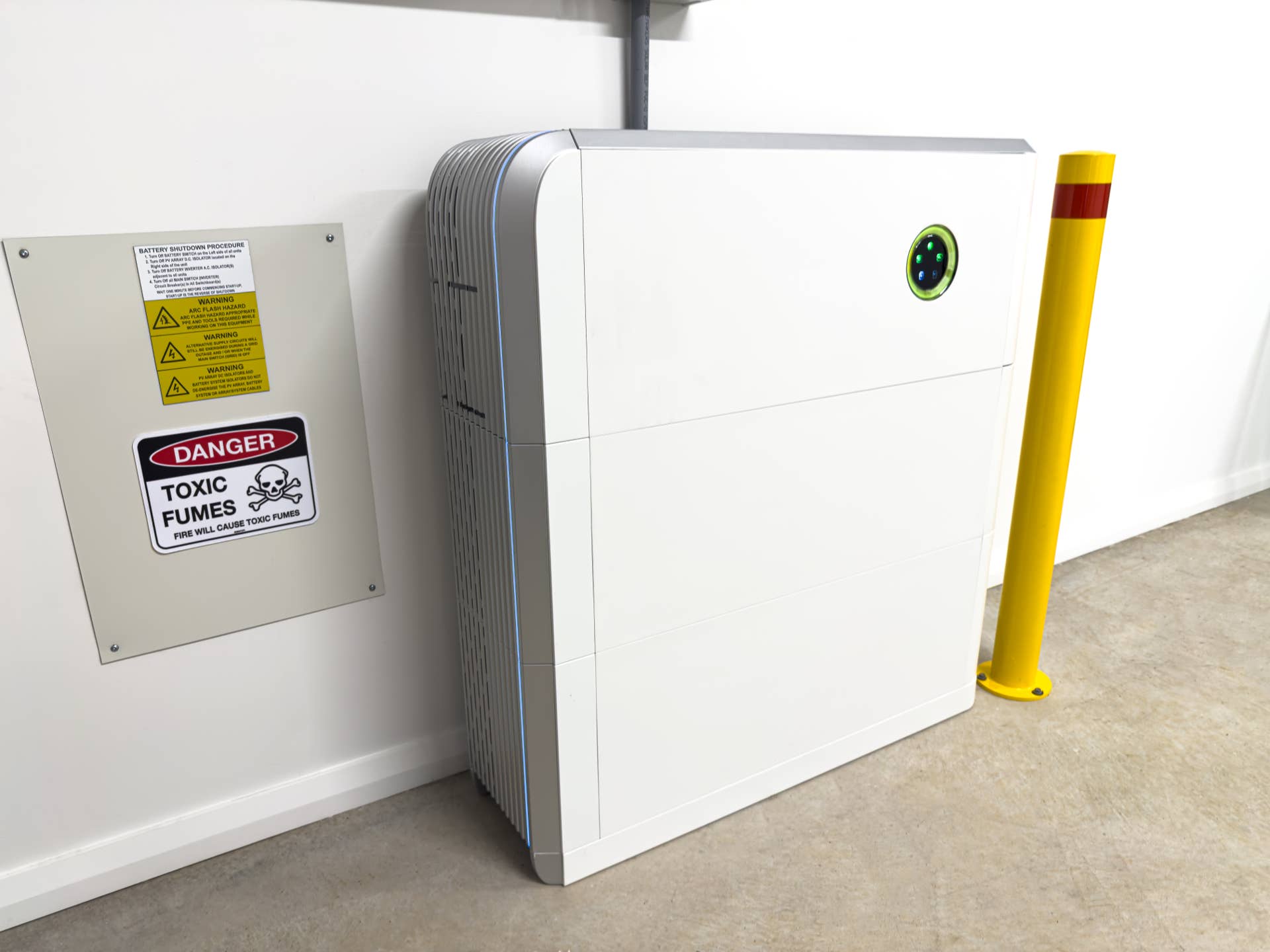 Tesla is also in the battery and energy storage business.
Morgan Stanley issues overweight rating, $100 PT for General Motors
Analysts at Morgan Stanley say they are “encouraged” by GM’s decision to expand their presence in the U.S. energy storage market, “particularly given its differentiated technology roadmap centered on sodium-ion chemistry.”
“GM’s strategy stands out: the company is investing in a more nascent technology that is only just beginning to see commercialization, primarily in China,” Morgan Stanley equity analyst Andrew Percoco said. The firm maintained its overweight rating and $100 price target.
GM shares were down 4.7% to $79.84 intraday on Wednesday, along with the rest of the automotive sector.
This week, GM also introduced a new way to use EV batteries when they are not powering the vehicle, enabling them to be used for other purposes.
“EVs with their sophisticated batteries sit largely untapped. GM wants to work collaboratively to make them the dynamic infrastructure assets we know they can be,” the company said, so it is further developing vehicle-to-grid two-way charging options that allow EVs to power a home or sell electricity back to the grid.
The company also says it already has 250,000 EVs on the road that are capable of this, but GM says it is “committed to the technology for all planned EVs going forward.”
“While commercialization may take longer and come with added execution risk relative to the well-known LFP technology, successful deployment could support a more durable and differentiated positioning over time,” Percoco said. “Beyond their investment in sodium ion technology, GM is increasing vehicle-to-grid capabilities for EV customers (i.e., VPPs), which has the potential to drive improved EV ownership economics and aid the grid during times of elevated demand.”
Morgan Stanley says Ford’s battery storage business isn’t fully priced into the stock
GM isn’t the only legacy automaker shifting its EV strategy, nor is it the only one diving feet-first into the battery storage business.
Morgan Stanley’s Andrew Percoco is also bullish on Ford Energy, the battery storage initiative the company has been quietly working on for about a year.
But the firm says the 30% stock increase the company experienced after its battery storage announcement represents only part of the value the new battery storage and AI infrastructure play brings to Ford.
“Energy storage systems are becoming a critical part of the US power market, as demand becomes more volatile and peak-heavy, offering modularity, faster deployment timelines, rapid response to sudden load ramps, and the ability to smooth peaks without requiring the overbuild of generation or transmission infrastructure,” Percoco said in a note viewed by TheStreet.
The firm expects U.S. energy storage system deployments to grow at a 38% compound annual rate over the next five years, reaching more than 279 GWh by 2030, with 169 GWh demand from data centers.
The sector is so hot, MS analysts believe more companies, like Ford rival General Motors, will dedicate technology and capacity to the segment “given subdued EV demand.”
But even with the more than 30% increase and the threat that GM will soon enter the same business, Morgan Stanley says investors are still undervaluing Ford Energy.
“We believe F is currently trading with 20-25 GWh of run-rate ESS demand priced into the stock. While this may seem like a lot, we believe the stock has further room to run if the company continues to add high-quality customers to its ESS backlog, which could bring additional capacity expansion into play (although we do not expect the company to formally announce any capacity expansion anytime soon),” Percoco said.
Ford’s new partnership with EDF will see the company deliver up to 20GWh of battery energy storage systems for utility-scale and data center customers starting in 2028.
The company’s flagship product is a 20-foot containerized 5.45 MWh system using 512 Ah LFP prismatic cells with liquid-cooled thermal management called the Ford Energy DC Block.
Related: Ford begins testing tech that will change Americans’ minds about EVs