
President Donald Trump upended the global trade order when he announced his “Liberation Day” tariffs in April.
After weeks of promising they would be “reciprocal,” the tariffs were anything but. Eventually, the U.S. settled on a 10% baseline for every country, even those with no humans living in them.
Such a significant shift has created uncertainty across the auto sector, as U.S. carmakers either adjusted or completely lowered their guidance in the first quarter.
Related: Toyota is stuck in neutral after the latest US and Japan trade update
Months later, the U.S. is still negotiating its deal with Japan, the second-largest U.S. auto importer, crystallizing just how helter-skelter the process has been for all involved.
“The era with globalization and global cars, everything equal — that I think we are going to leave and have a world a bit more regionalized,” Volvo CEO Håkan Samuelsson said, according to The Wall Street Journal.
That may be the case for some original equipment manufacturers (OEMs), but General Motors (GM) and Hyundai seem to be going the other way.
On Aug. 6, the two competing car companies from opposite sides of the world shared that they are deepening their partnership and plan to sell hundreds of thousands of vehicles together soon.
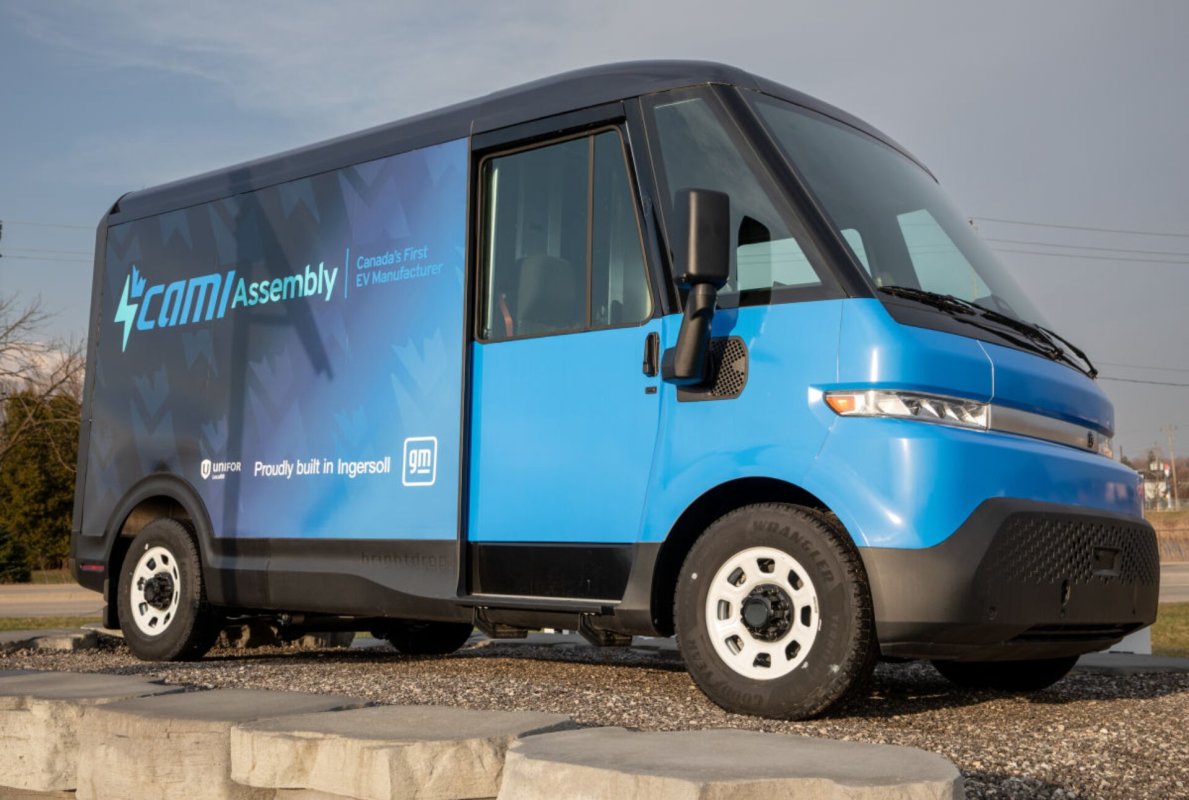 Chevy’s BrightDrop is about to get some Korean influence.
Image source: Gundlock/Bloomberg via Getty Images
General Motors and Hyundai take the next step in their partnership
General Motors and Korean manufacturer Hyundai (HYMLF) first announced their collaboration last year, well before anyone really knew the extent of President Trump’s tariff intentions.
On Aug. 6, the companies, both of which compete fiercely in the U.S. market, detailed their plans for the near future.
Related: Another automaker is forced to shift strategy due to tariffs
The tandem will co-develop five new vehicles, four of which will be sold in Central and South America. Those vehicles include a mid-size pickup, compact car, pickup, and SUV.
For the North American market, the companies are developing an electric commercial van that will be a smaller version of Chevrolet’s BrightDrop vans.
The first fruits of this collab will hit the market in 2028. Shortly after that, GM and Hyundai expect to build more than 800,000 vehicles a year.
More automotive:
- US car buyers should expect great summer deals, but there’s a catch
- Ford CEO predicts huge industry shift after latest tariff developments
- Tesla faces another lawsuit after $323 million Autopilot verdict
GM says it’ll take the lead on the mid-size truck platform, and Hyundai will develop the others. Each company will sell its vehicles under its own brand badges.
“GM and Hyundai have complementary strengths and talented teams. Our goal is to unlock the scale and creativity of both companies to deliver even more competitive vehicles to customers faster and more efficiently,” GM CEO Mary Barra said last year when the deal was first announced.
The pair say the partnership will reduce costs, boost efficiency, expand customer choice, and explore future tech like fuel cells.
GM and Hyundai are locked in a battle for North America
While General Motors has the highest U.S. market share, Hyundai has made huge leaps since it first started selling cars in the U.S. in 1986.
Earlier this month, Hyundai Motor North America CEO Randy Parker said, “We just wrapped up the strongest first half in Hyundai’s history, driven by sales growth across our lineup.”
Hyundai sold 439,280 vehicles worldwide in the first half of the year, a 10% year-over-year increase that was capped by a 10% second-quarter increase to 235,726 units. June sales increased 3% year-over-year to 69,702 units in North America.
Meanwhile, Chinese OEMs are making serious inroads in Mexico and Brazil, two of the biggest economies south of the U.S.
So the GM-Hyundai collaboration is aimed there, not North America.
Top 5 U.S. car market share leaders
The top five U.S. market share leaders, according to Cox Automotive data, are:
- General Motors – 17%
- Toyota – 15%
- Ford – 13%
- Hyundai – 11%
- Honda – 9%
Related: Ford Motor Co. is still haunted by this one, costly issue