
Global central banks are rapidly shifting toward interest-rate hikes as the Iran War drives oil prices higher and forces policymakers to rethink earlier plans for rate cuts in 2026.
The Federal Reservedid not act alone this week in holding benchmark interest-rates steady over concerns that oil shocks will filter through the global supply chain to raise prices across multiple industries.
The European Central Bank and the Bank of England held interest-rates unchanged March 19 with policymakers warning that the Iran War is driving inflation risks.
The Bank of Japan also held rates steady this week.
Now major global brokerages forecast a higher likelihood that the ECB and BoE will raise interest rates, perhaps as early as next month, Reuters reported March 20.
Both central banks signalled they were closely monitoring the impact of surging oil prices on growth and inflation, stressing they stand “ready to act” to contain risks from the war.
Barclays, J.P. Morgan expect ECB rate hike in April
Europe remains particularly vulnerable to oil shocks from the Iran War, given its heavy reliance on imported energy.
More Federal Reserve:
Fed Chair Powell sends frustrating message on future interest-rate cuts
Barclays and J.P. Morgan expect a rate hike in the ECB’s April policy meeting. The two also forecast a further increase in June and July, respectively.
Both Morgan Stanley and Deutsche Bank expect a 25-basis-point hike each in June and September.
This is a sharp shift from their previous forecasts for rates to remain on hold this year.
Goldman Sachs notes “very adverse” ECB scenario
In Goldman Sachs‘ “very adverse” scenario, close to the ECB staff’s “adverse” scenario, the bank expects a cumulative 75 basis-point hike with sequential 25 basis-point increases starting in June.
But Goldman added that an early April hike was also possible.
“We believe that the likelihood of this hiking scenario has risen given the continued upward pressure on energy prices,” Goldman said.
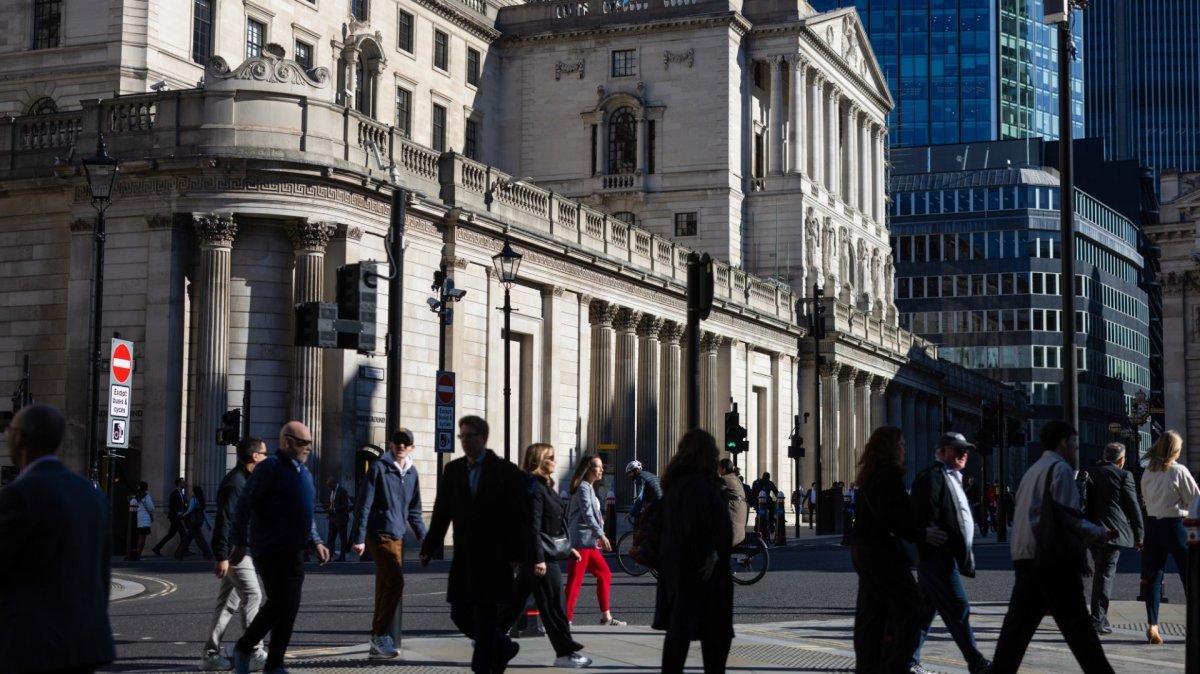 Analysts say some global central banks, including the Bank of England are rapidly shifting toward interest-rate hikes as the Iran War drives oil prices higher.
BoE shift was nearly instantaneous
The most immediate pivot was in Britain where less than three weeks ago traders were expecting a rate cut this week due to growing confidence inflation was drifting toward the BoE 2% target.
But policymakers held interest rates at 3.75% March 19, saying inflation would be higher in the near term because of “the new shock to the economy.”
BoE Governor Andrew Bailey said March 19 that policymakers held rates as they “assess how events unfold,” The New York Times reported.
BoE forecasts inflation could climb above target in 2026
J.P. Morgan expects the BoE to hike rates by 25 basis points each in April and July, changing its stance of no changes this year.
The BOE’s hawkish pivot came after it said inflation could climb to around 3.5%, above its 2% target, over the next two quarters.
Related: Fed split holds as Iran war scrambles rate path
Meanwhile, Goldman, Morgan Stanley and Citigroup pushed back their forecasts of two rate cuts this year and now expect the central bank to remain on an extended hold.
Citigroup and Morgan Stanley added they did not yet see enough evidence for policymakers to tighten policy soon.
“All of this is to say that while a hike is possible, it appears to be path dependent on variables that are yet unknown and difficult to predict,” Citigroup said.
J.P. Morgan expects inflation to ease next year, but only from spring, and is now forecasting two rate cuts in 2027.
Morgan Stanley said it could “see some chance of a cut” in the fourth quarter this year if there is a swift resolution to the conflict.
Federal Reserve eyes inflation risk from Iran War
The Federal Reserve’s 11-1 vote to hold interest rates steady at 3.50% to 3.75% underscores the central tension now driving U.S. monetary policy.
Investors are no longer debating whether risks to the Fed’s dual mandate exist but which risk matters more to the U.S. economy.
On one side, inflation remains stubborn. Producer prices came in hotter than expected March 18 showing acceleration that began before the Iran War began,
The risk? Inflation could reaccelerate rather than continue its slow drift toward the Fed’s 2% target.
In addition, economic drive is also showing signs of weakness. The softening labor market and slowing growth would typically prompt interest-rate cuts.
This was a path markets had been expecting just a few weeks ago at the Fed.
Iran War ignites U.S. stagflation concerns
The Iran War, by driving energy costs sharply higher, has reopened the traditional stagflationdilemma of rising prices with slowing growth.
The Federal Open Market Committee voted 11-1 March 18 to hold the benchmark Federal Funds Rate at 3.50% to 3.75%.
In its press release, the FOMC said available indicators suggest that economic activity has been expanding at a solid pace.
“Uncertainty about the economic outlook remains elevated. The implications of developments in the Middle East for the U.S. economy are uncertain,’’ the release said. “The Committee is attentive to the risks to both sides of its dual mandate.”
What the Fed dual mandate requires for jobs, prices
The Fed’s dual congressional mandate requires it to balance full employment and price stability.
- Lower interest rates support hiring but can fuel inflation.
- Higher rates cool prices but can weaken the job market.
The two goals often conflict, operate on different timelines and are influenced by unpredictable global events like pandemics and wars.
Even before the outbreak of the Iran War, the Fed faced a dilemma from worrisome risks to both sides of its congressional mandate: higher unemployment rates and sticky inflation.
Fed Chair Jerome Powell told reporters after the March 18 FOMC that the economy was settling into a moderately neutral range.
A neutral range for economists means monetary policy is neither stimulating nor restricting economic growth.
Fed’s 2026 forecast on interest rates unchanged
The Fed’s March median Summary of Economic Projections or “dot plot” calls for a single 25 basis point rate cut in 2026, and an additional 25 basis point cut in 2027, the same as the December 2025 forecast.
But Powell noted in his press conference that the rate cut was not guaranteed, especially if the projected decrease in inflation doesn’t occur.
Michael Feroli, the chief U.S. economist for J.P. Morgan, disagreed with the Fed’s 2026 rate-cut forecast.
As I reported March 19, Feroli said the Fed will keep interest rates on hold for the rest of 2026, and that the U.S. central bank’s next move will be a rate hike in 2027.
Related: Gold is pricing in something the Fed won’t say out loud