
Look out below…“Golden parachute” is one of those terms that is just bound to spark controversy.
It describes a compensation package for a company’s top executives that is triggered by their termination following a merger or acquisition. They often include more than just cash severance, such as continued health and welfare benefits.
Some companies also offer golden-parachute payments to executives who leave under circumstances other than a merger or acquisition. This is sometimes called a golden handshake.
The advantages of golden parachutes include enabling companies to more easily hire and retain top talent, reduce the possibility of hostile takeovers, and remove or cut back conflict-of-interest problems during a merger, according to the Corporate Finance Institute, a provider of finance training and certification services.
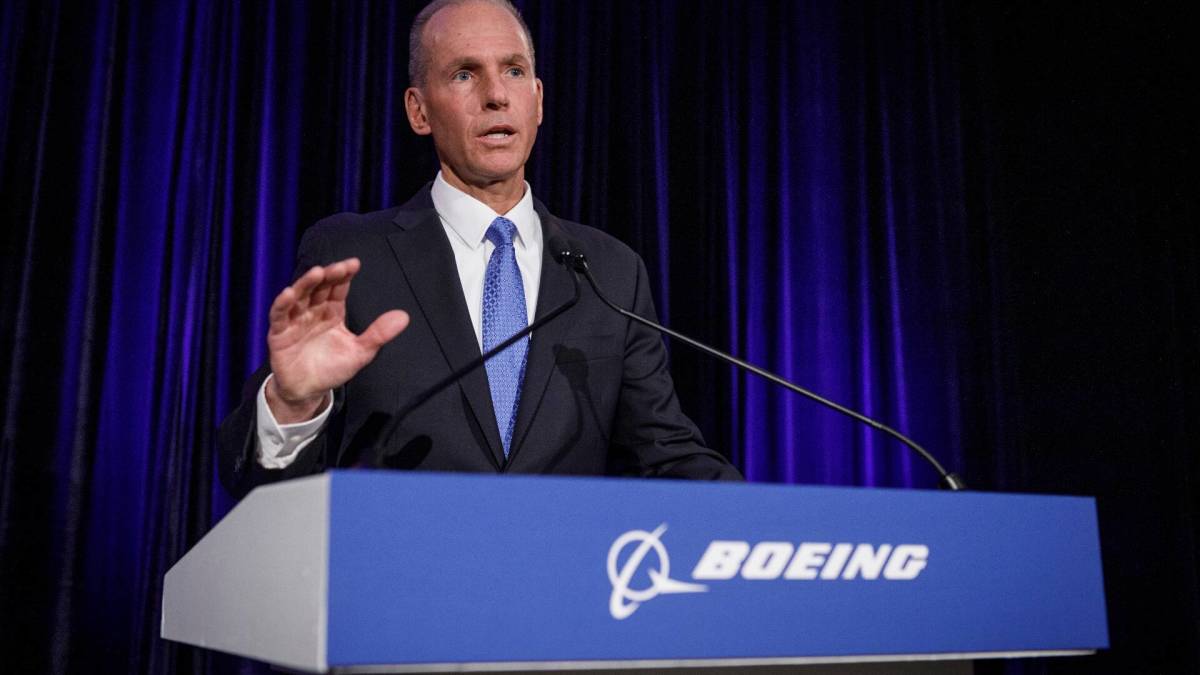 Boeing CEO Dennis Muilenburg speaks at a news conference after the annual meeting in Chicago on April 29, 2019. His golden parachute was controversial.
Shutterstock-John Gress Media Inc.
Critics complain, however, that golden parachutes require companies to shell out a lot of money while reducing executives’ incentive to do a good job.
“Golden parachutes of considerable size are now quite common,” said Harvard Law School Professor Lucian Bebchuk. “Their use is inconsistent with the view that executive-pay arrangements should give executives incentives to focus on the long term.”
“Generous golden parachutes encourage executives to sell the company before too long, pocket a large payoff, and move on,” he added.
Executive pay increasing
The term “golden parachute” dates to 1961 when creditors looked to oust the legendary billionaire Howard Hughes from control of Trans World Airlines.
More Economic Analysis:
- Next Fed interest-rate cut could slide into 2026
- Ex-Fed official faced ethics probe on illegal stock trades
- Fed official sends strong signal on December interest-rate cut
The creditors provided Charles C. Tillinghast Jr. an employment contract that included a clause that would pay him if Hughes regained control of the company and fired him.
Some of the biggest golden parachutes of all time include Jack Welch’s package from General Electric (GE) in 2001, which was estimated at more than $417 million, and Lee Raymond’s from Exxon Mobil (XOM) in 2005, which was roughly $320 million.
Former Boeing (BA) CEO Dennis Muilenburg’s $62 million package in 2019 drew outrage following two crashes of the aerospace giant’s 737 Max, which resulted in 346 deaths.
CEOs in the S&P 500 have been doing well for themselves lately, as their pay reached a record for a second consecutive year, according to the Institutional Shareholder Services 2025 Proxy Season Review.
Median S&P 500 CEO pay was $16.9 million, the highest pay level ever observed, the proxy advisory firm reported.
ISS said that average shareholder support increased for say-on-golden-parachute proposal. These are non-binding votes giving investors an advisory role regarding executive-compensation packages.
This worked in with a significant decline in median golden parachute compensation given to CEOs, the firm said. That decline was driven by factors such as shareholder pushback and a focus on better aligning compensation with company performance.
While an exact number of executives who receive golden parachutes isn’t available, data from a report by management consultants Alvarez & Marshal found that in 2025 86% of CEOs and 82% of chief financial officers are entitled to cash severance payments upon a change in control at their companies.
Golden parachutes driving M&A: Expert
Foot Locker CEO Mary Dillon reportedly did not have a golden parachute when the company was acquired by Dick’s Sporting Goods for $2.4 billion, according to Women’s Wear Daily.
She received $12.5 million in total compensation, which included an annual base salary of $1.4 million, $11 million in stock awards and $69,777 in other compensation.
Related: Prediction markets coming on strong, analysts say
Dillon and Foot Locker President Franklin Bracken left the company in September when the deal was completed, WWD reported.
Columbia Law School Professor Jeffrey Gordon said golden parachutes had helped drive a persistently high level of merger and acquisition activity in the 21st century.
“Golden parachutes have become increasingly lucrative over time, especially as compensation has shifted towards stock-based performance pay,” he said in a Feb. 1 report. “Indeed, it might be more accurate to describe them as ‘platinum parachutes.’”
Gordon said golden/platinum parachutes have changed the pattern of M&A activity.
“This new incentive structure for CEOs will distort how the firm is managed and the projects that the firm pursues,” he said.
“The CEO may guide the firm to pick projects that could generate complements (increase synergies) or substitutes (to invite killer acquisitions) through M&A rather than projects of highest long-term expected value of an independent firm.”
And since M&A transactions are commonly associated with layoffs, Gordon said, “employees bear an additional level of risk for which compensation is unlikely.”