
Wall Street is drawing a hard line between the stocks that benefit from artificial intelligence and those that get buried by it. Goldman Sachs has done the math, and the results are reshaping how investors position their portfolios right now.
The bank’s strategists have mapped out a rotation that is firmly underway in February 2026. Asset-heavy companies with factories, physical supply chains and specialized equipment are pulling ahead. Software names tied to labor-intensive workflows are absorbing the pain of a deliberate and deepening sell-off.
For everyday investors, the question is no longer whether artificial intelligence will disrupt markets. It already is. The real question is which stocks land on the right side of that divide, and Goldman has a specific framework to answer it.
Two metrics Goldman uses to rank AI disruption Risk
Goldman’s approach relies on two specific screens. The first is labor cost as a share of revenue.
Goldman’s company-level metric estimates exposure to AI automation by analyzing job functions and overlaying them with task-level measures of AI capability, then combining that estimate with each firm’s labor-cost-to-revenue ratio. Software, professional services, banks and media rank as the most at-risk sectors by this measure.
The second screen is physical asset density. Businesses anchored to factories, distribution networks or precision manufacturing equipment carry a natural moat. Those operations take years to replicate and no AI model can shortcut that timeline.
Together, the two measures separate genuinely durable businesses from those that look stable but carry real automation risk underneath.
The HALO Trade: asset-heavy stocks winning the rotation
Goldman’s strategists have named this dynamic the “HALO effect,” standing for heavy assets and low obsolescence. According to Goldman’s client note, authored by strategists including Guillaume Jaisson and Peter Oppenheimer, the bank’s basket of capital-intensive stocks has outperformed a capital-light group by about 35% since the start of 2025.
Grids, pipelines, utilities, transport infrastructure and critical machinery are all cited as prime examples of HALO businesses.
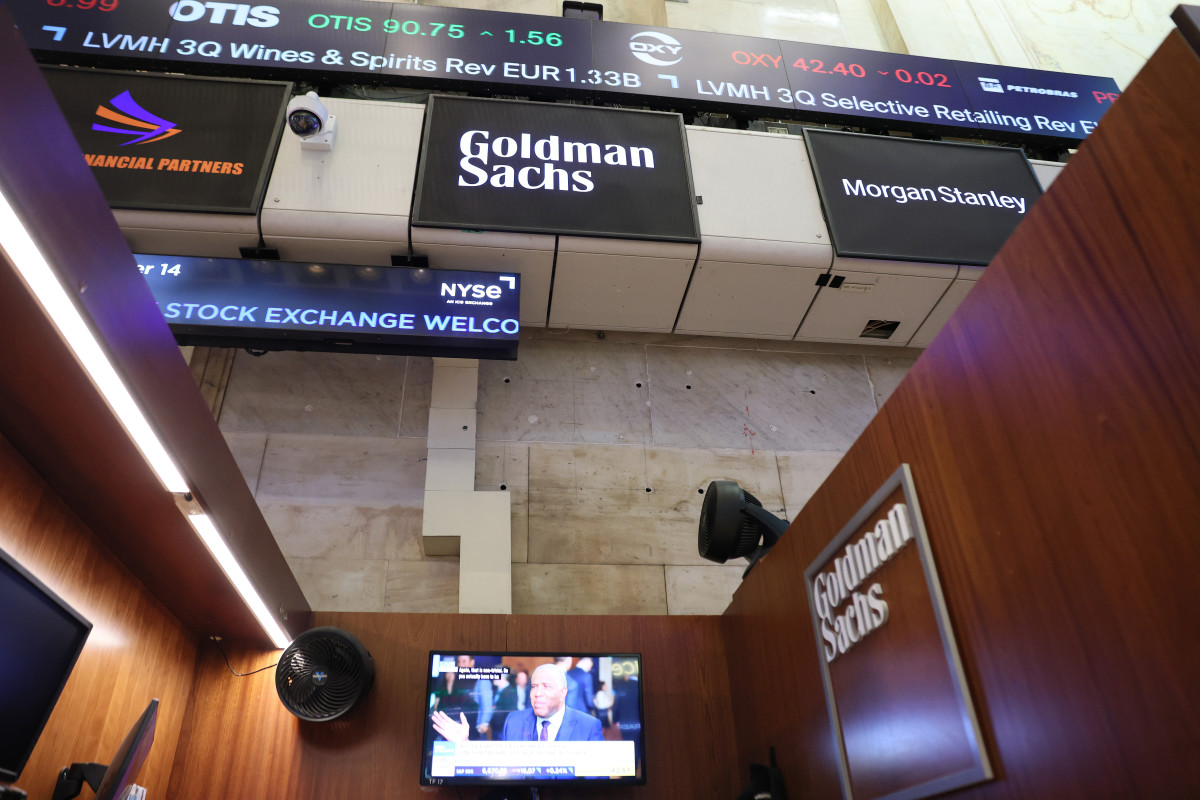
Photo by Michael M. Santiago on Getty Images
Jaisson wrote that markets are rewarding capacity, networks, infrastructure and engineering complexity, specifically assets that are costly to replicate and less exposed to technological obsolescence. Utilities, basic resources and energy are drawing the heaviest inflows as investors move from digital capital models into businesses with tangible production capacity.
European capital-intensive stocks Goldman favors
- ASML (ASML): Holds a monopoly on extreme ultraviolet chip lithography equipment with no credible substitute anywhere in the world.
- Airbus: Commercial aircraft assembly demands years of precision engineering expertise and global supply chain depth that artificial intelligence cannot replicate.
- Safran: Embedded in long-cycle aerospace contracts across global aviation programs, giving it unusually strong revenue visibility.
- LVMH: Luxury brand dominance backed by physical craftsmanship and heritage creates pricing power no algorithm can manufacture.
- Air Liquide: Industrial gas infrastructure built across multiple continents over decades is not a business model any AI startup can disrupt overnight.
The hyperscalers are themselves becoming capital-intensive plays. Amazon (AMZN), Microsoft (MSFT), Alphabet (GOOGL), Meta (META) and Oracle (ORCL) are on track to spend $1.5 trillion building AI infrastructure between 2023 and 2026, roughly twice what they invested across their entire history before 2022.
In 2026 alone, their capex is on track to exceed $650 billion.
Software split: Who survives and who doesn’t
Goldman has been deliberate about distinguishing the software companies that will weather this shift from those that will not.
The bank launched a basket that goes long on companies artificial intelligence cannot easily displace, and shorts those whose core workflows are most vulnerable to automation.
More AI Stocks:
- Morgan Stanley sets jaw-dropping Micron price target after event
- Bank of America updates Palantir stock forecast after private meeting
- Morgan Stanley drops eye-popping Broadcom price target
The sell-off has been severe and steady. Goldman’s software basket clocked its seventh consecutive daily decline in early February 2026, bringing its year-to-date loss to 19%. The rout has bled into broader tech measures, dragging the Nasdaq 100 down 1.4% so far in 2026.
Software stocks Goldman thinks are winners
- Microsoft (MSFT): Cloud and AI infrastructure that virtually every large enterprise depends on, with switching costs that make displacement extremely difficult.
- Oracle (ORCL): Database systems so deeply embedded in corporate workflows that replacing them carries enormous cost and operational risk.
- CrowdStrike (CRWD): Cybersecurity infrastructure that becomes more critical, not less, as AI tools multiply the attack surface for bad actors.
- Palo Alto Networks (PANW): Network security with deep regulatory entrenchment across financial services, healthcare and government.
- Cloudflare (NET): Internet infrastructure handling an increasing share of global AI-driven traffic at scale.
Software stocks Goldman thinks are losers
- Salesforce (CRM): Core workflow automation that AI agents are beginning to replicate internally without a paid subscription.
- Accenture (ACN): Consulting and outsourcing services that AI agents are absorbing at a pace threatening the traditional billing model.
- DocuSign (DOCU): Document management workflows that generative AI now handles from drafting through signature in a single pipeline.
- Monday.com (MNDY): Project coordination tools facing direct pressure from autonomous AI assistants that handle scheduling and task management natively.
- Duolingo (DUOL): Language learning platform competing directly against AI tutors that personalize lessons at a fraction of the cost.
What the broader market data shows
The scale of selling activity is striking. Goldman’s prime brokerage reported that notional short selling across single stocks in the week of Jan. 30 to Feb. 5 was the biggest on record in the bank’s data going back to 2016, with short sales outpacing long buys by a ratio of two to one.
Goldman CEO David Solomon acknowledged the intensity of the moves. Speaking at a UBS conference in Key Biscayne, Florida, Solomon told attendees that the sell-off narrative over the prior week had been “a little bit too broad,” and that there would be clear winners and losers among software companies rather than a wholesale collapse.
The rotation is real, the data backs it up, and Goldman has positioned client money on both sides of the trade. For investors still sorting out where to stand as artificial intelligence rewrites the competitive landscape, this is a framework worth understanding closely.