
Goldman Sachs just tweaked its year-end gold price target to $5,400 an ounce, up 10% from the prior $4,900 call.
Moreover, that bump also implies a 9% upside from current prices, with spot gold trading around $4,957 an ounce at the time of writing (Jan. 23, 2026).
The big bank argues that gold is far from just a short-term fear trade linked to elections or one-off shocks.
Instead, investors are treating gold as an insurance against long-term risks, including heightened debt levels, murky policy direction, and growing unease over central bank independence.
I covered the ballooning national debt that’s now over $38 trillion, which BlackRock CEO Larry Fink has been sounding the alarm about.
Moreover, IMF chief economist Pierre-Olivier Gourinchas warned investors about massive AI investments and the risk that those may not materialize into tangible financial results, potentially triggering a market correction.
On top of that, legendary fund managerRay Dalio said at Davos that amid policy uncertainty, “On the other side of trade deficits and trade wars, there are capital and capital wars.”
That’s exactly why he feels it’s prudent for investors to effectively allocate 5% to 15% of their portfolios to gold.
This echoes the view of Todd Campbell, TheStreet’s co-editor-in-chief, a 30-year Wall Street veteran who has witnessed multiple gold cycles unfold.
That’s exactly why Goldman Sachs sees robust support beneath prices instead of exhaustion at the top following gold’s momentous rally.
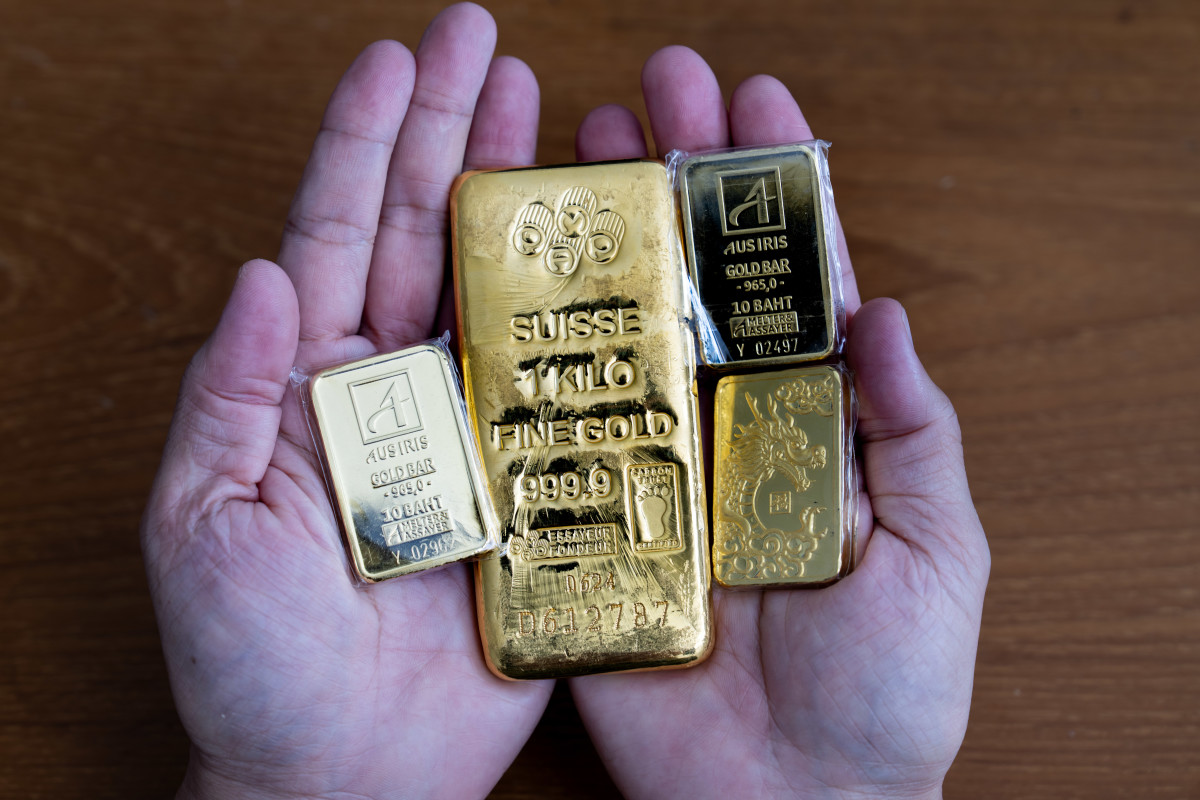 Goldman raises its gold target to $5,400 amid investor hedging against debt, AI risks, and uncertainty
Photo by NurPhoto on Getty Images
Goldman thinks this gold rally has staying power
Goldman Sachs comfortably raised its gold price target because the strong demand of late doesn’t look fleeting and isn’t driven by one-off catalysts as we’ve seen in the past.
More Experts
- Longtime fund manager sends blunt message on P/E ratios
- Jim Cramer issues blunt 5-word verdict on Nvidia stock
- What the White House decision really means for Nvidia
- Michael Burry shares bold predictions for OpenAI, Palantir
So, treating gold as a hedge rather than a trade makes investors less likely to sell at the first sign of clarity.
A big part of why the bank raised its forecast was that private investors who scooped up gold as insurance will most likely hold onto those positions through the end of the year.
The data backs those claims up:
- Central banks are forecasted to buy nearly 60 tons of gold per month in 2026, spearheaded by emerging markets.
- Western gold ETFs added 500 tons since early 2025, pointing to renewed institutional appetite.
- Global gold ETFs logged record inflows of nearly $89 billion in 2025, pushing holdings to all-time highs near 4,025 tons, according to the World Gold Council.
Moreover, inflows have remained positive into early 2026, with December marking the seventh consecutive month of inflows.
Gold vs. S&P 500 vs. Bitcoin (5-year annual returns)
- 2025: Gold +68.12% | S&P 500 +17.88% | Bitcoin -6.34%
- 2024: Gold +26.59% | S&P 500 +25.02% | Bitcoin +121.05%
- 2023: Gold +13.80% | S&P 500 +26.29% | Bitcoin +155.42%
- 2022: Gold -0.43% | S&P 500 -18.11% | Bitcoin -64.27%
- 2021: Gold -3.75% | S&P 500 +28.71% | Bitcoin +59.67%
Source: Westmetall, Slickcharts
Related: Cathie Wood quietly buys $7.27 million of popular tech stock
The “AI boom” paradox is helping gold
Hearing about the AI boom may sound like a bad record, but clearly, it’s doing a lot to indirectly boost gold.
Of late, we’re seeing the tech and investing luminaries get a lot more personal about it, too.
For instance, Citadel founder and billionaire investor Ken Griffin noted that U.S. AI infrastructure investment is expected to soar past the $500 billion market this year.
On the sentiment, he didn’t mince any words by saying, “Is it hype? Of course.”
Related: Top analyst drops bold call on Morgan Stanley after blowout earnings
Goldman Sachs’ own research warned that the incredible AI capex wave could reach a whopping $1 trillion in the coming years, even as monetization is still catching up.
That mismatch matters a ton as the stock market is already pretty top-heavy and pricey.
For perspective, the all-too-powerful “Magnificent Seven” made up about 37% of the S&P 500 (as of late October 2025), with concentration in only a handful of AI-powered winners.
Valuation levels are crazy as well, with the S&P 500 trading at over 22 times forward earnings. For perspective, according to FactSet, the 20-year average at the S&P 500 is at 16.1 times.
Even tech CEOs who were beating the AI bubble drum are now alluding to things getting a lot dicier.
Microsoft CEO Satya Nadella said that to prevent an AI bubble from forming, the benefits need to be broadly shared rather than confined to the tech industry. Moreover, Google CEO Sundar Pichai warned that “no company is going to be immune” if the boom breaks, acknowledging there are “elements of irrationality.”
Related: JPMorgan revamps AI ‘stocks to buy’ list ahead of earnings