
Big Tech just can’t stop chasing it.
The dream of controlling an all-knowing, human-like AI, artificial general intelligence (AGI), has become Silicon Valley’s obsession.
💵💰Don’t miss the move: Subscribe to TheStreet’s free daily newsletter💰💵
From cloud giants to chipmakers, they’re shelling out billions in building the elusive AGI, opening up never-before-seen avenues.
But just as the race heats up, one seasoned AI veteran dropped a single word that has quickly turned the narrative on its head.
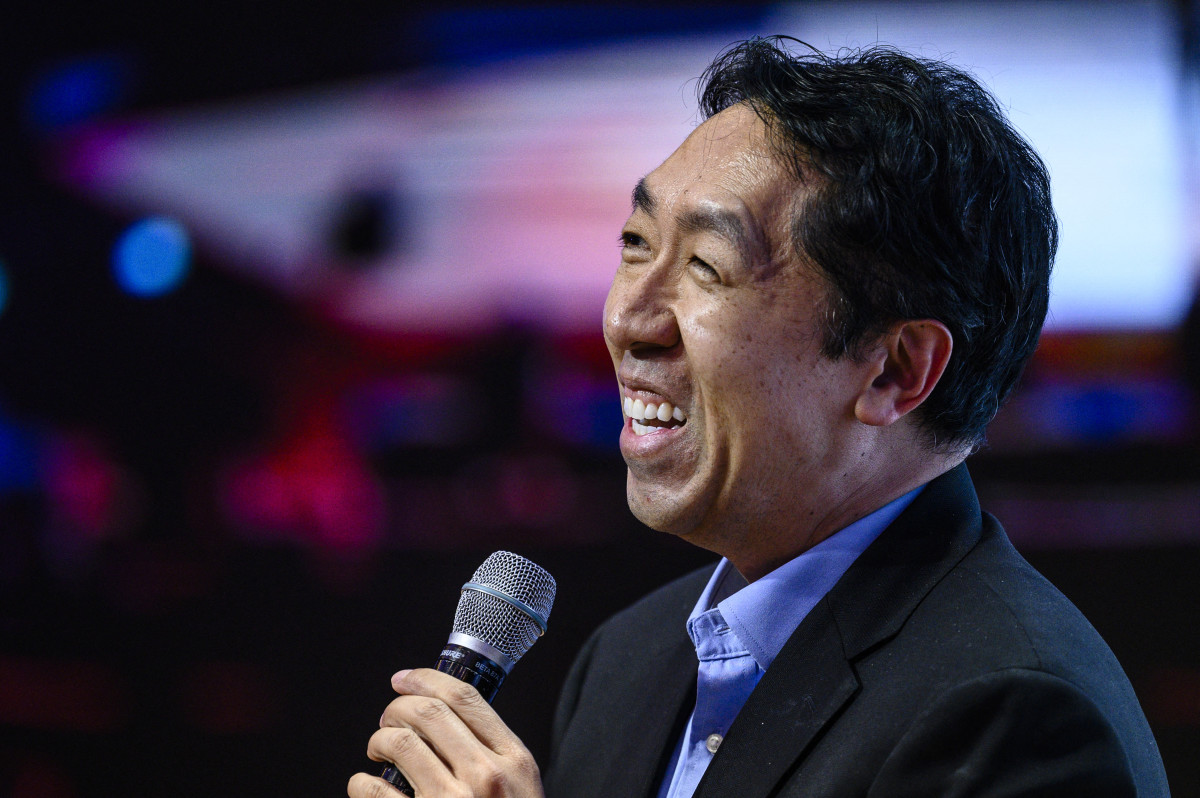 AI systems have advanced fast, but Andrew Ng says human-like intelligence is still out of reach.
Image source: Wallace/Getty Images
Big Tech bets billions on AGI
AGI has arguably been the holy grail of Big Tech.
Unlike the current narrow AI systems, AGI looks to replicate human-level thinking, problem-solving, and adaptability.
It’s arguably the tech industry’s most expensive gamble in its rich history, and the biggest names in Big Tech have gone all-in.
At Google I/O, co-founder Sergey Brin argued that the company’s powerful Gemini model is built to be the first true AGI.
Related: Wall Street giant shares bold message on S&P 500’s Magnificent 7
DeepMind CEO Demis Hassabis argued that AGI needs to be capable of advanced reasoning while building mental models of the world.
Meta Platforms, in particular, isn’t holding back.
In June, it launched its Superintelligence Lab, effectively reshaping its internal AI strategy around AGI milestones.
Meanwhile, Microsoft has dished out billions to OpenAI, with clauses governing AGI rights baked into their contract.
More Tech Stock News:
- TikTok’s next move has Google and Meta sweating bullets
- Cathie Wood shells out $13.9 million for one high-stakes biotech stock
- Apple’s quiet shake-up could redefine its future
Amazon’s no different, betting huge on AGI startup Anthropic, while Nvidia, whose GPUs drive over 80% of generative AI compute loads, recently jumped to a $4 trillion market cap.
Analysts forecast that the AGI market could surge from just under $4 billion last year to more than $100 billion by the mid-2030s.
Though those numbers are far from guaranteed, rest assured, the money will keep pouring from Big Tech.
Andrew Ng calls AGI ‘overhyped’ and explains why humans still matter
AGI isn’t taking over the world anytime soon, at least not if you ask Andrew Ng.
The AI pioneer and founder of Google Brain dismissed the buzz around the phenomenon, bluntly referring to it with one word — “overhyped” — during a talk at Y Combinator.
“For a long time, there’ll be a lot of things that humans can do that AI cannot.”
AGI obviously refers to a future version of AI that could beat humans in thinking and reasoning across a wide range of tasks.
However, Ng says we’re nowhere close at this point, and he’s not alone.
Related: Veteran analyst issues eye-popping Microsoft stock price target
Meta’s chief AI scientist, Yann LeCun, said last year that AGI fears are misplaced. He explained that even though large language models might seem impressive, they’re not the road to AGI.
Ng agrees and feels the real punch from AI lies in the ability to use it, not in building the most human-like system.
“People that know how to use AI to get computers to do what you want it to do will be much more powerful,” he said.
That doesn’t let developers off the hook, though.
Some folks will be there to create the tools, but plenty more will simply learn how to use them well, which represents the real edge.
The bigger message is obviously a more hopeful one that suggests humans aren’t becoming obsolete anytime soon. There’s still plenty of work to do, and AI is just a different way to accomplish it.
However, as the tech world pursues the AI objective like crazy, Ng’s take offers a reality check. Though a ton of companies are marching toward AGI, he’s reminding everyone that smart, strategic usage still matters more than sci-fi dreams.
That stance puts Big Tech in a remarkably tricky spot.
Companies such as Google, Microsoft, and Meta have sunk billions into the AGI dream. However, if AGI is overblown, as Ng and others suggest, it raises serious questions about whether tech giants are overpromising — and setting themselves up to underdeliver.