
Grab Holdings (GRAB) is using artificial intelligence to directly boost its operating margins.
On Aug. 4, 2026, Chief Financial Officer Peter Oey walked through how deeply AI now runs inside the company’s cost structure.
He did it a day after Grab posted record second-quarter results and raised its full-year targets.
The market responded quickly. Grab stock traded higher after the report, closing around $3.76 and climbing about 9% over five trading days.
For a company that spent years burning cash to win Southeast Asia, the pitch was simple: Grab can now grow without spending as heavily to do it.
Here’s what Oey said, why the profit number is misleading on its own, and what comes next for the AI bet.
What Grab’s CFO revealed about AI and margins
Oey used specific numbers, which is what caught attention.
He told CNBC that AI has helped Grab ship products more than 30% faster than a year ago, and that the gains flow straight into better margins and a leaner cost base.
In a separate interview, Oey told Reuters the company is now shipping products three times faster than last year and has cut outnearly 40,000 hours of sales inefficiencies.
Related: Overlooked chip ETF is beating biggest AI names
Grab has also used AI in customer service and in credit scoring, where machine-learning models help it judge the creditworthiness of drivers and merchants who often lack formal banking records.
Observability tools let engineers watch whether apps and systems are running correctly. That’s the same category of software Grab uses to monitor its AI tools at scale.
Why the numbers moved the stock
The second quarter gave the AI claims some backing.
Grab reported reported second-quarter revenue of $997 million, up 22% year-over-year.
Adjusted EBITDA, a measure of core operating profit before certain costs, rose 54% to $168 million. The margin on that figure expanded to 16.9% of revenue from 13.3% a year earlier.
That margin jump is the part tied to the efficiency story. Grab grew its business while spending proportionally less to run it.
The company also hit a record 54 million monthly transacting users, and mobility transactions grew 28% year-over-year even as it kept fares affordable.
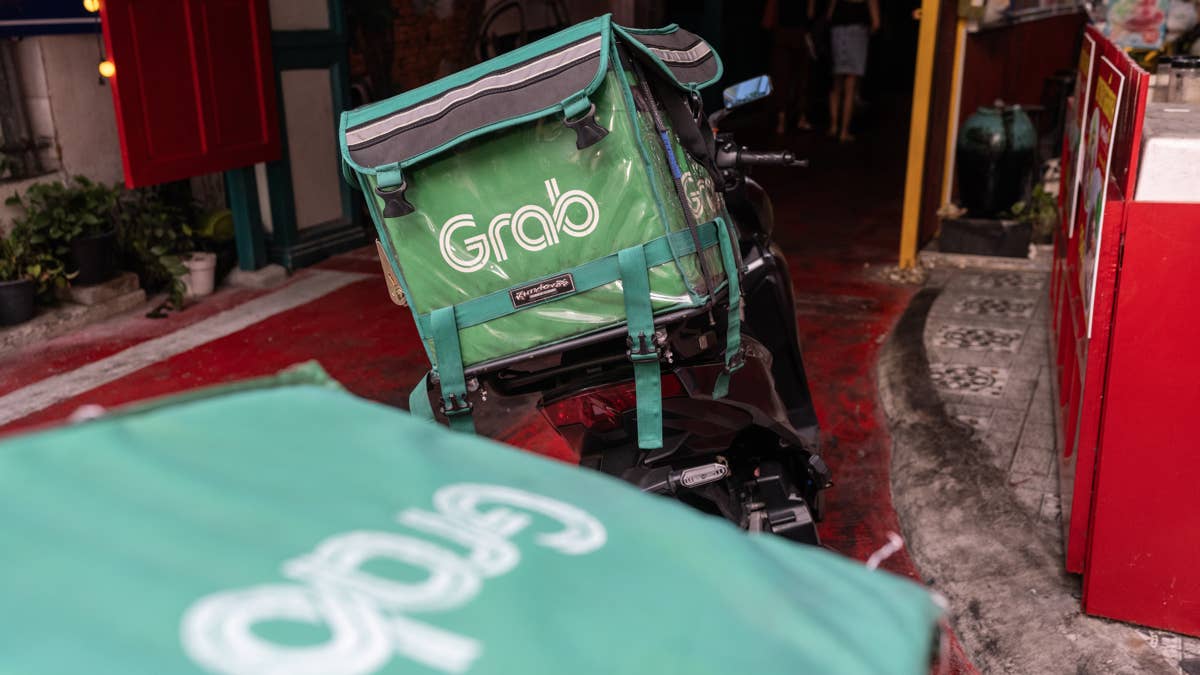 Grab’s CFO tied the company’s margin gains to years of AI investment across its Southeast Asian superapp.
John Wreford / Getty Images
The 1 caveat behind Grab’s big profit figure
Profit for the period reached$235 million, up from just $20 million a year earlier.
Most of that increase came from a one-time $307 million gain Grab booked when it consolidated Indonesian digital bank Superbank in June 2026.
Operating profit, which strips out that accounting gain, was a more modest $19 million, an improvement of $12 million from the prior year.
Grab itself warned that second-half profit will keep swinging with fair-value measurements and other non-operating items.
In plain terms, the $235 million figure is not a clean read on how the business runs day to day. The operating profit line is the cleaner signal, and it moved in the right direction.
How Grab raised its 2026 outlook
The efficiency gains gave management room to lift its targets.
Grab now expects full-year revenue of $4.10 billion to $4.15 billion, up from a prior range of $4.04 billion to $4.10 billion.
It raised its adjusted EBITDA target to $720 million to $740 million, from $700 million to $720 million.
Oey said the upgrade reflects the strength of the core business plus the consolidation of Superbank and the July acquisition of U.S. wealth platform Stash.
President and COO Alex Hungate noted the outlook also absorbs a 2% to 3% foreign-exchange headwind, Yahoo Finance reported.
What the new buyback tells investors
Grab paired the raised guidance with a fresh return of cash.
The board authorized a new $750 million share repurchase program. That brings Grab’s cumulative buyback authorization to $1.75 billion since 2024.
Grab had already executed roughly $400 million of an earlier $500 million program, Oey said on the call.
More AI Coverage:
- BofA names Datadog its top software pick ahead of earnings
- Google stock price faces major AI test ahead of earnings
- The whole chip trade is waiting on one report
A buyback of this size signals management no longer feels it needs to hoard cash for survival.
Grab held $7.4 billion in gross cash liquidity at quarter-end, so the return comes from a position of strength.
Buybacks reduce share count, which can lift earnings per share over time. They are not a guarantee of a higher stock price, and they work against investors if the shares are already expensive.
The next catalyst investors are watching
One pending deal could shape Grab’s next leg of growth.
Grab is trying to acquire foodpanda’s Taiwan operations from Delivery Hero for about $600 million, its first market outside Southeast Asia.
The deal sits with Taiwan’s Fair Trade Commission, which according to Taipei Times, extended its review deadline to Oct. 27, 2026.
The FTC cited concerns about Uber’s roughly 13% stake in Grab.
If approved, Grab expects to close the deal in the second half of 2026 and finish moving foodpanda users onto its app by early 2027. If regulators block it, Grab loses its clearest near-term expansion outside its home region.
What still has to go right for Grab
The AI story is credible, and it is not finished.
A few things need to hold for the bullish case to keep working:
- Margins keep expanding. The 16.9% adjusted EBITDA margin has to trend higher, not stall, as AI savings compound.
- Financial Services turns profitable. Management guided this segment to reach adjusted EBITDA profitability in the second half of 2026.
- The foodpanda deal clears. A Taiwan approval opens a new market; a rejection removes a growth lever.
- Lending stays healthy. Grab’s loan book disbursed $1.2 billion in the quarter, up 72%, so credit quality matters more now.
For investors, Grab has shown it can grow revenue faster than costs, and it is returning cash to shareholders.
The risks are real. The stock trades on a thin operating profit, the headline earnings figure is inflated by a one-time gain, and a key acquisition still needs a regulator’s approval.
Grab has moved from a company that spent to survive to one that is proving its model can scale profitably. The second quarter backed that up with numbers, and the months ahead will test whether the trend holds.
Related: Goldman Sachs turns its back on major semiconductor stock