
The U.S. economy and labor market haven’t been this opaque in years.
Last month, the government announced that it is canceling October’s employment report due to the government shutdown. On Dec. 8, the Bureau of Labor Statistics shared that it will also skip the October wholesale-price inflation report.
BLS September jobs data (month-to-month change)
- Jobs added: 119,000
- Civilian labor force: 171,248,000
- Labor participation rate: 62.4% (+0.1%)
- Employed people: 163,645,000 (+251,000)
- Unemployment rate: 4.4% (+0.1%)
- Unemployed people: 7,603,000 (+219,000) Source: Bureau of Labor Statistics (BLS)
So heading into the Federal Reserve meeting this week, officials are flying mostly blind when it comes to the state of the economy.
There are, of course, alternative data sets that don’t rely on the federal government, but the most trusted data comes from the BLS.
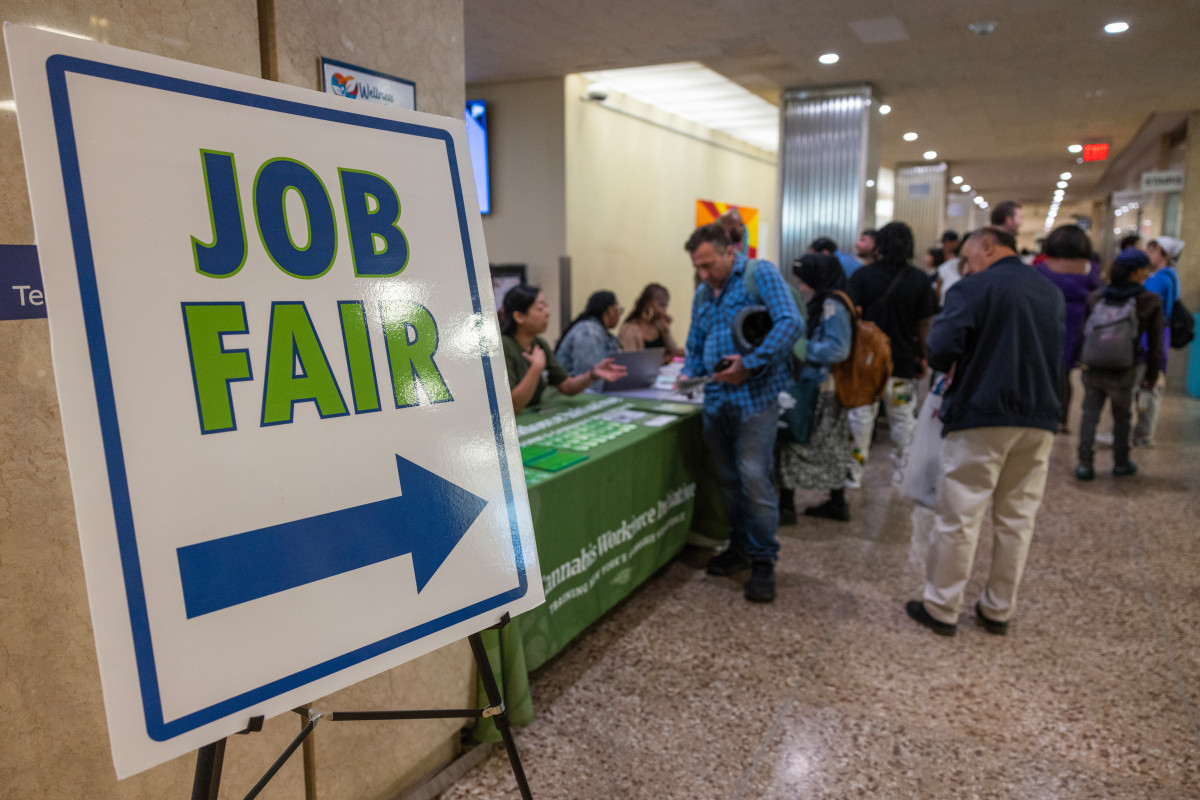 Employers are increasingly announcing layoffs around the holidays.
Photo by Bloomberg on Getty Images
The holiday season labor market isn’t stable like it used to be
U.S. workers once had some expectations of job security during the holiday season, but that time appears to be over.
U.S. employers issued WARN notices for 39,006 Americans in October, according to research by the Federal Reserve Bank of Cleveland. The Fed has tracked WARN notices since 2008, and the number has only ever been higher in 2008, 2009, 2020, and May 2025.
U.S. layoff stats 2025:
- 1.6 million workers laid off each month
- On pace for 19.2 million annually
- 206,101 employees laid off from 221 tech companies
- Job cuts up 5.9% year over year
- 21% of companies expected to lay off employees Source: Bureau of Labor Statistics
“Over the last decade, companies have shied away from announcing layoffs in the fourth quarter, so it’s surprising to see so many in October. With the onset of social media and the ability for workers to share their negative experiences with their employers, the trend of announcing layoffs before the holidays fell away, a practice that seemed particularly cruel,” Andy Challenger, chief revenue officer of Challenger, Gray, & Christmas, recently said.
BNP Paribas expects chilly holiday jobs season
Analysts and BNP Paribas released their winter jobs forecast this week, and the firm says it expects “chilly U.S. nonfarm payrolls.”
BNP says U.S. employers shed 100,000 nonfarm jobs in October and 20,000 in November, raising the jobless rate to 4.5% from 4.3% in October.
Its data shows that while layoffs are low for the Christmas shopping season, seasonal hiring has weakened.
“Weak seasonal hiring, government shutdown effects, and DOGE job cuts drive our frosty expectations,” BNP Paribas said.
But it also sees some positive signs in the data.
“We think this labor market weakness is transitory, driven by one-off shocks that should largely reverse by the January payrolls release. That said, over the medium term, we are monitoring AI risks to new hiring,” BNP Paribas said in the note.
“While our base case is that labor demand and supply continue to cool in tandem in 2026, we are mindful of the risk that the hiring side of the job market may loosen more due to increased AI adoption displacing new hires.”
Due to its optimistic view of the labor market, BNP analysts don’t think the Fed will “overreact to weakness” in the jobs market, given the extenuating circumstances of the government shutdown and the potential federal worker layoffs related to DOGE.
Major employers have been announcing massive layoffs
Amazon, UPS, and Target, three of the largest employers in the country, have already announced plans to lay off tens of thousands of workers in the coming weeks.
General Motors is cutting hundreds of jobs at its Georgia IT center. And Molson Coors eliminated 400 salaried jobs across its Americas business, representing about 9% of its white-collar workforce.
Major layoffs announced recently
- Target revealed plans in late October to eliminate 1,800 corporate jobs, marking its second-largest corporate downsizing ever.
- Amazon announced another round of layoffs just before the holidays. The cuts affected 14,000 corporate employees across multiple departments, aiming to reduce bureaucracy by “removing layers and shifting resources” to better serve its investments and customers.
- UPS, in a press release, shared that it has cut about 48,000 jobs so far this year, including 34,000 positions through its Network Reconfiguration and Efficiency Reimagined program.
According to tech market intelligence firm UnearthInsight, as many as 500,000 white-collar software workers could be laid off over the next two to three years, with approximately 70% of those layoffs affecting workers with four to 12 years of experience.
However, while the big corporations grab the headlines, small layoffs have become the most common type, and Glassdoor says the trend is expected to “stoke worker anxiety as it continues in 2026.”
Layoffs of fewer than 50 individuals accounted for just 38% of layoffs in 2015. By this year, the rate increased to 51%.
“Employers have started engaging in smaller but regular layoffs instead of infrequent but large cuts. We call these ongoing layoffs the ‘forever layoff’ as job cuts come in never-ending waves instead of a tsunami,” Glassdoor said.