
Passive income sounds like a dream. But for income investors, it’s a real strategy — and one that doesn’t require picking high-risk, high-reward stocks to pull off.
AT&T has been one of the most popular dividend stocks in America for years. It’s a name most people recognize, it pays a quarterly dividend, and it gives investors a way to generate income without having to sell a single share.
The question is: How much do you need to invest to hit that $1,000-a-year income target?
The math is surprisingly simple. And the business behind it is more interesting than many investors realize right now.
Buy 901 AT&T shares for $1,000 in annual dividends
AT&T (T) stock is currently trading at $28.99. The company pays an annualized dividend of $1.11 per share, or about $0.2775 per quarter.
To figure out how many shares you need, divide your target annual income by the per-share payout: $1,000 ÷ $1.11 = approximately 901 shares.
To buy 901 shares at $28.99 each, you’d need to invest roughly $26,120.
That’s not a small sum. But for income-focused investors building a portfolio of dividend stocks, it’s a concrete figure that makes planning a lot easier.
AT&T’s key dividend metrics:
- Stock price: $28.99
- Annualized dividend per share: $1.11
- Dividend yield: About 3.83%
- Quarterly dividend per share: Approximately $0.2775
- Shares needed for $1,000/year: About 901
- Estimated investment needed: Close to $26,120
- Payout frequency: Quarterly
- Free cash flow (2025):$16.6 billion
The yield itself — just under 4% — isn’t flashy by dividend stock standards. But what matters here is reliability.
The annual dividend expense for AT&T stock is about $7.75 billion, which indicates a payout ratio of less than 50% in 2025.
More on dividend stocks:
- Macy’s new AI tool drives 400% sales jump for the dividend stock
- Mega-cap dividend stock targets $9 trillion valuation
- Energy Transfer stands out as high-yield dividend stock
Analysts forecast AT&T’s free cash flow to increase from $16.6 billion in 2025 to $22.7 billion in 2030, which could support further dividend hikes.
AT&T has been paying its dividend consistently, and the underlying business gives investors real reasons to feel comfortable about that continuing.
AT&T’s dividend payout is sustainable
AT&T CEO John Stankey laid out a clear case on the company’s fourth-quarter 2025 earnings call.
The telecom giant met or exceeded every piece of its 2025 financial guidance.
- Free cash flow came in at $16.6 billion, toward the high end of its guidance range.
- Adjusted earnings per share (EPS) grew nearly 9% for the full year to $2.12, beating expectations.
More importantly, AT&T sees that momentum continuing.
For 2026, AT&T is guiding for free cash flow of $18 billion-plus. A healthy, growing free cash flow is what keeps a dividend stock’s payout safe and credible.
Notably, AT&T plans to return more than $45 billion to shareholders over the next three years through dividends and share buybacks combined.
That works out to over 20% of its current market cap.
“Over time, we expect that our improved growth, declining capital intensity, and higher free cash flow will provide us with even greater flexibility to support enhanced shareholder returns,” Stankey stated.
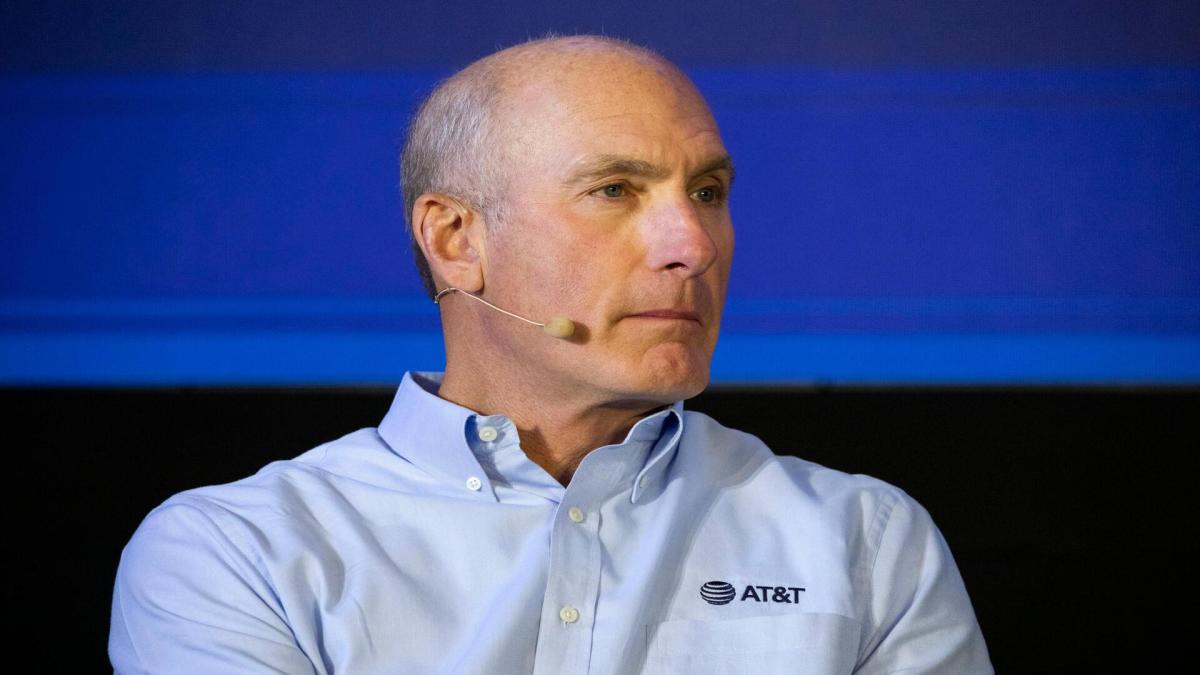 AT&T is focusing on share buybacks and dividends.
Bill Pugliano/ Getty Images
On the operational side, AT&T is in the middle of a meaningful growth push.
- It added more than one million fiber customers for the eighth straight year in 2025.
- Its fiber footprint stood at 32 million locations at the end of last year.
- The company expects that number to climb past 40 million by year-end 2026, partly thanks to its recently closed acquisition of Lumen Technologies’ fiber assets.
AT&T CFO Pascal Desroches confirmed at a March 2026 conference that the Lumen deal closed in early February, adding over four million fiber passings and around one million subscribers.
That’s a significant footprint expansion for a company that is deliberately positioning fiber and wireless together as a convergence play.
Where that strategy is working, the numbers are compelling. AT&T’s fiber convergence rate, or the share of fiber customers who also access its wireless service, hit 42% in the fourth quarter of 2025, up 2% year over year.
Stankey noted that in areas where AT&T offers both fiber and wireless, its postpaid phone market share is 10 percentage points higher than in areas where it doesn’t offer fiber.
Is AT&T a dividend stock you should own?
No dividend stock is risk-free, and AT&T carries real challenges.
The company took on additional debt to fund its Lumen and EchoStar spectrum acquisitions, pushing its net leverage to roughly 3.2x adjusted EBITDA (before interest, taxes, depreciation, and amortization) following the closing of those deals.
Related: AT&T rolls out major upgrade for customers, challenging T-Mobile
Management expects to bring that back down to the 2.5x target range within about three years.
The legacy copper network is also a drag though the company is actively working to eliminate the same by 2029.
Investors should note that AT&T was forced to cut its annual dividend from $2.08 per share in 2022, due to rising interest expenses and an unsustainable payout ratio.
Still, for income investors who want a dividend stock with clear free cash flow visibility, a defined capital return plan, and a growing core business, AT&T makes a legitimate case.
The $1.11 annual dividend is backed by $18 billion-plus in expected free cash flow and a coverage ratio that leaves plenty of room.
If your goal is $1,000 a year in passive income, you’d need roughly 901 shares, or about $26,120 invested at today’s prices.
Related: How much to invest in Ford stock for $1,000 in 2026 dividends